Advertisements
Advertisements
प्रश्न
A first order reaction is 50% completed in 1.26 × 10¹⁴ s. How much time would it take for 100% completion?
पर्याय
1.26 × 10¹⁵ s
2.52 × 10¹⁴ s
2.52 × 1028 s
infinite
Advertisements
उत्तर
infinite
Explanation:
Reaction would be 100% complete only after infinite time which cannot be calculated.
APPEARS IN
संबंधित प्रश्न
In a pseudo first order reaction in water, the following results were obtained:
| t/s | 0 | 30 | 60 | 90 |
| [A]/mol L−1 | 0.55 | 0.31 | 0.17 | 0.085 |
Calculate the average rate of reaction between the time interval 30 to 60 seconds.
Following data are obtained for reaction :
N2O5 → 2NO2 + 1/2O2
| t/s | 0 | 300 | 600 |
| [N2O5]/mol L–1 | 1.6 × 10⁻² | 0.8 × 10⁻² | 0.4 × 10⁻² |
1) Show that it follows first order reaction.
2) Calculate the half-life.
(Given log 2 = 0.3010, log 4 = 0.6021)
A first order reaction is 50% complete in 25 minutes. Calculate the time for 80% completion of the reaction.
Show that the time required for 99.9% completion of a first-order reaction is three times the time required for 90% completion.
Straight line graph for first order reaction is obtained between ____________.
Which of the following graphs is correct for a first order reaction?


With the help of an example explain what is meant by pseudo first order reaction.
The rate constant of a first order reaction is 6.9 × 10⁻³s–1. How much time will it take to reduce the initial concentration to its 1/8th value?
A first order reaction is 50% complete in 20 minute What is rate constant?
In the first order reaction, half of the reaction is complete in 100 seconds. The time for 99% of the reaction to occurs will be
Observe the graph shown in figure and answer the following questions:
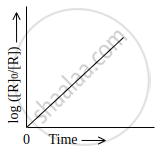
- What is the order of the reaction?
- What is the slope of the curve?
- Write the relationship between k and t1/2 (half life period).
The slope in the plot of ln[R] vs. time for a first order reaction is ______.
The slope in the plot of `log ["R"]_0/(["R"])` Vs. time for a first-order reaction is ______.
How will you represent first order reactions graphically?
What is the rate constant?
Define first-order reaction.
Show that `t_(1/2)= 0.693/k` for first reaction.
If the half-life (t1/2) for a first order reaction is 1 minute, then the time required for 99.9% completion of the reaction is closest to ______.
