Advertisements
Advertisements
प्रश्न
Prompt reporting is of strategic importance during a war. Refer to the above extract and explain.
Advertisements
उत्तर
The prompt reporting of the outcome of the war is extremely necessary for decision making. In the case of the Kargil war, the timely reporting of victory was critical as it provided the Prime Minister with the opportunity to make the news public in the meeting scheduled in Haryana. On the global front, the news of the outcome of the war had an impact on the meeting between Pakistan’s Prime Minister Nawaz Sharif and American President Bill Clinton, which was scheduled for the same day (4th July). The promptness of confirmed reporting during a war can avert major crises and can break the morale of the enemy.
APPEARS IN
संबंधित प्रश्न
Have you are wondered why soldiers are always clad in green? This is to enable them to camouflage themselves during wartime. Hiding in the jungles, their green attire blends into the surrounding trees and shrubs, making it difficult for the enemies to spot them.
Long before man-made use of camouflaging, insects have already adopted the tactic of disguise to escape from the clutches of their predators. By having body colour close to those of the rocks and dried leaves, they can escape from being pursued by the predators.
Butterflies and moths have developed a variety of camouflage strategies since they are quite defenceless and their predators are abundant. Possessing wings which resemble dried leaves help certain butterflies and moths to hide among heaps of dried leaves when predators are around.
Fortunately, not all insects choose the art of disguise to escape from their predators; otherwise, the world would be so dull and colourless. There are insects which assimilate the bright body colours of bees and wasps to escape from being pursued by their predator. Long ago, birds have already learnt to avoid brilliantly coloured wasps and bees in fear of their painful stings. Hence, over millions of years, many harmless insects have assimilated the bees and wasps by imitating. their bright body colours and shapes. In this way, they appear dangerous and hence ward them off.
The beefy, not only appears like the bumblebee in terms of body colour, even its hums sound similar too. The only difference is that the beefy does not have a stirring and is hence harmless. The hoverfly is another insect which imitates. the body colours of the wasps. Their bodies are striped yellow and black. The only deviations are that hoverflies do not have stings, and they have only one pair of wings each while wasps have two pairs each. These variations are hardly noticed by the predators and hence help them to escape.
A1. Complete the table with the information from the passage : (2)
| Insects | Similarity | Difference |
| Bumblebee - Beefy | ||
| Wasp - Hoverfly |
A2. Complete the tree diagram : (2)

A3. Find out : (2)
‘Nature has given a self-protection mechanism to insects’.
Find out at least two examples from the passage to prove this statement.
A4. Vocabulary - (2)
Find the words from the passage for :
(i) animal or bird that hunts other for food
(ii) to get free from danger
(iii) to prevent something from harming
(iv) to make a copy
A5. Personal response - (2)
‘Soldiers disguise themselves to prevent enemies to spot them’.
Give two more examples when the disguising technique is used by humans.
A6. Grammar - (2)
Rewrite the following sentences in the ways instructed :
(i) They have only one pair of wings.
(Make it negative without changing the meaning)
(ii) Insects have already adopted the tactic of disguise to escape from the clutches of their predators.
(Replace infinitive with gerund and rewrite)
(B) Summary : (3)
Summarise the above extract with the help of the points given and suggest a suitable title.
Camouflage of soldiers and insects - reason and ways for disguising - assimilation of insects - need of imitation.
Punctuation
Use capital letter, full stops, question marks, commas and inverted commas wherever necessary in the following paragraph. an arrogant lion was wandering though the jungle one day he asked the tiger who is stronger than you you O lion replied the tiger who is more fierce than a leopard asked the lion you sir replied the leopard he marched upto an elephant and asked the same question the elephant picked him up in his trunk swung him in the air and threw him down look said the lion there is no need to get mad just because you don’t know the answer.
Write an e-mail to the Principal of a neighbouring school requesting him/her to send a team of three members to participate in the Quiz Competition.
Fill in the blank with the suitable word.
Sita’s daughter carried _____________ the family business when Sita went abroad.
Give two examples of alliteration from the poem.
Why does the poet use repletion in the poem?
How does a tree planter do civic good?
What are the poetic devices (figurative language) in the poem? How do they contribute to the meaning/how do they effect the poem?
The poet refers to a dying fire. Who were sitting beside it and why?
What docs the line “and his shadow shouts on a nightmare scream” mean?
But a caged BIRD stands on the grave of dreams
His shadow shouts on a nightmare scream
His wings are clipped and his feet are tied
So he opens his throat to sing.
Read the above lines and answer the question that follow.
Explain with reference to the context.
But a caged BIRD stands on the grave of dreams
His shadow shouts on a nightmare scream
His wings are clipped and his feet are tied
So he opens his throat to sing.
Read the above lines and answer the question that follow.
What is the main conflict in this poem?
The caged bird sings with
A fearful trill of things unknown
But longed for still and his
Tune is heard on the distant hill
For the caged bird sings of freedom.
Read the above lines and answer the question that follow.
Explain with reference to the context.
Alack, it was I who leaped at the sun
To give it my loving friends to keep!
Naught man could do,have I left undone:
And you see my harvest, what I reap
This very day, now a year is run.
Read the above lines and answer the question that follow.
Explain with reference to the context.
Show liow Narayan depicts women in the story and their role in a man’s life.
Describe the picture of India given by the author.
(A) We did not know that Mr. Francis was retiring and leaving for Ooty.
(B) Little……………………………
Anil is too fast a runner not to come first in the race. (Begin: Anil is so………….)
With close reference to the story ‘The Bet’ by Anton Chekhov, mention the clauses of the bet as laid down between the young lawyer and the old banker. Give an account of the events that follow the bet .
Fill in the blank with an appropriate word:
He found the key just _______ the front door.
Discuss in groups of four.
“Are we to leave our successors a scorched planet of advancing deserts, impoverished landscapes and an ailing environment?”
How did Holmes guess that John Garrideb would go to 136, Little Ryder Street? Did he expect to find what he ultimately did before he went there?
Describe a recent quarrel that you have had with your brother, sister, or friend. How did it start? What did you quarrel about? How did it end?
We add ‘un-’ to make opposites. For example, true — untrue. Add ‘un’– to the word below to make its opposite. Then look up the meaning of the word you have formed in the dictionary.
important: ____________
Look at these sentences.
|
|
| ‘Would’ tells us what the author used to do, or what used to happen. | ‘Could’ tells us what the author was usually able to do, or grandfather is now not able to do. |
Choose would and could to replace the italicised words in the following sentences.
Choose would and could to replace the italicised words in the following sentences.
Grandfather says, in the old days,
1. elephants were able to fly in the sky, like clouds. They were also able to change their shapes. They used to fly behind clouds and frighten them. People used to look up at the sky in wonder.
2. because there was no electricity, he used to get up with the sun, and he used to go to bed with the sun, like the birds.
3. like the owl, he was able to see quite well in the dark. He was able to tell who was coming by listening to their footsteps.
Dr. Babasaheb Ambedkar has cited the quotes by John Stuart Mill and Daniel O’Connel. Go through the lesson and write down 4 to 5 lines for each of them.
If you could change the end of the story i.e. after the Swallow refused to fly to Egypt, how would you change it? Summarise your idea in 10 to 12 lines.
You have just returned after your first experience of the kite - festival in Gujarat / Ahmedabad. You were thrilled with the festivities.
You have a friend who lives abroad. Write a letter to your friend describing how you enjoyed the kite-festival.
Discuss with your partner on the following topic. Express your views and opinions in favour of and against the topic.
Is cell-phone the need for the times?
Writing is considered to be one of the most challenging, demanding, and lucrative careers in the world. Match the professions in table (A) with their descriptions in a table (B) and also what they are called from the table (C).
| Sr No. | A Profession | B Description | C Known as |
| 1. | Blog Writing | Writes in scientific journals, university magazines, etc as a result of their Studies and Research | a. Translator |
| 2. | Story Writing | Writes on trends or comments on issues in a column every day or weekly | b. Blogger |
| 3. | Song/Lyric Writing | Writes in National, State, and local newspapers as a staff member | c. Journalist |
| 4. | Academic Writing | Writes long stories of fiction, non-fiction, and other genres | d. Story Writer |
| 5. | Translating | Writes for theatre on genres like fiction and non-fiction, historical, etc. | e. Song Writer/Lyricist |
| 6. | Newspaper Writing | Writes lyrics/songs for films, plays, etc. on a given topic. | f. Academic Writer |
| 7. | Column Writing | Writes/Publishes an information piece, views, opinions, etc. on (www-World Wide Web) | g. Dramatist/ Playwright |
| 8. | Screen Writing | Writes in short on one or more genres of fiction/ in magazines, anthologies, etc. | h. Novelist |
| 9. | Fiction/Novel Writing | Translates an original work from one language into another | i. Screenplay Writer |
| 10. | Drama/ Play Writing | Writes Scripts for Films/ Movies/ TV etc. | j. Columnist |
The present review concludes with two words 'Heartwarming and enjoyable'. Write your opinion about 100 to 150 words.
Mass media events often need comperes. Find out the area or sector in which a compere is a must. Write about the special skills needed to take up compering as a career and give some clues about how to acquire these skills.
Write what you think about the following thoughts and actions of Mathilde :
Mathilde did not tell her friend about the loss and replacement.
Form groups of 5-8. Translate the play into your mother tongue (or Hindi) as a group activity. Enact the translation in the classroom.
Write your name in Bold Capitals.
- Now, within 3 minutes trying to make as many words as you can using the letters in your name. You cannot use the same letter twice in a word unless it is so in your name.
- You may use the above idea to devise a game with your friends.
Write 3 to 5 sentences about the following character.
Bertha
Write your own interpretation of the story.
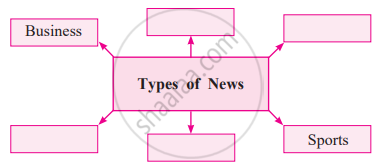
Complete the remaining blocks determining the types of news.
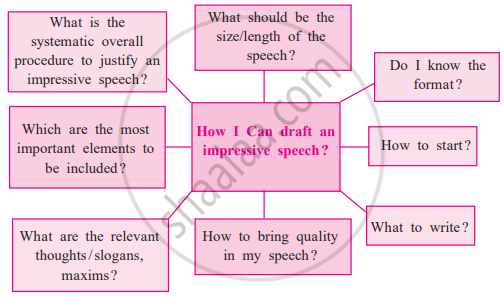
Drafting a Speech. Discuss in groups each block and make notes about it.
Work in pairs and discuss the factors that contribute towards making a choice and make a presentation to the class.
On seeing these pictures, you would have gone down your memory lane. Write a paragraph in about 50 words describing your favourite sport when you were young.

“Heroes are ordinary people who do extraordinary things.” Write an anecdote on the extraordinary deed of Jaiswal K.P. who helped in the recent Kerala Flood. Use the tips given in the box.
An anecdote is a brief, revealing account of an individual person or an incident. Consider these questions to write an anecdote.

- Who was involved in the story?
- When did it happen? Is this relevant?
- What happened?
- Where did it happen? How is it relevant?
Imagine a conversation among your friends about the four characters in the play – Tabaqui, Shere Khan, Mother Wolf and Father Wolf. Use the hints to write it.
- The characters' entry in the play.
- Compare and contrast their character traits.
- The reaction of the characters on seeing the man cub.
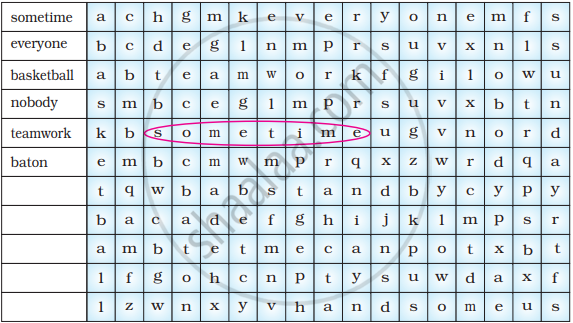
In the puzzle find the words given in the column. Notice that these words are formed by joining two words. One is done for you.
Find some more such words.
Do you want to try to write your own paragraph now?
Write a paragraph on Monkey.

- ______
- ______
- ______
- ______
- ______
Here is a word, clock. Write down words relating to clock.

Do you know that there are seven wonders in the world? Can you tell the name of the one which is in India? Find out and write the names of all the seven wonders and the countries they are located in.
| Wonders of the world | Countries | |
| (i) | The Taj Mahal | |
| (ii) | The Great Wall of China | |
| (iii) | ||
| (iv) | ||
| v) | ||
| (vi) | ||
| vii) |
Now complete the following, in the same way, using the words juicy or exciting. The order may vary according to your choice.
apple ______
orange ______
sugarcane ______
rock climbing ______
skiing ______
river rafting ______
Do your work ______[neat]
The grandmother played a vital role in the author’s formative years. Give your own example of how elders have a positive influence on the younger generation. Include examples from the story also.
How did Mary Kom manage to get financial support for her trip to the USA?
What difficulty did she experience while eating Chinese food?
Lack of adequate financial resources and sponsorships often affect sportspersons. How is this evident from Mary Kom’s life?
The Government of Tamil Nadu has imposed a ban on the use of plastic. Effective implementation of this ban depends on public awareness and individual responsibility.
Write an article of 150 words for your school magazine to create an awareness of the dangers posed by indiscriminate use of plastic. Expand the ideas given below as notes.
Notes:
a. Introduction
(i) Plastic – synthetic material – doesn’t decompose in soil
(ii) Inevitable role of plastic – man’s day-to-day life
b. Human Health Hazard
(i) Leeching of plastic into food – micro plastic entering food chain
(ii) Human body’s inability to deal with this unnatural substance
(iii) Reaction of microplastic in human body and ill effects
c. Adverse Effects on Plants and Animals
(i) Plastic particles choking waterways – affect aquatic animals
(ii) Ingestion by aquatic and terrestrial animals–blocking of intestines and respiratory passages
d. Environmental Degradation
(i) Manufacturing process and burning of plastics–pollute atmosphere
(ii) Plastic–non-biodegradable – interferes with soil microorganisms – affects soil fertility
e. Conclusion
(i) Suggestions for restricted use – alternatives for one-time use of plastics
(ii) Segregation of plastic waste – for recycling
Write the contraction for the following phrase.
are not - ______.
Which of the following lines tells us that the poet Wordsworth carried a mental picture of the daffodils?
How does John Brown convey his firsthand experience of war to his mother and evoke a deep emotional response in the readers? Justify your answer in about 200-250 words with supporting details from the poem, by John Brown.
As the Head of Environmental Initiatives at school, you have to deliver a speech on the occasion of World Environment Day on June 5th. Write a speech following the guidelines given below:
- Greeting or salutation and purpose – the importance of World Environment Day
- Key issues such as climate change, and pollution – the role of students in fostering a sense of environmental responsibility
- Concrete steps required towards a more sustainable and an eco-friendly lifestyle – strong call for action.
