Advertisements
Advertisements
प्रश्न
In a carbinol system of nomenclature tert.butyl alcohol is named as _______________
पर्याय
trimethyl carbinol
dimethyl ethyl carbinol
methyl carbinol
ethyl carbinol
Advertisements
उत्तर
In a carbinol system of nomenclature tert.butyl alcohol is named as trimethyl carbinol
APPEARS IN
संबंधित प्रश्न
Write the IUPAC name of the given compound:

Name the following compound according to the IUPAC system.

Write the IUPAC name of the following compound:

Write the IUPAC name of the following compound:

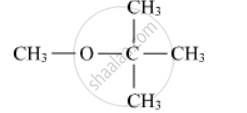
Give the IUPAC name of the following ether:
O2N – C6H4 – OCH3(p)
Give the IUPAC name of the following ether:
CH3CH2CH2OCH3
Write IUPAC name of the following compound (CH3)2 N − CH2CH3
Write the IUPAC name of the following compound:
Write the structures of the products when Butan-2-ol reacts with CrO3
Write the structures of the products when Butan-2-ol reacts with SOCl2
Write the IUPAC name of the following :

In the dehydration of alcohols to alkenes by heating with concentrated sulphuric acid, the initiation step is:
(1) formation of carbonation
(2) formation of an ester
(3) protonation of the alcohol molecule
(4) elimination of water
Write structural formula for pentane-1,4-diol.
Write IUPAC name of the following
\[\begin{array}{cc}\ce{CH3-CH-CH-CH2-OH}\\|\phantom{.....}|\phantom{.......}\\\ce{OH}\phantom{..}\ce{CH3}\phantom{.....}\end{array}\]
Write IUPAC names of the following

Isopropyl alcohol on oxidation forms:
3-methylphenol is called ____________.
Butane-2-ol is ____________.
n-Propyl alcohol and isopropyl alcohol can be chemically distinguished by which reagent?
The IUPAC name of the ether CH2 = CH–CH2OCH3 is:
Convert the following:
Ethyl alcohol into ethyl acetate.
Draw structure of the following compound.
2-Methoxypropane
Write structural formulae for:
Salicylic acid
The IUPAC name of  is ______.
Write the IUPAC name of the following compound:
\[\begin{array}{cc}
\phantom{..............}\ce{CH3}\\
\phantom{............}|\\
\ce{CH3 - CH - CH - C - CH3}\\
|\phantom{.....}|\phantom{......}|\\
\phantom{...}\ce{CH3}\phantom{.}\ce{OH}\phantom{...}\ce{CH3}
\end{array}\]
Write the IUPAC name.
\[\begin{array}{cc}
\phantom{................}\ce{CH3}\\
\phantom{.............}|\\
\ce{CH3 - CH - CH - C -CH3}\\
\phantom{.}|\phantom{......}|\phantom{......}|\\
\phantom{....}\ce{CH3\phantom{...}\ce{OH}\phantom{...}\ce{CH3}}\
\end{array}\]
Write IUPAC name of the following compound:
\[\begin{array}{cc}
\phantom{................}\ce{CH3}\\
\phantom{.............}|\\
\ce{CH3 - CH - CH - C - CH3}\\
|\phantom{......}|\phantom{......}|\\
\phantom{...}\ce{CH3}\phantom{...}\ce{OH}\phantom{...}\ce{CH3}
\end{array}\]
