Advertisements
Advertisements
प्रश्न
Write structures of the compounds whose IUPAC names are as follows:
3-Chloromethylpentan-1-ol.
Advertisements
उत्तर
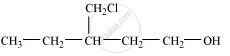
संबंधित प्रश्न
Name the following compound according to the IUPAC system.

Write the IUPAC name of the following compound:

Give the IUPAC name of the following ether:
O2N – C6H4 – OCH3(p)
Give the IUPAC name of the following ether:
CH3CH2CH2OCH3
Give the IUPAC name of the following ether:

In the dehydration of alcohols to alkenes by heating with concentrated sulphuric acid, the initiation step is:
(1) formation of carbonation
(2) formation of an ester
(3) protonation of the alcohol molecule
(4) elimination of water
Write structural formulae for Cyclohex-2-en-1-ol.
Write IUPAC name of the following

In a carbinol system of nomenclature tert.butyl alcohol is named as _______________
Glycerol is ____________.
Give IUPAC names of the following compound:

An example of a compound with functional group – O – is ____________.
Cresol has ____________.
Give IUPAC name of the compound given below.
\[\begin{array}{cc}
\phantom{}\ce{CH3 - CH - CH2 - CH2 - CH - CH3}\phantom{.}\\
\phantom{.........}|\phantom{...................}|\phantom{...........}\\
\phantom{..}\ce{Cl}\phantom{.................}\ce{OH}\phantom{..}
\end{array}\]
Assertion: Addition reaction of water to but-1-ene in acidic medium yields butan-1-ol.
Reason: Addition of water in acidic medium proceeds through the formation of primary carbocation.
Write a chemical reaction for the following conversion:
Acetic acid into ethyl alcohol.
Write IUPAC name of the following compound:
\[\begin{array}{cc}
\phantom{................}\ce{CH3}\\
\phantom{.............}|\\
\ce{CH3 - CH - CH - C - CH3}\\
|\phantom{......}|\phantom{......}|\\
\phantom{...}\ce{CH3}\phantom{..}\ce{OH}\phantom{...}\ce{CH3}
\end{array}\]
Write structural formulae for:
p-Nitrophenol
The IUPAC name of  is ______.
Write the IUPAC name.
\[\begin{array}{cc}
\phantom{................}\ce{CH3}\\
\phantom{.............}|\\
\ce{CH3 - CH - CH - C -CH3}\\
\phantom{.}|\phantom{......}|\phantom{......}|\\
\phantom{....}\ce{CH3\phantom{...}\ce{OH}\phantom{...}\ce{CH3}}\
\end{array}\]
