Advertisements
Advertisements
प्रश्न
Write steps to carry out the conversion of phenol to aspirin.
Advertisements
उत्तर
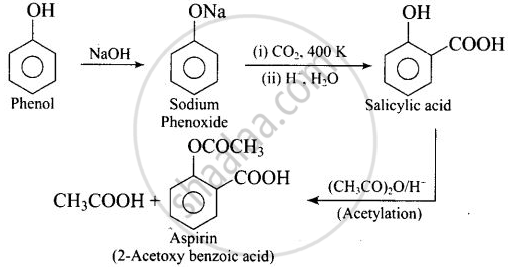
APPEARS IN
संबंधित प्रश्न
Explain metamerism with suitable examples of ethers
Name the following compound according to the IUPAC system.
\[\begin{array}{cc}
\ce{CH3 - C = C - CH2OH}\\
|\phantom{......}|\phantom{.....}\\
\ce{CH3}\phantom{.}\ce{Br}\phantom{....}\\
\end{array}\]
Write the IUPAC name of the following compound:
\[\begin{array}{cc}
\phantom{........................}\ce{CH3}\\
\phantom{....................}|\\
\ce{CH3 - CH - CH - C - CH3}\\
|\phantom{.........}|\phantom{.........}|\\
\phantom{...}\ce{CH3}\phantom{....}\ce{OH}\phantom{....}\ce{CH3}\\
\end{array}\]
Write the IUPAC name of the following compound:
\[\begin{array}{cc}
\ce{CH3 - CH - CH - CH3}\\
|\phantom{.........}|\phantom{...}\\
\ce{OH}\phantom{....}\ce{OH}\\
\end{array}\]
Write the IUPAC name of the following compound:
\[\begin{array}{cc}
\ce{HO - CH2 - CH - CH2 - OH}\\
|\phantom{...}\\
\ce{OH}\phantom{.}\\
\end{array}\]
Give the IUPAC name of the following ether:
O2N – C6H4 – OCH3(p)
Give the IUPAC name of the following ether:

How is phenol converted into the following?
benzoquinone
How is phenol converted into the following?
picric acid
Write the structures of the products when Butan-2-ol reacts with SOCl2
Write IUPAC name of the following

In a carbinol system of nomenclature tert.butyl alcohol is named as _______________
Glycerol is ____________.
Cresol has ____________.
Ethyl alcohol is industrially prepared from ethylene by:
n-Propyl alcohol and isopropyl alcohol can be chemically distinguished by which reagent?
The heating of phenyl methyl ether with HI produces:
Which of the following gives a positive iodoform test?
Write the IUPAC name of the compound given below.
\[\begin{array}{cc}
\phantom{}\ce{CH3 - CH2 - C = C - OH}\\
\phantom{........}|\phantom{....}|\phantom{}\\
\phantom{..............}\ce{CH3 CH2OH}
\end{array}\]
Write structural formulae for:
Salicylic acid
