Advertisements
Advertisements
प्रश्न
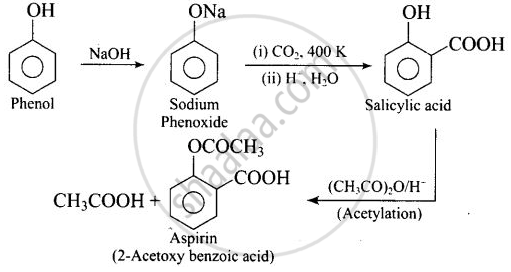
Write steps to carry out the conversion of phenol to aspirin.
Advertisements
उत्तर
APPEARS IN
संबंधित प्रश्न
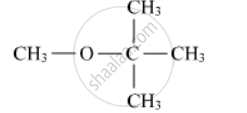
Write the IUPAC name of the given compound:

Write the IUPAC name of the following compound:
C6H5 – O – C2H5
Natalite is a mixture of
(a) diethyl ether and methanol
(b) diethyl ether and ethanol
(c) dimethyl ether and methanol
(d) dimethyl ether and ethanol
How is phenol converted into the following?
benzoquinone
Write the IUPAC name of the following compound:
What.will be the product fonned when chlorobenzene is heated with sodium metal in the presence of dry ether?
Isopropyl alcohol on oxidation forms:
3-methylphenol is called ____________.
One of the following is not a dihydroxy derivative of benzene.
An example of a compound with functional group – O – is ____________.
Which of the following compounds is oxidised to prepare methyl ethyl ketone?
Ethylene reacts with Baeyer’s reagent to give ______.
The correct acidic strength order of the following is:

(I)

(II)

(III)
Which of the following compounds will react with sodium hydroxide solution in water?
Match the starting materials given in Column I with the products formed by these (Column II) in the reaction with HI.
| Column I | Column II | ||
| (i) | CH3—O—CH3 | (a) |  |
| (ii) | \[\begin{array}{cc} \ce{CH3}\phantom{..................}\\ \backslash\phantom{.............}\\ \ce{CH-O-CH3}\\ /\phantom{..............}\\ \ce{CH3}\phantom{..................} \end{array}\] |
(b) | \[\begin{array}{cc} \ce{CH3}\phantom{....}\\ |\phantom{.......}\\ \ce{CH3-C-I + CH3OH}\\ |\phantom{.......}\\ \ce{CH3}\phantom{....} \end{array}\] |
| (iii) | \[\begin{array}{cc} \ce{CH3}\phantom{.}\\ |\phantom{....}\\ \ce{H3C-C-O-CH3}\\ |\phantom{....}\\ \ce{CH3}\phantom{..} \end{array}\] |
(c) | 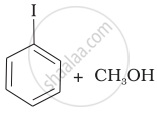 |
| (iv) |  |
(d) | CH3—OH + CH3—I |
| (e) | \[\begin{array}{cc} \ce{CH3}\phantom{.....................}\\ \backslash\phantom{.................}\\ \ce{CH-OH + CH3I}\\ /\phantom{.................}\\ \ce{CH3}\phantom{.....................} \end{array}\] |
||
| (f) | \[\begin{array}{cc} \ce{CH3}\phantom{.....................}\\ \backslash\phantom{.................}\\ \ce{CH-I + CH3OH}\\ /\phantom{.................}\\ \ce{CH3}\phantom{.....................} \end{array}\] |
||
| (g) | \[\begin{array}{cc} \ce{CH3}\phantom{....}\\ |\phantom{.......}\\ \ce{CH3-C-OH + CH3I}\\ |\phantom{.......}\\ \ce{CH3}\phantom{....} \end{array}\] |
Assertion: p-nitrophenol is more acidic than phenol.
Reason: Nitro group helps in the stabilisation of the phenoxide ion by dispersal of negative charge due to resonance.
Explain why Lewis acid is not required in bromination of phenol?
Write the IUPAC name of the following compound.

Identify A and B in the following:

