Advertisements
Advertisements
प्रश्न
How does the bond of affection between Mrs. Croft and the narrator evolve?
Advertisements
उत्तर
The bond of affection between Mrs. Croft and the narrator evolves when he used to make the old lady soup for dinners and used to take care of her. The bond also is seen when he introduces Mala for the first time to the old lady and she appreciates it.
APPEARS IN
संबंधित प्रश्न
Summers are becoming hotter with each passing year. Write a description of one such very hot day. What did you see and hear as you walked outside ?
How were birds and animals affected ?
Do you agree with the poet that a nation’s growth depends upon the wealth of trees? Why/why not?
What arc the poetic devices used in Maya Angelou’s poem “Caged Bird”?
What does the poem “Abou Ben Adhem” convey?
Discuss trans-culturation as represented in Seattle’s speech.
Fill in the blank with an appropriate word:
Ali took ……… his cap and wiped his face.
Fill in each of the numbered blanks with the correct form of the word given in brackets. Do not copy the passage, but write in the correct serial order the word or phrase appropriate to the blank space.
Example:
(0) One morning, I (0) ……. (see) the python curled up on the dressing table.
Answer: saw.
It was (1) ……. (gaze) at its own reflection in the mirror. I (2) ……… (go) for grandfather, but by the time we (3) ……… (return) to the room, the python (4) …….. (move) on. He was seen in the garden, and once the cook saw him, (5) ……… (crawl) up the ladder to the roof. Then we (6) …….. (find) him on the dressing table again, (7) (admire) himself in the mirror. “He’s trying to look better for Aunt Mabel,” I said. I (8) ……. (regret) this remark immediately because grandmother overheard it and held up my pocket money for the rest of the week!
List the advances in technology that have improved forensic analysis.
Why does the author aver that the growth of the world population is one of the strongest factors distorting the future of human society?
Explain the following phrase
Turned to dust
Use it in a sentence of your own.
Who was Roger Presbury and how was John Garrideb connected with him?
Discuss in pairs or in small groups
Living abroad is challenging in many ways.
Give reasons for the following.
Srinath and his family members’ eager expectation of Satyajit’s arrival.
Your teacher will speak the word given below. Write against two new words that rhyme with it.
chop ______ ______
Use the phrase in a sentence of your own, after finding out its meaning.
carry on
Discuss the following with your partner and complete the following sentence.
Organic fertilizer means ______________.
Discuss with your partner and choose the correct alternative.
A democratic country is governed by, its - __________________.
You might have read war stories or watched war movies. Make a list of the factors which make them interesting.
'The Road Not Taken' (Robert Frost), 'O Captain My Captain' (Walt Whitman), etc. are inspirational poems. Search these poems on the internet and write down your opinion about the poems in your notebook.
Write in short about at least five cities in India that are considered to be the most developed cities.
Watch the advertisements on TV. Choose any one of them for group discussion and analysis. Write your report in the advertisement.
Given in a mixed order below are some good human attributes of the family. Pick out from the box and write it against the line that reflects it.
He believed, his daughter was still alive, after three years.
Write what you think about the following thoughts and actions of Mathilde :
Mathilde wrote a note to her friend as dictated by her husband.
Give, in your own words, TWO reasons for each of the following :
One of the schoolboys helped the old woman cross the street.
Imagine someone has invited your family to a programme and you were the only person at home when the invitation was given orally.
Write a note (4-5 lines) to pass on the message to the other people in your family. Or, Write an imaginary conversation in which you pass on the message to your parents.
Rewrite the play in the form of a short story.
Gather information on any one of the following by talking to your elders, family members, and from other sources in your mother tongue and write a short note on it in English.
A special type of embroidery
Listen carefully and write the word in the appropriate column.
| Positive Feelings | Negative Feelings |
Teacher: hopeful, lonely, happy, jealous, surprised, shy, loving, proud, cheerful, anxious, nervous, excited, embarrassed, scared, silly, comfortable, peaceful, depressed, enthusiastic, motivated, inspired, threatened, crushed, angry.
Study the following format of an informal letter carefully. Using the format,

Write an informal letter to your friend who has gone to another town for a month.
Write the reason in your own words.
Akbar had to dress like a slave.
Look around in your vicinity - your family, friends, neighbours, classmates, etc. and write about any four teenagers who have made a name for themselves by doing something extraordinary.
| Teenager Group | Name/s | Special/extraordinary tasks/things performed |
| 1. Family | ||
| 2. Friends | ||
| 3. Neighbours | ||
| 4. Classmates |
Discuss in groups about the procedure of planting a tree. Write the steps in bullet points and present them before the class.
Discuss in pairs and write what your father and mother do for your family.
|
Father |
Mother |
|
|


Write about a day when you felt very happy. Use the following questions to help you. Think/Recollect a day ............
Note down the points.
- Do you remember the exact day and date?
- Was it a special occasion or celebration?
- What happened on that day?
- How did you react to the things that happened on that day?
- How did other people react when they saw you were so happy?
- What did you do next ?
- What happened in the end?
- Describe any other emotions you felt that day
Now, with the help of the guidelines write a short paragraph of at least 100 words about that happy day. Give a suitable title for your narrative/write up.
Work in groups and discuss. Then write a diary entry in about 60-80 words describing your feelings and emotions for the given situation.
Imagine, you are Pongo.
Your feelings when you caught the boy.
Write a letter to the manager of a famous daily, ordering a subscription for your school library.
Your friend has presented a beautiful art piece on your birthday. Write a letter to her appreciating her art work.
Write a paragraph from the contents of the table given below. Frame sentences with these words – but, as well as, whereas.
eg. A turtle as well as a tortoise belongs to the reptile family.
| Tortoise | Turtle |
| reptile family | reptile family |
| land animal | sea animal |
| has a long life | lives for many years |
| uses tiny feet to walk | uses flippers to swim |
| eats grass, weeds and flowers | eats insects and bugs |
Silent letter.
What is common in the following groups of words?
- knee, knife, knot, know ______
- neighbour, daughter, fight, straight ______
- honest, honour, hour, heir ______
Try and make more silent letter words.
gnat: ______, ______
tongue: ______, ______
chalk: ______, ______
whistle: ______, ______
Use the option to fill in the blank.
Ram ______ a good football player.
Now make one more question for each picture. Write the question in the space below each picture. Use how many, what are, where are/is, how, why, to make questions.
 |
 |
 |
 |
 |
 |
Find one word from the story that means
to be inquisitive c ______.
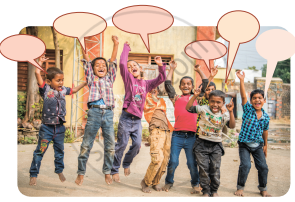
The children in the picture are watching an exciting sporting event, where their school team is winning. Suggest suitable utterances reflecting their feelings:
State whether the following statement are true or false
The cop suddenly slowed his walk, when he heard the barking of dogs.
Write conversation on the following situation.
Between two friends on the importance of punctuality
How did the author react on seeing his photograph?
The narrator got angry because
______.
What are all the factors that influence our moods?
Why had Miss Meadows chosen 'A Lament' as the lesson that particular day?
What advice did Aunt Jane offer the couple?
Jill said that they owned the steering wheel of a car, one of the tyres, two of the cylinders and leg of the sofa. What does this convey?
Attempt a description of the following process, in about 100 word each, either using the imperative or the passive.
Organising a birthday party in your house
Complete the dialogue:
| Manas: | How much is the SSC exam fee? |
| Clerk: | __________________ |
| Manas: | When is the last date to submit the exam form? |
| Clerk: | __________________ |
On returning home, Tishani Doshi writes her thoughts reflecting on how her decision to enrol for the Students on Ice programme has been the single most important decision of her life that has completely transformed her.
Imagine yourself to be Tishani and express these thoughts.
You may begin like this:
I can’t thank my stars enough for having cashed in on the opportunity of........
Use the following charts to prepare meaningful dialogues.
Use your ideas to fill in the blanks.

Do you like to watch plays?
Which is the last play you saw?
Write a composition (in approximately 400-450 words) of the following subject:
Recently you attended the wedding of a close relative. It was the first family gathering after the pandemic. Describe the excitement of meeting all the family members, the venue of the wedding, the food that was served and the celebrations that followed.
As the school leader, you have been given the responsibility of organising a school trip for the students of classes XI and XII to a place of historical importance. Write a proposal in about 150 words stating the steps you would take to successfully organise the trip.
