Advertisements
Advertisements
प्रश्न
Shakespeare's minor characters play an important part in the development of the plot. What purpose do Dogberry, Verges and the Company of the Watch serve in the play Much Ado About Nothing?
Advertisements
उत्तर
The presentation and function of Dogberry, Verges and The watch in Much Ado About Nothing. In Shakespearean times, Elizabethan audiences enjoyed the play's in which involved a character that denoted 'slapstick' comedy into the play. In the play Much Ado About Nothing, this character is Dogberry and his close companions Verges and the Watch. Comedy is excellent as a dramatic device as it involves opportunities for misunderstandings and comical episodes. Throughout the play, it is apparent that the characters contribute a great deal too dramatic interest in the play. Dogberry and his companions enter the play at a moment of high drama: the time is not just in the very middle of the play itself when the dramatic tension is at its greatest, but it is just after Don John's plot, turn's Claudio against Hero, the woman whom Claudio is to marry the following day. Without these characters in the play, it would surely be lacking in the broad humor of working-class men, and be exclusively about courtiers whose wit is different from broad humor, and no substitute for it. The audience laughs openly at Dogberry and the townsmen whereas we do not laugh outright at the people of the court, except in the case of Beatrice and Benedick and the way they are deceived and deceive themselves. In, the play the function of the Watch is to police the island and provide a safe haven for its residents. This is ironic due to the way they perform their tasks so badly. The language used throughout the play by Dogberry and the other's help to add to the dramatic interest of the play. The audience laughs at Dogberry and Verges because they feel the need to copy the style of the court and do it very badly in a way that humors the audience. They are long-winded, and they misuse word so much that in places they use one which is the opposite of what they intended to say e.g. "plaintiff" when they meant defendant. Dogberry's character, a minor role in the play, is authoritarian even though he lacks the ability to make himself understood. From the beginning, he is prone to the kind of digression that expresses its own sense of self-importance, and he has occasionally to be promoted by his colleague Verges, who is invariably far more direct than he is. Dogberry indulges in the kind of witless banter he describes and so ends up patronizing himself. Despite sometimes getting things particularly right he tends to set up, unwittingly, the possibilities for alternative readings. He tries to explain the Watch's duties to them... Dogberry "you are thought here...stand in the prince's name" 2nd Watchman "How if a will not stand?" Dogberry "Why, then, take no note of him. Thank God to be rid of a knave." In Dogberry's speech, he misuses the word stand. In familiar Elizabethan slang, a stand is slang for a male erection, so Dogberry is UN intentionally telling the watch to go around telling men to have erection's and that it was the governor's policy. He is also offering a comic variation on the play's title: Sex maybe Much Ado about Nothing. If a man fails to stand as there will be nothing to note. What makes this funny is the fact it is Dogberry, a householder of the community, who provides the audience with his opportunity for coarse laughter. Most of What Dogberry, asks, says or does is to be taken down, fails into the category of utterly useless information. In conclusion to the play and its most comic characters, Dogberry is the main, 'slapstick' comic of the play. His foolishness and stupidity lead the others into misfortune.
APPEARS IN
संबंधित प्रश्न
Give reasons -
Chaitanya’s silver medal in a running race was very special for the writer, because :
(i) __________________
(ii) __________________
What is the tone of the poem?
What are the poetic devices (figurative language) in the poem? How do they contribute to the meaning/how do they effect the poem?
Thus I entered, and thus I go!
In triumphs, people have dropped down dead,
"Paid by the world, what dost thou owe
Me? "....God might question; now instead,
'Tis God shall repay: I am safer so.
Read the above lines and amswer the question that follow.
Explain with reference to the context.
Explain ‘may his tribe increase.’
Show how the story though Indian in context is quintessentially human also. Discuss.
Make a critical appreciation of the short story, “A Horse and Two Goats,” by R.K. Narayan.
What is the theme of all summer in a day by Ray Bradbury?
Write a composition (350 - 400 words) on the following:
Study the picture given below. Write a story or a description or an account of what it suggests to you. Your composition may be about the subject of the picture or you may take suggestions from it; however, there must be a clear connection between the picture and your composition.

Fill in the blank with an appropriate word:
The cyclist rode quickly ______ the path.
Why do you think people undertake such adventurous expeditions in spite of the risk involved?
Distinguish between the following pairs of sentences.
Green stripes could be used or alternatively black ones.
The extract deals with the atmosphere of two homes. Collect the words associated with - Garden.
The person who makes mistake or commits crime should be punished because _________________.
- _______________________________
- _______________________________
- _______________________________
- _______________________________
Choose the correct alternative for the given line. Focus on the inference of the poet.
‘Earth has not anything to show more fair:’
The line means - _________________.
Explain the extended metaphor related to dentistry in the poem.
Write in short about at least five cities in India that are considered to be the most developed cities.
Complete the following and write a paragraph for the given activity.

Discuss in pairs and write what your father and mother do for your family.
|
Father |
Mother |
|
|


Write a meaningful paragraph using the hints given below.
Mahesh – celebrates – 14th birthday – an old-age home – family, friends – informs home in advance – delegates tasks – friends buy things necessary – arrives home early – decorates place – balloons, colour papers – inmates gathered – cuts cake – sing-song, claps – distributes cakes – expresses his feelings – gets blessings – offers things – bedsheets, footwear, etc. needed – fun, entertainment – happy and content.
“The Himalayas are the highest mountain ranges.” He knew that the Himalayas ______ the highest mountain ranges.
Arrange the picture in order by writing the numbers 1,2,3 and 4 in the given boxes and write this familiar story in about 100 words.
Make use of the words given below.
| thirsty, village, pitcher, disappointment, pebbles, water level |
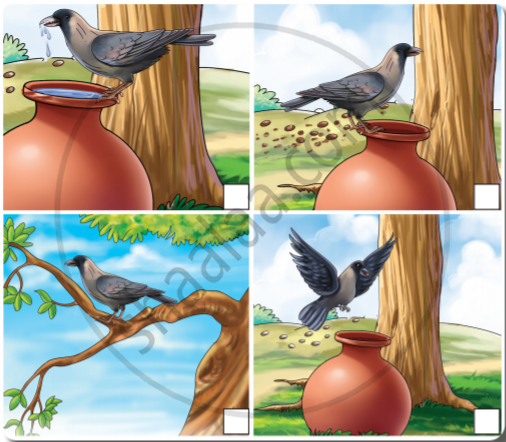
One hot day, a thirsty crow _____________________________________________________________
__________________________________________________________________________________________
Now make one more question for each picture. Write the question in the space below each picture. Use how many, what are, where are/is, how, why, to make questions.
 |
 |
 |
 |
 |
 |
Sit in groups of five. Now, each student will tell a story. Decide which story was the best and declare a or of the group.
Do your work ______[neat]
How did the grandmother spend the last few hours of her life?
Why was Mary Kom named the ‘Queen of Boxing’ and ‘Magnificent Mary'?
Are children afraid of visiting the dentist? Give reasons.
Answer the following question as briefly as possible and with close reference to the relevant text.
Referring closely to the poem, We are the Music Makers, refer to any two examples given by the poet which identify poets and singers as “movers and shakers.”
Which is the last play you saw?
