Advertisements
Advertisements
प्रश्न
Describe the role of CaCl2 in the preparation of competent cells?
Advertisements
उत्तर
CaCl2 is known to increase the efficiency of DNA uptake to produce transformed bactrial cells. The divalent Ca+2 ions supposedly create transient pores on the bactrial cell wall by which the entry of foreign DNA is facilitated into the bactrial cells.
APPEARS IN
संबंधित प्रश्न
Can you think and answer how a reporter enzyme can be used to monitor the transformation of host cells by foreign DNA in addition to a selectable marker?
Write the role of ‘restriction sites’ in the cloning vector pBR322.
Explain the importance of ‘Selectable marker’, with the help of a suitable example.
How does the β-galactosidase coding sequence act as a selectable marker? Why is it a preferred selectable marker to antibiotic resistance genes? Explain.
The genetic material of virus includes:
Which of the following statement is not true for a clone?
Which of the following is not a genetic vector?
Plasmid pBR322 has a PstI restriction enzyme site within gene ampR that confers ampicillin resistance. If this enzyme is used for inserting a gene for β-galactoside production and the recombinant plasmid is inserted in an E.coli strain.
What does ‘competent’ refer to in competent cells used in transformation experiments?
A plasmid without a selectable marker was chosen as vector for cloning a gene. How does this affect the experiment?
Name the regions marked A, B and C.

Describe the role of Agrobacterium tumefaciens in transforming a plant cell.
Which of the following enzyme(s) are NOT essential for gene cloning?
- Restriction enzymes
- DNA ligase
- DNA mutase
- DNA recombinase
- DNA polymerase
Choose the correct answer from the options given below:
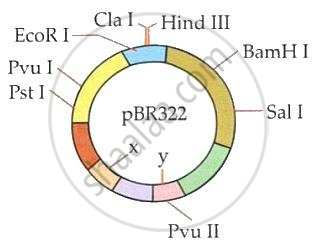
The following diagram showing restriction sites in E. coli cloning vector pBR322. Find the role of ‘X’ and ‘Y’ genes:
The “Ti plasmid” of Agrobacterium tumefaciens stands for ______.
What is the primary function of a vector in recombinant DNA technology?
Which of the following describes the function of a selectable marker in a cloning vector?
In blue–white screening, what do the white colonies indicate?
