Topics
Introduction to Book-Keeping and Accountancy
- Accounting
- Book-Keeping
- Accountancy
- Book-Keeping vs. Accountancy
- Basis (Methods) of Accounting System
- Qualitative Characteristics of Accounting Information
- Basic Terms in Accounting
- Transaction
- Capital and Drawings
- Debtors, Creditors and Bad Debts
- Expenditure and Its Types
- Discount and Its Types
- Solvent Person vs. Insolvent Person
- Accounting Year
- Trading Concerns vs. Not for Profit Concerns
- Concept of Goodwill
- Fundamentals of Business Earnings
- Concepts of Assets, Liabilities and Net Worth
- Accounting Principles
- Accounting Concepts
- Core Accounting Concepts
- Accounting Standards
Meaning and Fundamentals of Double Entry Book-Keeping
Journal
- Accounting Documents
- Goods and Service Tax(GST)
- Types of Accounting Documents
- Voucher
- Tax Invoice (Under GST)
- Credit Memo
- Receipt
- Cheque
- Types of Cheques
- Books of Accounts
- Books of Accounts > Journal
- Journal Entries
- Journal Entries > Goods Account
- Journal Entries > Recording Discount in Journal
- Journal Entries > Other Important Journal Entries
Ledger
Subsidiary Books
- Concept of Subsidiary Books
- Cash Book
- Cash Book > Simple Cash Book (Single Column Cash Book)
- Cash Book > Two Column Cash Book (With Cash and Bank Columns)
- Cash Book > Petty Cash Book
- Simple Petty Cash Book
- Analytical Petty Cash Book
- Purchase Book
- Purchase Return Book
- Sales Book
- Sales Return Book
- Journal Proper
Bank Reconciliation Statement
- Accounting Documents Used in Banking
- Accounting Documents Used in Banking
- Pay-in-Slip
- Withdrawal Slip
- Bank Pass Book
- Bank Statement
- Bank Advice
- Concept of Virtual Banking
- Bank Reconciliation Statement(BRS)
- Cash Book vs Pass Book : Causes of Differences
- Time Difference(Regarding BRS)
- Errors and Omission Made by Bank or Businessman
- Formats of BRS
- Preparation of BRS
- Cash Book and Pass Book Comparison for Common Period
- Cash Book and Pass Book Balances for Different Periods
- Bank Balance as per Cash Book (Favourable / Debit Balance)
- Bank Balance as per Pass Book (Favourable / Credit Balance)
- Overdraft as per Cash Book (Unfavourable / Credit Balance)
- Overdraft as per Pass Book (Unfavourable/Debit balance)
- Reconciliation of Debtors and Creditors
Depreciation
Rectification of Errors
Final Accounts of a Proprietary Concern
Single Entry System
- Concept of Single Entry System
- Single Entry System vs. Double Entry System
- Parts of Single Entry System
- Statements of Affairs
- Statement of Profit or Loss
- Statement of Profit or Loss > Net Worth Method
- Practical Problems on Single Entry System
- Definition: Voucher
- Types of Vouchers
- Important Points Regarding Voucher Types
- Examples for Each Voucher Type
- Importance of Vouchers
- Information Given by a Voucher
- How to Prepare a Voucher
- Key Takeaways
Maharashtra State Board: Class 11
Definition : Voucher
A voucher is a formal written document that supports and records a financial transaction in business or accounting.
Maharashtra State Board: Class 11
Types of Vouchers
| Voucher | Use |
|---|---|
| Cash Voucher | Used to record all cash (notes/coins) transactions (payment or receipt). Has the following subtypes:
|
| Journal Voucher | Used to record adjustments, corrections, or entries not involving direct cash |
| Non-Cash / Transfer Voucher | A type of journal voucher used only to transfer balances between accounts, with no cash or bank involved |
| Contra Voucher | Used to record transactions that involve the transfer of funds between cash and bank accounts, or between two bank accounts within the same business. |
| Compound Voucher | Records multiple debits and credits in a single transaction. Here, only one side (debit or credit) has multiple accounts; the other side has just one account. |
| Complex Voucher | Used when multiple parties are involved with multiple debits and credits. Both sides (debit or credit) can have multiple accounts each. |
| Internal Voucher | Created by the business itself without any external document |
| External Voucher | Received from an agency (outside business) as proof of transaction |
| Purchase Voucher | Records all purchase transactions |
| Sales Voucher | Records all sales transactions |
| Bank Voucher | Records all bank-related (cheque, NEFT, DD) transactions. Has the following subtypes:
|
| Debit Note | Used when goods are returned to the supplier (purchase return) or to request a reduction in the amount owed. |
| Credit Note | Used when goods are returned by a customer (sales return) or when the business needs to credit the customer for an overcharge or adjustment. |
Maharashtra State Board: Class 11
Important Points Regarding Voucher Types
1. Purchase and Sale Vouchers vs. Payment/Debit and Receipt/Credit Vouchers
| Voucher Type | Purpose |
|---|---|
| Purchase/Sale Vouchers | Record the actual transaction of buying or selling goods |
| Payment/Receipt Vouchers | Record the cash or bank settlement of the transaction |
Note: Payment and receipt vouchers are used to show money movement, not the commercial activity
2. Bank Vouchers vs. Payment/Debit and Receipt Vouchers
| Voucher Subtype | Direction of Money | Mode of Transaction |
|---|---|---|
| Cash Payment / Cash Receipt | Outflow/Inflow | Cash |
| Bank Payment / Bank Receipt | Outflow/Inflow | Bank |
Note: Subtypes help avoid confusion by showing both direction and mode of transaction
3. Why main voucher types (cash, bank) exist when there are clear subtypes (cash receipt, bank receipt, etc.):
| Main Voucher Type | Purpose |
|---|---|
| Cash/Bank Vouchers | Instantly show whether the transaction involved physical cash or a bank. |
| Payment/Receipt | Show direction of funds (inflow or outflow) |
Note: Both mode and direction are needed for accurate record-keeping and auditing
4. Journal Vouchers vs. Transfer Vouchers
| Voucher Type | Used For |
|---|---|
| Journal Vouchers | Adjustments, corrections, provisions, and transfers (broad category) |
| Transfer Vouchers | Only for internal account-to-account transfers |
Note: Transfer vouchers provide sharper classification within journal entries
5. Voucher Name Logic: Debit/Payment Vouchers and Credit/Receipt Vouchers
| Voucher Type | Rule Applied | Reason for Name / Name Logic |
|---|---|---|
| Credit/Receipt | Credit the Giver (Personal Account) Debit what comes in (Real account). |
The account of the person giving cash is credited—proof that money was received. Income is credited, hence the name "credit" voucher, and cash is received, so it is also called a "receipt" voucher. |
| Debit/Payment | Debit the Receiver (Personal Account) Credit what goes out (Real account). |
The receiving account is debited, confirming that money was paid out. Expense is debited, hence the name "debit" voucher, and cash is paid, so it is also called a "payment" voucher. |
Maharashtra State Board: Class 11
Examples for Each Voucher Type
| Voucher Type | Example |
|---|---|
| Cash Voucher | Cash paid for office supplies or cash received from sales |
| Bank Voucher | Payment to supplier by cheque or cash deposited into bank |
| Contra Voucher | Cash withdrawn from bank for office use or cash deposited in bank |
| Journal Voucher | Recording depreciation or accrued salary (no cash involved) |
| Transfer Voucher | Moving funds from travel expenses to administration expenses |
| Purchase Voucher | Buying raw materials from a supplier (cash/credit/bank) |
| Sales Voucher | Selling goods to a customer (cash/credit/bank) |
| Compound Voucher | Paid electricity bill ₹2,000 and telephone bill ₹1,000 in cash (electricity expenses and telephone expenses accounts are debited and only cash account is credited) |
| Complex Voucher | Paid salaries to staff (₹20,000) and rent (₹10,000) by cash and received commission income (₹5,000) by cheque—all in one transaction. (Salaries and rent accounts are debited. Cash, commission, and bank accounts are credited.) |
| Credit Note | Goods returned by a customer (issuing a credit note) |
| Debit Note | Returning defective goods to supplier (sending a debit note) |
| Internal Voucher | Preparing a slip for taxi fare paid (no external receipt) |
| External Voucher | Supplier’s invoice for goods purchased |
Maharashtra State Board: Class 11
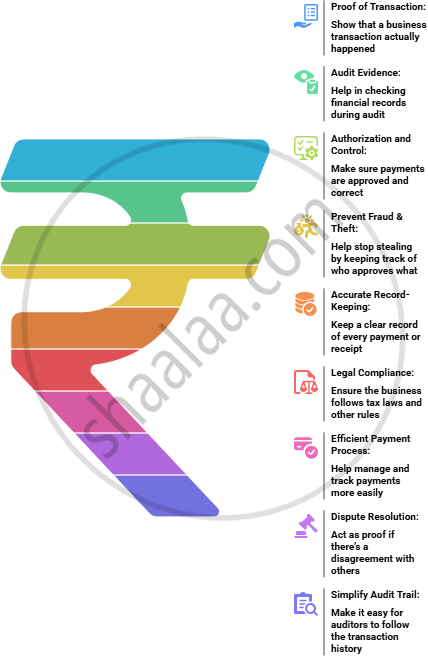
Importance of Vouchers
Maharashtra State Board: Class 11
Information Given by a Voucher
Common Details in All Vouchers
| Detail | Description |
|---|---|
| Voucher Number/Serial Number | Unique for tracking and audit |
| Date | When the voucher is prepared/transaction occurred |
| Amount | Full amount (with taxes/deductions if needed) |
| Account Codes | Relevant ledger accounts debited/credited |
| Name of Party | Supplier, customer, payee, or receiver |
| Description/Narration | Purpose and details of transaction |
| Supporting Documents | Bills, invoices, receipts, contracts, delivery notes, etc. |
| Prepared By | Name/signature of creator |
| Approved By | Name/signature of approver or authorized person |
Additional Details as per Voucher Type
| Voucher Type | Additional Details |
|---|---|
| Payment/Debit | Payment method (cash, cheque, bank transfer), reason for payment, payee details |
| Receipt/Credit | Mode of receipt (cash, bank), customer info, reference to invoice/sale |
| Journal Voucher | Adjustment/correction details: reason for entry, accounts affected (no cash/bank involved) |
| Contra Voucher | Accounts involved (cash, bank, or both); reference to bank/cash book; slip of fund movement. |
| Purchase Voucher | Item details, quantity, purchase order/invoice number, supplier info, payment terms |
| Sales Voucher | Product/service sold, quantity, invoice number, customer info, sales terms |
| Bank Voucher | Bank name, cheque/NEFT/DD number, bank account details, transaction reference |
| Transfer Voucher | Accounts being transferred from/to, purpose of transfer, supporting internal memo |
| Compound/Complex | Multiple debits/credits listed, combined amounts, linked accounts, reason for group entry |
| Debit Note Voucher | Reason for return/adjustment, item and quantity returned, reference to original purchase |
| Credit Note Voucher | Reason for adjustment, item returned by customer, reference to original sale |
Maharashtra State Board: Class 11
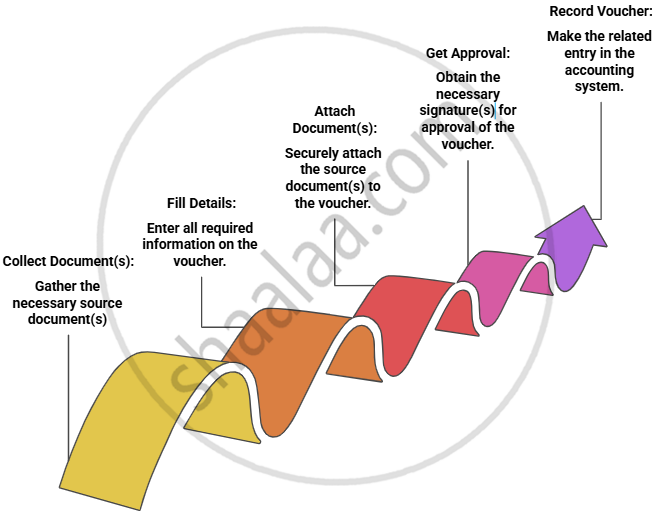
How to Prepare a Voucher
Maharashtra State Board: Class 11
Key Takeaways
-
A voucher is proof of a business transaction.
-
There are many voucher types, e.g., cash, bank, journal, etc.
- Separate voucher types make accounting clear, accurate, and reliable.
-
Always attach documents and have signatures for every voucher.
-
Neatly filed vouchers help during audits and queries
