Topics
Introduction to Book-Keeping and Accountancy
- Accounting
- Book-Keeping
- Accountancy
- Book-Keeping vs. Accountancy
- Basis (Methods) of Accounting System
- Qualitative Characteristics of Accounting Information
- Basic Terms in Accounting
- Transaction
- Capital and Drawings
- Debtors, Creditors and Bad Debts
- Expenditure and Its Types
- Discount and Its Types
- Solvent Person vs. Insolvent Person
- Accounting Year
- Trading Concerns vs. Not for Profit Concerns
- Concept of Goodwill
- Fundamentals of Business Earnings
- Concepts of Assets, Liabilities and Net Worth
- Accounting Principles
- Accounting Concepts
- Core Accounting Concepts
- Accounting Standards
Meaning and Fundamentals of Double Entry Book-Keeping
Journal
- Accounting Documents
- Goods and Service Tax(GST)
- Types of Accounting Documents
- Voucher
- Tax Invoice (Under GST)
- Credit Memo
- Receipt
- Cheque
- Types of Cheques
- Books of Accounts
- Books of Accounts > Journal
- Journal Entries
- Journal Entries > Goods Account
- Journal Entries > Recording Discount in Journal
- Journal Entries > Other Important Journal Entries
Ledger
Subsidiary Books
- Concept of Subsidiary Books
- Cash Book
- Cash Book > Simple Cash Book (Single Column Cash Book)
- Cash Book > Two Column Cash Book (With Cash and Bank Columns)
- Cash Book > Petty Cash Book
- Simple Petty Cash Book
- Analytical Petty Cash Book
- Purchase Book
- Purchase Return Book
- Sales Book
- Sales Return Book
- Journal Proper
Bank Reconciliation Statement
- Accounting Documents Used in Banking
- Accounting Documents Used in Banking
- Pay-in-Slip
- Withdrawal Slip
- Bank Pass Book
- Bank Statement
- Bank Advice
- Concept of Virtual Banking
- Bank Reconciliation Statement(BRS)
- Cash Book vs Pass Book : Causes of Differences
- Time Difference(Regarding BRS)
- Errors and Omission Made by Bank or Businessman
- Formats of BRS
- Preparation of BRS
- Cash Book and Pass Book Comparison for Common Period
- Cash Book and Pass Book Balances for Different Periods
- Bank Balance as per Cash Book (Favourable / Debit Balance)
- Bank Balance as per Pass Book (Favourable / Credit Balance)
- Overdraft as per Cash Book (Unfavourable / Credit Balance)
- Overdraft as per Pass Book (Unfavourable/Debit balance)
- Reconciliation of Debtors and Creditors
Depreciation
Rectification of Errors
Final Accounts of a Proprietary Concern
Single Entry System
- Concept of Single Entry System
- Single Entry System vs. Double Entry System
- Parts of Single Entry System
- Statements of Affairs
- Statement of Profit or Loss
- Statement of Profit or Loss > Net Worth Method
- Practical Problems on Single Entry System
- Definition: Cash Book
- Features
- Purpose
- Types
- Key Takeaways
Definition : Cash Book
A cash book is a special account book where all business cash and bank transactions (money received and paid) are recorded each day.
Features
| Feature | Description |
|---|---|
| Book of Original Entry | Records cash and bank transactions as they happen, just like a daily diary. |
| Works as a Ledger too | Shows summaries of all cash and bank transactions—no need for a separate cash account. |
| Two Sides | Has a Receipt Side (Debit/left) for money coming in and a Payment Side (Credit/right) for money going out. |
| Clear Columns | Uses columns for Date, Particulars/Description, Voucher No., Ledger Folio, and Amount. |
| Chronological Order | Transactions are recorded in the order they happen (date-wise). |
| Easy to Check Balances | Balance can always be easily calculated to see actual cash/bank in hand or at the bank. |
| Helps Catch Errors | Regular recordings and balances help spot mistakes or frauds quickly. |
Purpose
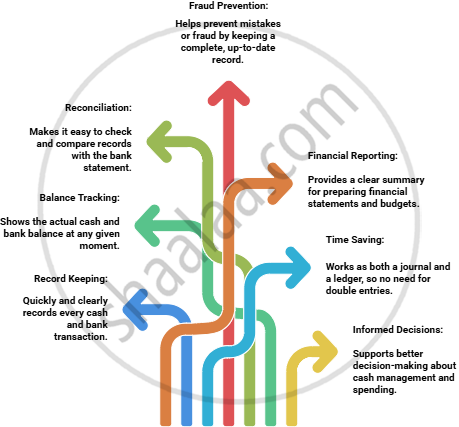
Types
| Type | Main Columns | What It Records | Who Uses It |
|---|---|---|---|
| Single Column | Cash only | All cash receipts and payments | Small businesses, shops |
| Double Column | Cash and Bank | Both cash and bank (cheque) transactions | Firms dealing with both cash & bank |
| Triple Column | Cash, Bank, Discount | Cash, bank, and discount (allowed/received) | Larger businesses with discounts |
| Petty Cash Book | Petty cash expenses | Small, routine expenses | All businesses to track daily small payments |
Key Takeaways
-
The cash book records all cash and bank transactions daily and acts as both a journal (original entry book) and a ledger (shows cash/bank balances).
-
Each cash book has a receipt side (left/debit for money in) and a payment side (right/credit for money out).
-
Types of cash books exist for different needs, including those that also record cheques, discounts, and petty expenses.
-
Key features include clear columns (date, amount, particulars), easy-to-check balances, and catching mistakes or fraud quickly.
-
The cash book is an essential tool for tracking business money and helps prepare financial statements.
-
Keeping an accurate cash book and regularly doing bank reconciliation helps maintain correct records and avoid confusion about how much cash or bank balance is actually available.
Related QuestionsVIEW ALL [12]
Record the following transactions in the Cash Book of M/s Kamal Traders. Balance for the month of July 2018: Cash in hand ₹ 2,000 and balance in Bank Current account ₹ 8,000.
| July 2018 | Amt (₹) | |
| 03 | Cash Sales | 2,300 |
| 05 | Purchased goods and amount paid by cheque | 6,000 |
| 08 | Cash Sales | 10,000 |
| 12 | Paid General Expenses | 700 |
| 15 | Sold goods and amount received by Cheque and deposited into Bank | 20,000 |
| 18 | Purchased Motor Car paid by Cheque | 15,000 |
| 20 | Cheque received from Mrunal deposited into Bank | 10,000 |
| 22 | Cash Sales | 7,000 |
| 25 | Mrunal’s cheque returned dishonoured | |
| 28 | Paid Rent | 2,000 |
| 29 | Paid Telephone expenses by cheque | 500 |
| 31 | Cash is withdrawn from Bank for personal use | 2,000 |
Prepare a two-column Cash Book with the help of the following information for January 2018.
| January 2018 | Amt (₹) | |
| 01 | Started business with cash | 1,20,000 |
| 03 | Cash paid into Bank of Baroda | 50,000 |
| 05 | Purchased goods from Sakshi on credit | 20,000 |
| 06 | Sold goods to Divakar and received a bearer cheque | 20,000 |
| 10 | Paid to Sakshi cash | 20,000 |
| 14 | Cheque received on December 06, 2018, deposited into Bank | |
| 18 | Sold goods to Shivaji on credit | 12,000 |
| 20 | Cartage paid in cash | 500 |
| 22 | Received cash from Shivaji | 12,000 |
| 27 | Commission received | 5,000 |
| 30 | Drew cash for personal use | 2,000 |
