Topics
Stakeholders in Commercial Organisations
- Meaning of Stakeholders
- Distinction Between Stakeholders and Shareholders
- Distinction Between Stakeholders and Customers
- Internal and External Stakeholders
- Expectations of Stakeholders
- Stakeholders Analysis
Marketing
Marketing and Sales
- Concept of Marketing
- Objectives of Marketing
- Importance of Marketing
- Comparison Between Marketing and Selling
- Product and Service
- Differences Between Products and Services
- Marketing Mix> Pricing
- Objectives of Pricing
Advertising and Sales Promotion
- Advertising
- Objectives of Advertising
- Importance and Merits of Advertising
- Demerits of Advertising
- Meaning of Advertising Agency
- Functions of Advertising
- Social Advertising Media
- Sales Promotion
- Role of Sales Promotion
- Techniques of Sales Promotion
Consumer Protection
- Concept of Consumer Protection
- Importance of Consumer Protection
- Consumer Exploitation
- Types of Consumer Exploitation
- Importance of Consumer Awareness
- Methods of Consumer Protection
- Consumer Protection Act, 2019
- Consumer Rights
- Basic Concepts Under the Consumer Protection Act
- Remedies Available to a Consumer
- Establishment of Central Consumer Protection Authority (Ccpa)
- Machinery for Redressal of Consumers' Grievances
E-commerce
- Benefits of E-commerce Over Traditional Commerce
- E-Tailing
- E-advertising
- E-Marketing
- E-security
Finance and Accounting
Capital and Revenue
- Basic Terms in Accounting
- Expenditure and Its Types
- Distinction Between Capital and Revenue Receipts
- Meaning of Capital Loss and Revenue Loss
- Meaning of Capital Profit and Revenue Profit
Final Accounts of Sole Proprietorship
- Trading Account
- Profit and Loss Account
- Balance Sheet
- Differences Between Trial Balance and Balance Sheet
- Difference Between a Balance Sheet and a Profit and Loss Account
- Concepts of Assets, Liabilities and Net Worth
Costs
- Money Cost Or Accounting Cost / Explicit Cost
- Elements of Cost
- Classification of Costs
- On the Basis of Nature
- On the Basis of Behaviour
- On the Basis of Control
- Other Types of Cost
Budgeting
- Budgeting
- Comparison Between Budgeting and Forecasting
- Utility of Budgets
- Limitations of Budgets
- Concept of Cash Flow Statement
- Distinction Between Funds Flow Statement and Cash Flow Statement
Sources of Finance
- Sources of Finance
- Capital Market
- Functions of Capital Market
- Sources of Raising Capital
- Kinds of Shares> Equity Shares
- Kinds of Shares> Preference Shares
- Retained Earnings
- Global Depository Receipts (GDRs)
- American Depository Receipts (ADR)
- Indian Depository Receipts (Idrs)
- Concept of Debentures
- Public Deposits
- Loan from Commercial Banks
- Loan from Financial Institution
- Trade Credit
- Intercorporate Deposit
Human Resources
Recruitment, Selection and Training
- Aspects of Staffing > Recruitment
- Sources of Recruitment
- Methods of Recruitment
- Difference Between Selection and Recruitment
- Steps in Employee Selection Process
- Training
- Importance of Training
- Types of Training
- Preparation of Training Programme
- Methods of Training
- Advantages and Disadvantages of Recruitment
- Methods of Selection
- Types of Selection Tests
- Performance Appraisal
Industrial Relations, Trade Unions and Social Security
- Meaning of Industrial Relations
- Objectives of Industrial Relations
- Causes of Poor Industrial Relations
- Methods to Improve Industrial Relations
- Meaning of Industrial Disputes
- Meaning of Trade Unions
- Objectives of Trade Unions
- Functions of Trade Unions
- Problems of Trade Unions in India
- Measures for Strengthening Trade Unions
- Concept of Social Security
- Scope of Social Security
- Social Security in India
Logistics
Logistics and Insurance
Banking
- Banking
- Types of Bank
- Functions of a Central Bank
- Control of Credit by Reserve Bank of India
- Role of Banks in Economic Development
- Advantages of Opening a Bank Account
- Electronic Banking (E-Banking) - ATM, Credit and Debit Cards
- Financial Fraudulent Practices
Government Initiatives in Environment Protection
- Community Participation and Public Awareness
- Use of Efficient and Eco-friendly Technology
- Sustainable Use of Resources
- Environmental Values and Ethics
- The Environment Protection Act, 1986
- Functions of Central Pollution Control Board
- Definition: Balance Sheet
- Key Features and Rules
- Format and Contents
- Journal Entries for Preparing Balance Sheet
- Definition: Adjustments in Final Accounts
- Features of Adjustments in Final Accounts
- Important Adjustments: Final Accounts of a Proprietary Concern
- Key Takeaways
Definition : Balance Sheet
A balance sheet is a financial statement that shows the assets, liabilities, and owner’s equity of a business at a specific point in time, providing a clear picture of its financial position.
Key Features and Rules
- No debit or credit sides: Only the “Liabilities” and “Assets” sections.
- Personal and real accounts appear: Only balances—no expense (nominal) accounts on the balance sheet.
- The balance sheet must always tally (totals on both sides must be equal) because total assets will always equal the sum of liabilities and owner’s equity—this is a fundamental rule called the accounting equation
- It ensures every rupee owned by the business is financed either by borrowing or by the owner's own funds.
- If it does not tally, it means there are mistakes in recording transactions.
Format and Contents
Format
In the books of M/s
Balance Sheet as on 31st March …
| Liabilities | Amt (₹) | Amt (₹) | Assets | Amt (₹) | Amt (₹) |
|---|---|---|---|---|---|
| Capital (opening) | xx | Cash in hand | xx | ||
| Add: Net Profit | xx | Cash at Bank | xx | ||
| Add: Interest on capital | xx | Bills Receivable | xx | ||
| xxx | Sundry Debtors | xx | |||
| Less: Drawings | xx | Goodwill | xx | ||
| Less: Interest on Drawings | xx | Furniture | xx | ||
| Less: Net Loss | xx | xx | Plant & Machinery | xx | |
| Bank Loan | xx | Land & Building | xx | ||
| Bank Overdraft | xx | Prepaid expenses | xx | ||
| Sundry Creditors | xx | Outstanding Income | xx | ||
| Bills Payable | xx | Closing Stock | xx | ||
| Outstanding Expenses | xx | ||||
| Pre-received Income | xx | ||||
| Total | xxx | Total | xxx |
Some Important Content Items:
-
Capital (opening): The owner's initial investment at the start of the year.
-
Bank Loan: Money borrowed from the bank, to be repaid.
-
Bank Overdraft: Amount withdrawn beyond the bank balance.
-
Sundry Creditors: People or businesses to whom money is owed for purchases.
-
Outstanding Expenses: Expenses incurred(are payable) but not yet paid
-
Pre-received Income: Income received in advance for goods/services to be provided later.
-
Cash in hand: Amount of cash physically available.
-
Cash at Bank: Bank account balance.
-
Sundry Debtors: Customers who owe money to the business.
-
Goodwill: Reputation or brand value of the business.
-
Furniture: Value of furniture owned.
-
Plant & Machinery: Value of machines and industrial equipment.
-
Land & Building: The worth of real estate assets owned.
-
Prepaid expenses: Expenses paid in advance (like prepaid rent or insurance).
-
Outstanding Income: Income earned but not yet received.
-
Closing Stock: Unsold goods at the end of the year.
How the Format Works
-
The Liabilities side represents sources of funds (how the business is financed).
-
The Assets side shows the uses of those funds (how the money is invested in the business).
Difference in Title :
- Trading and Profit & Loss Accounts are prepared "for the year ended" because they show the summary of income and expenses over a specific accounting period, helping us know the profit or loss made during that time.
- In contrast, the Balance Sheet is prepared "as on" a particular date because it shows the financial position—assets, liabilities, and capital—only at that exact moment, like a snapshot of the business at the end of the year.
Journal Entries for Preparing Balance Sheet
| S.No | Adjustment Item | Journal Entry | Effect/Remark |
|---|---|---|---|
| 1 | Closing Stock | Closing Stock A/c ... Dr. To Trading A/c |
Credits Trading Account, shown as asset |
| 2 | Depreciation on Assets | (i) Depreciation A/c ... Dr. To Asset A/c (ii) Profit & Loss A/c ... Dr. To Depreciation A/c |
Reduces asset value; expense in P&L |
| 3 | Outstanding Expenses | Expenses A/c ... Dr. To Outstanding Expenses A/c |
Added to expense, shown as liability |
| 4 | Prepaid Expenses | Prepaid Expenses A/c ... Dr. To Expenses A/c |
Deduct from expense, show as asset |
| 5 | Accrued Income (Outstanding Income) | Outstanding Income A/c ... Dr. To Income A/c |
Add to income, show as asset |
| 6 | Income Received in Advance | Income A/c ... Dr. To Income Received in Advance A/c |
Deducted from income, shown as liability |
| 7 | Bad Debts | (i) Bad Debts A/c ... Dr. To Debtors A/c (ii) Profit & Loss A/c ... Dr. To Bad Debts A/c |
Deducted from debtors; expense in P&L |
| 8 | Reserve/Provision for Doubtful Debts (R.D.D) | Profit & Loss A/c ... Dr. To R.D.D. A/c |
Anticipated loss: deduct from debtors |
| 9 | Provision/Reserve for Discount on Debtors | Profit & Loss A/c ... Dr. To Provision for Discount on Debtors A/c |
Deduct from debtors; treat as loss |
| 10 | Provision/Reserve for Discount on Creditors | Provision for Discount on Creditors A/c ... Dr. To Profit & Loss A/c |
Deduct from creditors; treat as gain |
| 11 | Goods withdrawn by proprietor for personal use |
(i) Drawings |
The amount withdrawn from capital, affects owner's equity |
| 12 | Goods distributed as a free sample | (i) Goods distributed as free sample A/c ... Dr. To Trading/Purchases A/c (ii) Advertisement A/c ... Dr. To Goods distributed as free sample A/c |
Treated as advertisement expense |
| 13 | Interest on Capital | (i) Interest on Capital A/c … Dr. To Capital A/c (ii) Profit & Loss A/c ... Dr. To Interest on Capital A/c |
Reward for investment: added to capital, expense in P&L |
| 14 | Interest on Drawings | (i) Capital A/c ... Dr. To Interest on Drawings A/c (ii) Interest on Drawings A/c ... Dr. To Profit & Loss A/c |
Charged on amounts withdrawn for personal use |
Definition : Adjustments in Final Accounts
Adjustments in final accounts are changes or entries made at the end of the accounting period to include any income or expenses that were missed or need to be updated so that the financial statements show the true financial position of the business.
Features of Adjustments in Final Accounts
Important Adjustments : Final Accounts of a Proprietary Concern
| Name of Adjustment | Journal Entries | Two Effects |
|---|---|---|
| 1) Closing Stock | Closing Stock A/c .......... Dr To Trading A/c |
|
| 2) Depreciation |
|
|
| 3) Outstanding or Unpaid Expenses | Expenses A/c ............... Dr To Outstanding expenses A/c |
|
| 4) Prepaid Expenses | Prepaid Expenses A/c ...... Dr To Expenses A/c |
|
| 5) Accrued Income/Outstanding Income | Accrued Income A/c ........ Dr To Income A/c |
|
| 6) Pre-received Income | Income A/c ................. Dr To Pre-received Income A/c |
|
| 7) Bad Debts |
|
|
| 8) R.D.D. (Reserve for doubtful debts) | Profit & Loss A/c ........ Dr To R.D.D. A/c |
|
| 9) Provision for Discount on Debtors | Profit & Loss A/c ........ Dr To Provision for discount on debtors A/c |
|
| 10) Provision for Discount on Creditors | Provision for discount on creditors A/c .......... Dr To Profit & Loss A/c |
|
| 11) Goods taken by proprietor for personal use |
|
|
| 12) Goods distributed as free sample |
|
|
| 13) Interest on Capital | Profit & Loss A/c .......... Dr To Capital A/c |
|
| 14) Interest on Drawings | Capital A/c .............. Dr To Profit & Loss A/c |
|
Key Takeaways
-
A balance sheet is a financial statement that shows a business’s assets, liabilities, and capital on a specific date, providing a snapshot of its financial position.
-
The balance sheet must always tally (both sides equal) due to the accounting equation: Assets = Liabilities + Owner’s Equity, ensuring all funds are accounted for.
-
“Trading and Profit & Loss accounts” are prepared “for the year ended” because they summarize income and expenses over an accounting period, while the balance sheet is “as on” a date because it shows position at that exact moment.
-
Typical balance sheet format includes columns for liabilities and assets with subitems such as capital, loans, creditors, cash, inventory, and fixed assets, always ensuring both sides are balanced.
-
Adjustments in final accounts are changes or journal entries at year-end to include all relevant incomes and expenses, making financial statements true and fair.
-
Common adjustments include closing stock, outstanding/prepaid expenses, accrued income, income received in advance, bad debts, provisions, discounts, and depreciation, each having a double effect—once in the profit accounts and once in the balance sheet.
-
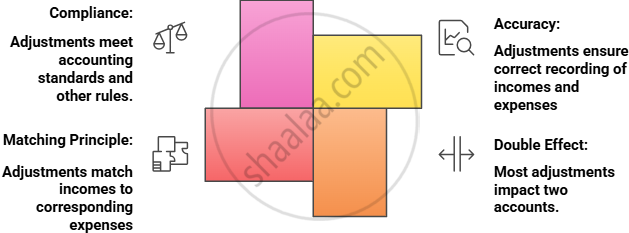
The main features of adjustments: they provide accuracy, affect two places in accounts, match incomes and expenses to the right period, ensure legal/practical compliance, and support clear financial reporting.
Test Yourself
Related QuestionsVIEW ALL [44]
Do you agree or disagree with the following statement:
Capital is excess of Liabilities over Assets.
Prepare trading and profit and loss account in the books of Ramasundari for the year ended 31st December, 2017 and balance sheet as on that date from the following information:
| Particulars | ₹ | Particulars | ₹ |
| Opening stock | 2,500 | Sales | 7,000 |
| Wages | 2,700 | Purchases | 3,300 |
| Closing Stock | 4,000 | Salary | 2,600 |
| Discount received | 2,500 | Capital | 52,000 |
| Machinery | 52,000 | Cash at Bank | 6,400 |
| Creditors | 8,000 |
From the following Receipts and Payments account of Sivakasi Pensioner’s Recreation Club, prepare income and expenditure account for the year ended 31st March, 2018 and the balance sheet as on that date.
| Dr. | Receipts and Payments Account for the year ended 31st March, 2018 | Cr. | ||
| Receipts | ₹ | ₹ | Payments | ₹ |
| To balance b/d | By Rent and rates | 18,000 | ||
| Cash in hand | 10,000 | By Electricity charges | 17,000 | |
| Cash at bank | 20,000 | 30,000 | By Furniture purchased | 12,000 |
| To Subscription | By Billiards table purchased | 70,000 | ||
| 2016 – 2017 | 5,000 | By Repairs and renewals | 16,000 | |
| 2017 – 2018 | 25,000 | By Special dinner expenses | 4,000 | |
| 2018 – 2019 | 6,000 | 36,000 | By Special dinner expenses | 2,000 |
| To Legacies | 40,000 | By Balance c/d | ||
| To Rent from hall | 14,000 | Cash in hand | 1,000 | |
| To Lockers rent | 5,000 | |||
| To Collection for special dinner | 12,000 | |||
| To Balance c/d | ||||
| Bank overdraft | 3,000 | |||
| 1,40,000 | 1,40,000 | |||
Additional information:
- The club had 300 members each paying ₹ 100 as annual subscription.
- The club had furniture ₹ 10,000 on 1.4.2017.
- The subscription still due but not received for the year 2016 – 2017 is ₹ 1,000.
