Topics
Introduction to Book-Keeping and Accountancy
- Accounting
- Book-Keeping
- Accountancy
- Book-Keeping vs. Accountancy
- Basis (Methods) of Accounting System
- Qualitative Characteristics of Accounting Information
- Basic Terms in Accounting
- Transaction
- Capital and Drawings
- Debtors, Creditors and Bad Debts
- Expenditure and Its Types
- Discount and Its Types
- Solvent Person vs. Insolvent Person
- Accounting Year
- Trading Concerns vs. Not for Profit Concerns
- Concept of Goodwill
- Fundamentals of Business Earnings
- Concepts of Assets, Liabilities and Net Worth
- Accounting Principles
- Accounting Concepts
- Core Accounting Concepts
- Accounting Standards
Meaning and Fundamentals of Double Entry Book-Keeping
Journal
- Accounting Documents
- Goods and Service Tax(GST)
- Types of Accounting Documents
- Voucher
- Tax Invoice (Under GST)
- Credit Memo
- Receipt
- Cheque
- Types of Cheques
- Books of Accounts
- Books of Accounts > Journal
- Journal Entries
- Journal Entries > Goods Account
- Journal Entries > Recording Discount in Journal
- Journal Entries > Other Important Journal Entries
Ledger
Subsidiary Books
- Concept of Subsidiary Books
- Cash Book
- Cash Book > Simple Cash Book (Single Column Cash Book)
- Cash Book > Two Column Cash Book (With Cash and Bank Columns)
- Cash Book > Petty Cash Book
- Simple Petty Cash Book
- Analytical Petty Cash Book
- Purchase Book
- Purchase Return Book
- Sales Book
- Sales Return Book
- Journal Proper
Bank Reconciliation Statement
- Accounting Documents Used in Banking
- Accounting Documents Used in Banking
- Pay-in-Slip
- Withdrawal Slip
- Bank Pass Book
- Bank Statement
- Bank Advice
- Concept of Virtual Banking
- Bank Reconciliation Statement(BRS)
- Cash Book vs Pass Book : Causes of Differences
- Time Difference(Regarding BRS)
- Errors and Omission Made by Bank or Businessman
- Formats of BRS
- Preparation of BRS
- Cash Book and Pass Book Comparison for Common Period
- Cash Book and Pass Book Balances for Different Periods
- Bank Balance as per Cash Book (Favourable / Debit Balance)
- Bank Balance as per Pass Book (Favourable / Credit Balance)
- Overdraft as per Cash Book (Unfavourable / Credit Balance)
- Overdraft as per Pass Book (Unfavourable/Debit balance)
- Reconciliation of Debtors and Creditors
Depreciation
Rectification of Errors
Final Accounts of a Proprietary Concern
Single Entry System
- Concept of Single Entry System
- Single Entry System vs. Double Entry System
- Parts of Single Entry System
- Statements of Affairs
- Statement of Profit or Loss
- Statement of Profit or Loss > Net Worth Method
- Practical Problems on Single Entry System
- Definition : Journal Entry
- Types
- Examples
Definition : Journal Entry
A journal entry is a short written record of a business transaction in the accounting books, showing which account is debited and which is credited, always following the double-entry system.
Types
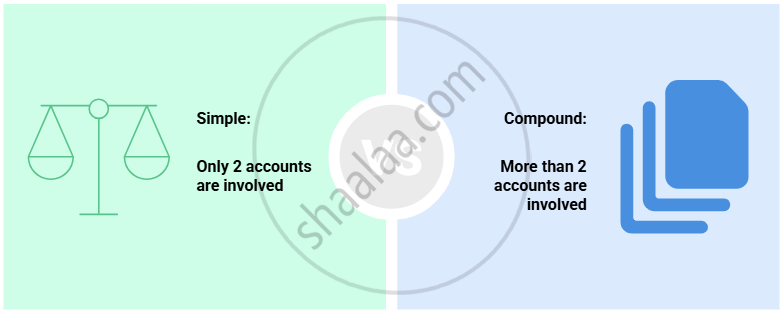
Examples
| Type of Journal Entry | Transaction | Journal Entry |
|---|---|---|
| Simple Entry | Purchased goods for cash ₹10,000 on 9th September, 2025. | Date: 2025/09/09 Purchases A/c Dr. ₹10,000 To Cash A/c ₹10,000 (Being goods purchased for cash) |
| Compound Entry | Paid rent of ₹5,000 and an electricity bill of ₹2,000 by cash on 10th September, 2025. | Date: 2025/09/10 Rent A/c Dr. ₹5,000 Electricity Expense A/c Dr. ₹2,000 To Cash A/c ₹7,000 (Being rent and electricity bill paid) |
Related QuestionsVIEW ALL [8]
From the following transactions of Shyam, a stationery dealer, pass journal entries for the month of August 2017.
| Aug. | Particulars |
| 1 | Commenced business with cash ₹ 4,00,000, Goods ₹ 5,00,000 |
| 2 | Sold goods to A and money received through RTGS ₹ 2,50,000 |
| 3 | Goods sold to Z on credit for ₹ 20,000 |
| 5 | Bill drawn on Z and accepted by him ₹ 20,000 |
| 8 | Bill received from Z is discounted with the bank for ₹ 19,000 |
| 10 | Goods sold to M on credit ₹ 12,000 |
| 12 | Goods distributed as free samples for ₹ 2,000 |
| 16 | Goods taken for office use ₹ 5,000 |
| 17 | M became insolvent and only 0.80 per rupee is received in final settlement |
| 20 | Bill of Z discounted with the bank is dishonoured |
Raja has a hotel. The following transactions took place in his business. Journalise them.
| Jan. | Particulars | ₹ |
| 1 | Started business with cash | 3,00,000 |
| 2 | Purchased goods from Rajiv on credit | 1,00,000 |
| 3 | Cash deposited with the bank | 2,00,000 |
| 20 | Borrowed loan from bank | 1,00,000 |
| 22 | Withdrew from bank for personal use | 800 |
| 23 | Amount paid to Rajiv in full settlement through NEFT | 99,000 |
| 25 | Paid club bill of the proprietor by cheque | 200 |
| 26 | Paid electricity bill of the proprietor’s house through debit card | 2,000 |
| 31 | Lunch provided at free of cost to a charity | 1,000 |
| 31 | Bank levied charges for locker rent | 1,000 |
Pass journal entries in the books of Sasi Kumar who is dealing in automobiles.
| 2017 Oct | Particulars | ₹ |
| 1 | Commenced business with goods | 40,000 |
| 3 | Cash introduced in the business | 60,000 |
| 4 | Purchased goods from Arul on credit | 70,000 |
| 6 | Returned goods to Arul | 10,000 |
| 10 | Paid cash to Arul on account | 60,000 |
| 15 | Sold goods to Chandar on credit | 30,000 |
| 18 | Chandar returned goods worth | 6,000 |
| 20 | Received cash from Chandar in full settlement | 23,000 |
| 25 | Paid salaries through ECS | 2,000 |
| 30 | Sasi Kumar took for personal use goods worth | 10,000 |
Mary is a rice dealer having business for more than 5 years. Pass journal entries in her books for the period of March, 2018.
| March | Particulars | ₹ |
| 1 | Cement bags bought on credit from Sibi | 20,000 |
| 2 | Electricity charges paid through net banking | 500 |
| 3 | Returned goods bought from Sibi | 5,000 |
| 4 | Cement bags taken for personal use | 1,000 |
| 5 | Advertisement expenses paid | 2,000 |
| 6 | Goods sold to Mano | 20,000 |
| 7 | Goods returned by Mano | 5,000 |
| 8 | Payment received from Mano through NEFT | 15,000 |
Journalise the following transactions in the books of Ramesh who is dealing in computers:
| 2018 March | Particulars |
| 1 | Ramesh started business with cash ₹ 3,00,000, Goods ₹ 80,000 and Furniture ₹ 27,000. |
| 2 | Money deposited into bank ₹ 2,00,000 |
| 3 | Bought furniture from M/s Jayalakshmi Furniture for ₹ 28,000 on credit. |
| 4 | Purchased goods from Asohan for ₹ 5,000 by paying through debit card. |
| 5 | Purchased goods from Guna and paid through net banking for cash ₹ 10,000 |
| 6 | Purchased goods from Kannan and paid through credit card ₹ 20,000 |
| 7 | Purchased goods from Shyam on credit for ₹ 50,000 |
| 8 | Bill drawn by Shyam was accepted for ₹ 50,000 |
| 9 | Paid half the amount owed to M/s Jayalakshmi Furniture by cheque |
| 10 | Shyam’s bill was paid |
Enter the following transactions in the journal of Manohar who is dealing in textiles:
| 2018 March | Particulars | ₹ |
| 1 | Manohar started business with cash | 60,000 |
| 2 | Purchased furniture for cash | 10,000 |
| 3 | Bought goods for cash | 25,000 |
| 6 | Bought goods from Kamalesh on credit | 15,000 |
| 8 | Sold goods for cash | 28,000 |
| 10 | Sold goods to Hari on credit | 10,000 |
| 14 | Paid Kamalesh | 12,000 |
| 18 | Paid rent | 500 |
| 25 | Received from Hari | 8,000 |
| 28 | Withdrew cash for personal use | 4,000 |
