Topics
Introduction to Book-Keeping and Accountancy
- Accounting
- Book-Keeping
- Accountancy
- Book-Keeping vs. Accountancy
- Basis (Methods) of Accounting System
- Qualitative Characteristics of Accounting Information
- Basic Terms in Accounting
- Transaction
- Capital and Drawings
- Debtors, Creditors and Bad Debts
- Expenditure and Its Types
- Discount and Its Types
- Solvent Person vs. Insolvent Person
- Accounting Year
- Trading Concerns vs. Not for Profit Concerns
- Concept of Goodwill
- Fundamentals of Business Earnings
- Concepts of Assets, Liabilities and Net Worth
- Accounting Principles
- Accounting Concepts
- Core Accounting Concepts
- Accounting Standards
Meaning and Fundamentals of Double Entry Book-Keeping
Journal
- Accounting Documents
- Goods and Service Tax(GST)
- Types of Accounting Documents
- Voucher
- Tax Invoice (Under GST)
- Credit Memo
- Receipt
- Cheque
- Types of Cheques
- Books of Accounts
- Books of Accounts > Journal
- Journal Entries
- Journal Entries > Goods Account
- Journal Entries > Recording Discount in Journal
- Journal Entries > Other Important Journal Entries
Ledger
Subsidiary Books
- Concept of Subsidiary Books
- Cash Book
- Cash Book > Simple Cash Book (Single Column Cash Book)
- Cash Book > Two Column Cash Book (With Cash and Bank Columns)
- Cash Book > Petty Cash Book
- Simple Petty Cash Book
- Analytical Petty Cash Book
- Purchase Book
- Purchase Return Book
- Sales Book
- Sales Return Book
- Journal Proper
Bank Reconciliation Statement
- Accounting Documents Used in Banking
- Accounting Documents Used in Banking
- Pay-in-Slip
- Withdrawal Slip
- Bank Pass Book
- Bank Statement
- Bank Advice
- Concept of Virtual Banking
- Bank Reconciliation Statement(BRS)
- Cash Book vs Pass Book : Causes of Differences
- Time Difference(Regarding BRS)
- Errors and Omission Made by Bank or Businessman
- Formats of BRS
- Preparation of BRS
- Cash Book and Pass Book Comparison for Common Period
- Cash Book and Pass Book Balances for Different Periods
- Bank Balance as per Cash Book (Favourable / Debit Balance)
- Bank Balance as per Pass Book (Favourable / Credit Balance)
- Overdraft as per Cash Book (Unfavourable / Credit Balance)
- Overdraft as per Pass Book (Unfavourable/Debit balance)
- Reconciliation of Debtors and Creditors
Depreciation
Rectification of Errors
Final Accounts of a Proprietary Concern
Single Entry System
- Concept of Single Entry System
- Single Entry System vs. Double Entry System
- Parts of Single Entry System
- Statements of Affairs
- Statement of Profit or Loss
- Statement of Profit or Loss > Net Worth Method
- Practical Problems on Single Entry System
- Definition: Journal
- Importance and Utility
- Format and Contents
- Example: Recording a Transaction in the Journal
- Definition: Casting
- Reasons for Casting of Journal
- Steps in Journal Casting
- Definition: Journalising
- Process of Journalising
- Key Takeaways
Definition : Journal
A journal is a book where every business transaction is recorded as soon as it happens.
Importance and Utility
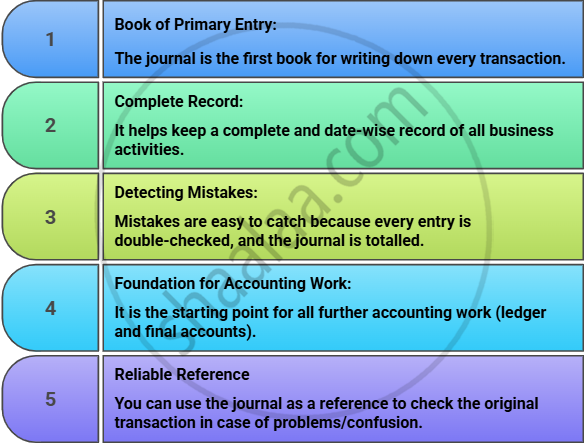
Format and Contents
| Date | Particulars | L.F. | Debit Amount ₹ | Credit Amount ₹ |
|---|---|---|---|---|
|
Year |
Account debited Dr. To (Account credited) (Being...) |
xxx |
xxx |
-
Date: The day the transaction happened.
-
Particulars: The accounts involved. Debit first, then credit with “To.”
-
L.F.: Page number in ledger (it is left blank if not posted yet).
-
Debit & Credit: Amount to be debited and credited for each account.
-
Narration: Short description of the entry inside brackets. It must start with the word "Being".
Example of a Journal Entry
Transaction: ₹5,000 rent paid in cash on 9th September, 2025
| Date | Particulars | L.F. | Debit Amount ₹ |
Credit Amount ₹ |
|---|---|---|---|---|
| 2025.09.09 | Rent A/c Dr. To Cash A/c (Being rent paid in cash) |
5,000 |
5,000 |
Definition : Casting
Casting means totalling up the amounts in the debit and credit columns of the journal—usually at the end of each page or section.
Reasons for Casting of Journal
-
You can confirm that the sum of all debits equals the sum of all credits (a basic rule in double-entry bookkeeping).
-
It is easier to detect calculation mistakes early, ensuring both sides are balanced.
Steps in Journal Casting
-
At the bottom of each journal page, write the total of all debit amounts and the total of all credit amounts.
-
If continuing to the next page, the amounts are carried forward as “Total c/f (carried forward)” and brought in as “Total b/f (brought forward)” on the new page.
-
On the final page, the “Grand Total” is written, and debits and credits must always match.
Definition : Journalising
Journalising is the process of recording business transactions in the journal as soon as they happen.
Process of Journalising
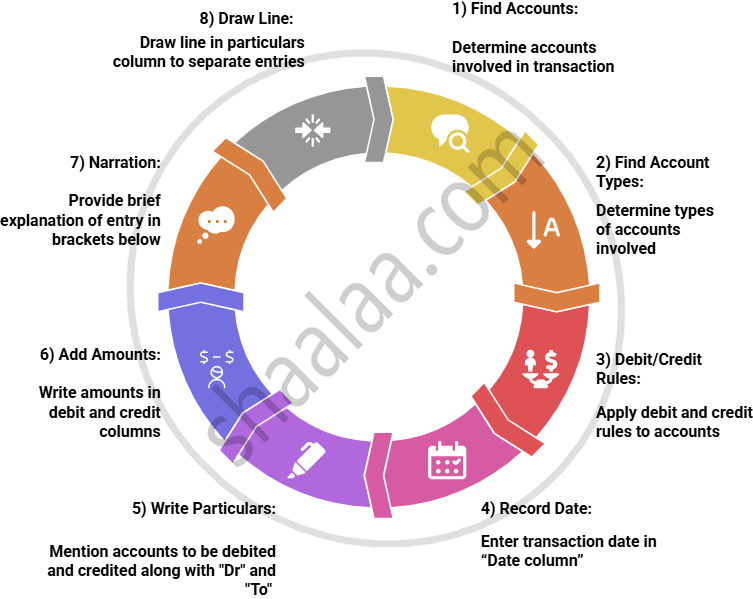
Key Takeaways
- The journal is the starting point of accounting. It helps make sure every rupee in the business is tracked, explained, and easy to find later!
-
Always record transactions from original documents like bills, receipts, or invoices—these are called source documents.
-
Every transaction will always affect at least two accounts: one is debited, and one is credited.
-
Write each journal entry with the date, accounts involved, amounts, and a short explanation (narration).
-
Totalling (casting) the journal regularly helps catch mistakes early—credits and debits should always balance.
-
Journalising means writing down each transaction in the journal in the correct format, step by step.
-
Good journal entries are important for making ledgers and final accounts later..
Related QuestionsVIEW ALL [32]
Journalise the following transactions in the books of Anand General Merchants.
|
2019 April |
|
| 1 | Mr. Anand started the business with cash ₹ 60,000. |
| 5 | Purchased goods for cash ₹ 30,000. |
| 7 | Sold goods of ₹ 10,000 to Suresh. |
| 10 | Purchased Furniture from Mr. Govind on credit ₹ 30,000. |
| 15 | Paid for Rent ₹ 3000 and paid by debit card. |
| 21 | Purchased goods from Urmila on credit ₹ 70,000. |
| 27 | Paid for Transport ₹ 1,000 to United Transport. |
| 30 | Paid to Urmila ₹ 20,000 on behalf of Sharmila. |
