Topics
Introduction to Partnership and Partnership Final Accounts
- Concept of Partnership
- Partnership Deed
- Provisions of the Indian Partnership Act, 1932
- Special Aspects of Partnership Accounts> Partner's Capital Account
- Partner's Capital Account> Fixed Capital Account
- Partner's Current Account
- Partner's Capital Account> Fluctuating Capital Account
- Examples on Partners’ Capital Accounts
- Partnership Final Accounts
- Trading Account
- Profit and Loss Account
- Balance Sheet
- Adjustments in Final Account
- Examples on Partnership Final Accounts
Introduction to Partnership
Accounts of ‘Not for Profit’ Concerns
Partnership Final Accounts
- Partnership Final Accounts
- Adjustments - Income Receivable
- Interest on Capital and Current Accounts
- Adjustments - Interest on Investment and Loans
- Adjustments - Goods Destroyed by Fire Or Accident (Insured Or Uninsured)
- Adjustments - Goods Stolen
- Adjustments of Financial Statements - Goods Distributed as Free Samples and Manager's Commission
- Adjustments - Goods Withdrawn by Partners
- Adjustments - Unrecorded Purchases and Sales
- Adjustments - Capital Expenditure Included in Revenue Expenses and Vice-versa
- Adjustments - Bills Receivable Dishonoured
- Adjustments - Bills Payable Dishonoured
- Adjustments - Deferred Expenses
- Adjustments - Capital Receipts Included in Revenue Receipts and Vice-versa
- Adjustments - Commission to Working Partner Managers on the Basis of Gross Profit Net Profit, Sales, Etc
Reconstitution of Partnership
- Modes of Reconstitution of a Partnership Firm
- Admission of Partner
- New Profit Sharing Ratio
- Methods of Valuation of Goodwill
- Admission of Partner> Adjustment of Capital
- Admission of Partner> Revaluation of Assets and Liabilities
- Admission of Partner> Accounting Treatment of Goodwill
- Retirement of Partner
- Needs of Retirement Or Death of a Partner
- Retirement/Death of a Partner> Treatment of Goodwill
- Retirement/Death of a Partner> Revaluation of Assets and Liabilities
- Retirement/Death of a Partner> New Profit Sharing Ratio
Reconstitution of Partnership (Admission of Partner)
- Reconstitution of Partnership
- Admission of Partner
- New Profit Sharing Ratio
- Sacrificing Ratio
- Admission of Partner> Accounting Treatment of Goodwill
- Average Profit Method
- Super Profit Method
- Admission of Partner> Reserves and Accumulated Profit/Losses
- Admission of Partner> Revaluation of Assets and Liabilities
- Admission of Partner> Adjustment of Capital
- Examples on Admission of Partner
Reconstitution of Partnership (Retirement of Partner)
- Retirement of Partner
- Retirement/Death of a Partner> New Profit Sharing Ratio
- Retirement/Death of a Partner> Gaining Ratio
- Retirement/Death of a Partner> Treatment of Goodwill
- Hidden Goodwill
- Retirement/Death of a Partner> Reserves and Accumulated Profits/Losses
- Retirement/Death of a Partner> Revaluation of Assets and Liabilities
- Retirement/Death of a Partner> Adjustment of Capitals
- Computation of Amount Due to the Retiring Partner
- Payment of Amount due to Retiring Partner
- Examples on Retirement of Partner
Dissolution of Partnership Firm
Accounts of “Not for Profit” concerns
- Concept of Non-Profit Concerns
- Receipts and Payments Account
- Additional Information - Prepaid Expenses of the Current and Previous Year
- Additional Information - Subscription Received in Advance
- Additional Information - Subscription Outstanding of the Current and Previous Year
- Additional Information - Capitalisation of Entrance Fees
- Additional Information - Creation of Special Funds Out of Donations
- Additional Information - Stock of Stationery
- Additional Information - Opening Balances of Assets and Liabilities
- Income and Expenditure Account
Reconstitution of Partnership (Death of Partner)
- Death of Partner
- Retirement/Death of a Partner> New Profit Sharing Ratio
- Retirement/Death of a Partner> Gaining Ratio
- Retirement/Death of a Partner> Revaluation of Assets and Liabilities
- Determination of Amount due to the Deceased Partner
- Settlement of Amount Payable to the Deceased Partner
- Examples on Death of Partner
Single Entry System
- Concept of Single Entry System
- Statements of Affairs
- Additional Information - Additional Capital
- Effects of Adjustments-Drawings
- Concept of Depreciation
- Additional Information - Undervaluation of Assets and Liabilities
- Additional Information - Overvaluation of Assets and Liabilities
- Interest on Capital and Current Accounts
- Additional Information - Partners Salary
- Illustrations of Single Entry System
Dissolution of Partnership Firm
- Concept of Dissolution of Partnership Firm
- Difference Between Dissolution of Partnership and Dissolution of Firm
- Accounting at the Time of Dissolution of a Firm
- Types of Firm Dissolution> Simple Dissolution
- Accounting Entries To Close The Books Of Accounts
- Transfer Stage
- Realisation/Disposal Stage
- Distribution Stage
- Treatment of Unrecorded (Undisclosed) Assets and Liabilities
- Process of Dissolution> Valuation of Goodwill
- Process of Dissolution> Realisation Account
- Examples on Simple Dissolution
- Types of Firm Dissolution> Dissolution under Insolvency Situation
- When One Partner Becomes Insolvent
- When Two Partners Become Insolvent
- When All Partners Are Insolvent
Bill of Exchange (Only Trade Bill)
- Necessity of Bill of Exchange (Only Trade Bill)
- Acceptance
- Concept of Bills of Exchange
- Honouring and Dishonouring of Bill of Exchange
- Accounting Treatment> Discounting the Bill of Exchange
- Accounting Treatment> Retaining the Bill till the Due Date
- Accounting Treatment> Endorsement of Bill of Exchanges
- Accounting Treatment > Bills Sent to Bank for Collection
- Insolvency of Drawee
- Retirement of Bill under Rebate
- Accounting at the Time of Dissolution of a Firm
- Examples on Bills of Exchange
Bills of Exchange
- Credit Transactions
- Concept of Bills of Exchange
- Acceptance
- Due Date
- Promissory Note
- Honouring and Dishonouring of Bill of Exchange
- Classification of Bills for Accounting
- Accounting Treatment> Retaining the Bill till the Due Date
- Accounting Treatment> Discounting the Bill of Exchange
- Accounting Treatment> Endorsement of Bill of Exchanges
- Accounting Treatment > Bills Sent to Bank for Collection
- Renewal Bill of Exchange
- Retirement of Bill under Rebate
- Insolvency of Drawee
- Examples on Bills of Exchange
Company Accounts
- Concept of Shares
- Shareholder's Fund> Share Capital of a Company
- Private Placement of Shares
- Terms of Issue of Shares> Issue of Shares at Par
- Under Subscription of Shares
- Over Subscription of Shares
- Types of Share Issue
- Forfeiture of Shares
- Concept of Debentures
- Terms of Issue of Debentures> Issue of Debentures at Par
- Issue of Debentures for Consideration Other than Cash
- Interest on Debentures
Company Accounts - Issue of Shares
- Joint Stock Company
- Concept of Shares
- Kinds of Shares> Equity Shares
- Kinds of Shares> Preference Shares
- Shareholder's Fund> Share Capital of a Company
- Treatment of Share Capital in Balance Sheet
- Methods of Issue of Share Capital
- Terms of Issue of Shares> Issue of Shares at Par
- Terms of Issue of Shares> Issue of Shares at Premium
- Terms of Issue of Shares> Issue Shares at Discount
- Over Subscription of Shares
- Pro-rata Allotment
- Under Subscription of Shares
- Calls-In-Arrears
- Calls-In-Advance
- Issue of Shares for Consideration other than Cash
- Forfeiture of Shares
- When Shares Were Originally Issued at a Premium
- When Shares Were Originally Issued at Discount
- Reissue of Forfeited Shares
Analysis of Financial Statements
- Comparative Financial Statement
- Common-Size Statement
- Concept of Cash Flow Statement
- Quick Ratio/Acid Test Ratio/Liquid Ratio
- Classification of Ratios> Income Statement Ratio
- Classification of Ratios> Combined/Mixed Ratio
- ROCE
Analysis of Financial Statements
- Concept of Financial Statements
- Concept of Financial Statement Analysis
- Formats of Financial Statement Analysis
- Tools of Analysis of Financial Statements
- Comparative Financial Statement
- Comparative Balance Sheet
- Comparative Income Statement
- Common-Size Statement
- Common Size Balance Sheet
- Common-Size Income Statement
- Concept of Cash Flow Statement
- Preparation of Cash Flow Statement
- Concept of Ratio Analysis
- Current Ratios/Working Capital Ratios
- Quick Ratio/Acid Test Ratio/Liquid Ratio
- Gross Profit Ratio
- Net Profit Ratio
- Operating Profit Ratio
- Operating Ratio
- Return on Investment
- Return on Capital Employed
Computer In Accounting
- Introduction
- Definition: Depreciation
- Origin and Meaning of the Word “Depreciation”
- Exceptions to Depreciation
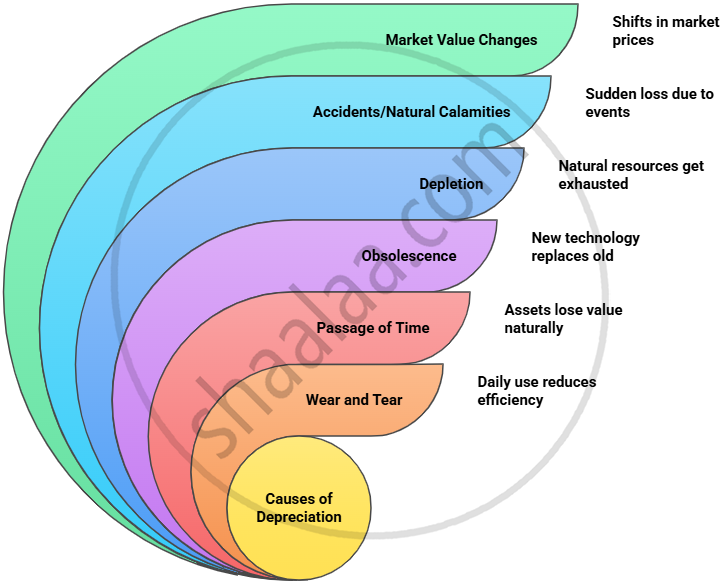
- Causes of Depreciation
- Examples: Causes of Depreciation
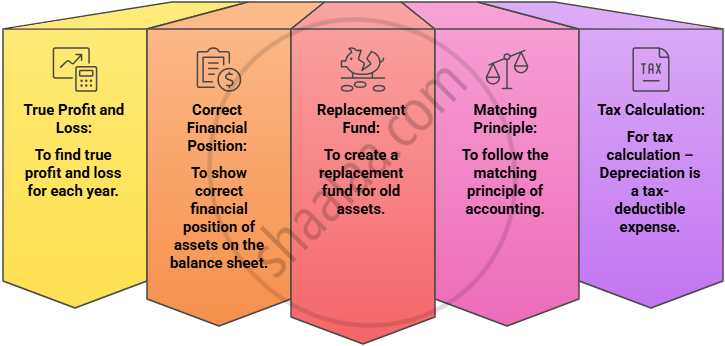
- Importance of Charging Depreciation
- Examples: Importance of Charging Depreciation
- Conditions for Charging Depreciation
- Depreciation vs. Provisions vs. Reserves
- Examples: Depreciation vs. Provisions vs. Reserves
- Key Takeaways
Maharashtra State Board: Class 11
Introduction
- In business, many assets like buildings, machinery, vehicles, and computers are used for several years.
- Over time, these assets lose value because of use, age, or new technology.
- This reduction in value is called depreciation.
- In accounting, depreciation means distributing the cost of an asset over the years it is used.
- Instead of recording the whole cost of a machine at once, a part of its cost is charged every year as an expense.
- This helps show the true profit of the business for each year and reflects the real value of assets on the balance sheet.
Maharashtra State Board: Class 11
Definition : Depreciation
Depreciation means a gradual decrease in the value of fixed assets like buildings, machinery, furniture, and equipment due to their use, passage of time, or technological changes.
Maharashtra State Board: Class 11
Origin and Meaning of the Word “Depreciation”
- The word “depreciation” comes from the Latin term depretiare, which means to lower in price (from “de” = down and “pretium” = price).
- Originally, it referred to the reduction in the value or price of something over time.
- In accounting, it means reducing the value of an asset every year as it’s used.
Maharashtra State Board: Class 11
Exceptions to Depreciation
Some assets do not depreciate in value. Instead, they may remain stable or even appreciate (increase in value) over time.
| Asset | Reason for Exception |
|---|---|
| Land | It does not wear out or get used up. In many cases, its value increases with demand. |
| Antiques and Artworks | Their value often increases with time due to rarity and appreciation. |
| Livestock and Plantations | These are living assets and are valued differently. |
| Assets held for investment | Such assets (like shares) are not used for operations and hence not depreciated. |
Note: Depreciation applies mainly to tangible fixed assets that have a limited useful life — like machinery, equipment, vehicles, or furniture.
Maharashtra State Board: Class 11
Causes of Depreciation
Maharashtra State Board: Class 11
Examples : Causes of Depreciation
| Cause | Example |
|---|---|
| Wear and Tear | Machine parts wearing out due to friction. |
| Passage of Time | Patents expiring after their term. |
| Obsolescence | Old computers replaced by faster ones. |
| Depletion | Mines, oil wells, forests. |
| Accidents/Natural Calamities | Machinery damaged in a fire. |
| Market Value Changes | Fall in land or building prices. |
Maharashtra State Board: Class 11
Importance of Charging Depreciation
Maharashtra State Board: Class 12
Examples : Importance of Charging Depreciation
| Point | Example |
|---|---|
| To find true profit and loss | A bakery buys an oven for ₹1,00,000. Every year, it records part of its value as an expense, so profits aren’t overstated. |
| To show correct financial position | A school's bus gets older and loses value over time. This is shown in the accounts, so assets aren’t inflated. |
| To create a replacement fund | A delivery company sets aside money by charging depreciation so it can buy new vehicles when old ones wear out. |
| To follow the matching principle | A shop uses a computer for three years. The cost is spread over three years to match the revenue earned each year. |
| For tax calculation | A factory claims depreciation as an expense, which reduces taxable income and saves on taxes. |
Maharashtra State Board: Class 11
Conditions for Charging Depreciation
| Condition | Explanation | Reason |
|---|---|---|
| The asset should have a measurable cost | Includes purchase price, transport, and installation costs. | Without knowing the cost, we can’t calculate how much value decreases over time. |
| It should have a limited useful life | It will wear out or become obsolete over time. | Only assets that eventually wear out or become outdated need depreciation. |
| The reduction in value must be permanent and gradual | Not temporary or accidental. | Depreciation is for long-term loss, not for short-term damage or one-time events. |
| Depreciation must be charged every year | Whether the business earns profit or incurs a loss. | Asset value falls every year, no matter how the business performs. |
| The asset must be used in business operations | Depreciation cannot be claimed on unused or personal assets. | Only assets used to earn business income should be depreciated. |
Maharashtra State Board: Class 12
Depreciation vs. Provisions vs. Reserves
| Basis | Depreciation | Provision | Reserve |
|---|---|---|---|
| Meaning | Fall in asset value | Amount kept for known liability | Amount from profits for general purpose |
| Type | Expense | Liability | Appropriation of profit |
| Accounting Entry | Charged to expense | Deducted before profit | Deducted after profit determination |
Maharashtra State Board: Class 12
Examples : Depreciation vs. Provisions vs. Reserves
| Concept | Example |
|---|---|
| Depreciation | A school buys a bus for ₹5,00,000. Each year, its value decreases due to use, so the school records depreciation to show the bus is getting older and less valuable. |
| Provision | A shop expects that some customers will not pay their bills. Each year, it sets aside money (provision for bad debts) to cover these possible losses. |
| Reserve | After earning profit, a business keeps aside part of it (general reserve) so they can use it later for expansion or emergencies, like opening a new branch. |
Maharashtra State Board: Class 11
Key Takeaways
- Depreciation is the gradual decrease in the value of assets like machinery or vehicles due to use, time, or technology changes.
- The word "depreciation" comes from Latin and means "to lower in price."
- Land, antiques, and investments are not depreciated because their value typically doesn’t fall with use.
- Depreciation is applied only if the asset has a measurable cost, a limited useful life, and is used in business operations, with loss in value being permanent and gradual and charged every year.
- Charging depreciation helps show true profit or loss, accurate asset values, replacement fund creation, matching cost to revenue, and proper tax calculation.
- Depreciation must be charged annually as assets lose value regardless of business performance.
- Depreciation, provision, and reserve are different: depreciation is an expense for asset value loss; provision is money set aside for expected liabilities; reserve is saved profit for future use.
