Topics
Introduction to Book-Keeping and Accountancy
- Accounting
- Book-Keeping
- Accountancy
- Book-Keeping vs. Accountancy
- Basis (Methods) of Accounting System
- Qualitative Characteristics of Accounting Information
- Basic Terms in Accounting
- Transaction
- Capital and Drawings
- Debtors, Creditors and Bad Debts
- Expenditure and Its Types
- Discount and Its Types
- Solvent Person vs. Insolvent Person
- Accounting Year
- Trading Concerns vs. Not for Profit Concerns
- Concept of Goodwill
- Fundamentals of Business Earnings
- Concepts of Assets, Liabilities and Net Worth
- Accounting Principles
- Accounting Concepts
- Core Accounting Concepts
- Accounting Standards
Meaning and Fundamentals of Double Entry Book-Keeping
Journal
- Accounting Documents
- Goods and Service Tax(GST)
- Types of Accounting Documents
- Voucher
- Tax Invoice (Under GST)
- Credit Memo
- Receipt
- Cheque
- Types of Cheques
- Books of Accounts
- Books of Accounts > Journal
- Journal Entries
- Journal Entries > Goods Account
- Journal Entries > Recording Discount in Journal
- Journal Entries > Other Important Journal Entries
Ledger
Subsidiary Books
- Concept of Subsidiary Books
- Cash Book
- Cash Book > Simple Cash Book (Single Column Cash Book)
- Cash Book > Two Column Cash Book (With Cash and Bank Columns)
- Cash Book > Petty Cash Book
- Simple Petty Cash Book
- Analytical Petty Cash Book
- Purchase Book
- Purchase Return Book
- Sales Book
- Sales Return Book
- Journal Proper
Bank Reconciliation Statement
- Accounting Documents Used in Banking
- Accounting Documents Used in Banking
- Pay-in-Slip
- Withdrawal Slip
- Bank Pass Book
- Bank Statement
- Bank Advice
- Concept of Virtual Banking
- Bank Reconciliation Statement(BRS)
- Cash Book vs Pass Book : Causes of Differences
- Time Difference(Regarding BRS)
- Errors and Omission Made by Bank or Businessman
- Formats of BRS
- Preparation of BRS
- Cash Book and Pass Book Comparison for Common Period
- Cash Book and Pass Book Balances for Different Periods
- Bank Balance as per Cash Book (Favourable / Debit Balance)
- Bank Balance as per Pass Book (Favourable / Credit Balance)
- Overdraft as per Cash Book (Unfavourable / Credit Balance)
- Overdraft as per Pass Book (Unfavourable/Debit balance)
- Reconciliation of Debtors and Creditors
Depreciation
Rectification of Errors
Final Accounts of a Proprietary Concern
Single Entry System
- Concept of Single Entry System
- Single Entry System vs. Double Entry System
- Parts of Single Entry System
- Statements of Affairs
- Statement of Profit or Loss
- Statement of Profit or Loss > Net Worth Method
- Practical Problems on Single Entry System
- Introduction to Modern Approach
- Traditional Approach vs. Modern Approach
- Chart Showing Classification of Accounts
- Rules for Recording Changes in Assets/Expenses/Losses
- Rules for Recording Changes in Liabilities/Capital/Revenue/Gains
- Examples
- Key Takeaways
Introduction to Modern Approach
What Is It?
The Modern Approach (also called the Accounting Equation Approach) classifies every account into five simple groups based on the effect on the business:
-
Assets—What the business owns (cash, building, furniture)
-
Liabilities—What the business owes (loan, creditors)
-
Capital—Owner’s money invested in the business
-
Income/Revenue—Money earned (sales, commission)
-
Expenses/Losses—Money spent or losses incurred (rent, salary)
The Base Equation
- Assets = Liabilities + Capital
- If we include income and expenses:
Assets = Liabilities + Capital + Revenue – Expenses
Every transaction will affect at least two of these categories.
Why Modern Approach?
-
Globally Accepted: Aligns with international accounting standards.
-
Balances Statements: Directly supports the preparation of financial statements.
-
Logical Structure: Each transaction relates naturally to the business's financial condition.
-
Simplifies Learning: Five clear categories and rules, removing the confusion of older systems.
Traditional Approach vs. Modern Approach
|
Aspect |
Traditional Approach |
Modern Approach |
|---|---|---|
|
Basis of Classification |
Account Types (Personal, Real, Nominal) |
Accounting Equation (Assets, Liabilities, Capital, Income, Expenses) |
|
Main Categories |
|
|
|
Rules for Debit/Credit |
“Golden rules”:
|
Rule is based on category:
|
|
Conceptual Foundation |
Simpler, historical roots (British system); focus on the “type” of account |
Based on the accounting equation (Assets = Liabilities + Capital), it aligns with global standards (IFRS/Ind AS) and is better for financial reporting |
|
Usage/Adoption |
Older, still taught for conceptual clarity; used in small businesses or legacy systems (old/outdated accounting system/software) |
Widely used globally, especially in modern computerized and international accounting systems |
Chart Showing Classification of Accounts

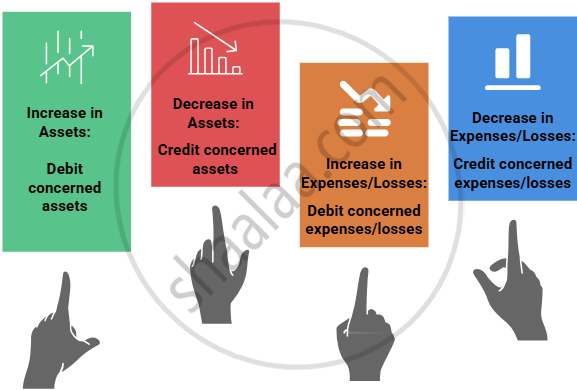
Rules for Recording Changes in Assets/Expenses/Losses
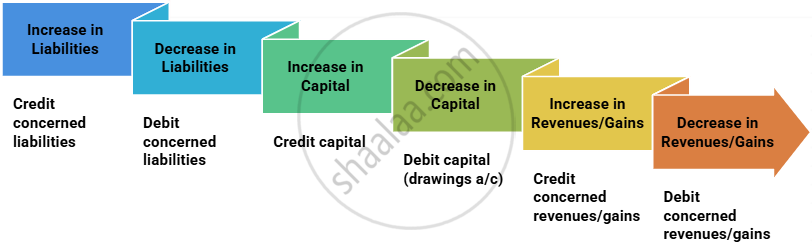
Rules for Recording Changes in Liabilities/Capital/Revenue/Gains
Examples
|
Example |
Change |
Application of Rule |
|---|---|---|
|
Buying a computer for business: ₹40,000 |
Increase in asset (computer) Decrease in asset (cash) |
Debit Computer A/c Credit Cash A/c |
|
Selling old furniture for ₹5,000 |
Decrease in asset (furniture)
|
Debit Cash A/c
Credit Furniture A/c |
|
Paying office rent ₹10,000 |
Increase in expense (rent) Decrease in asset (cash) |
Debit Rent Expense A/c
Credit Cash A/c |
|
Insurance claim received for repair cost ₹2,000 |
Decrease in expense/loss (repair expense)
Increase in asset (cash at bank) |
Debit Bank A/c
Credit Repair Expense A/c |
|
Taking a bank loan ₹1,00,000 |
Increase in liability (bank loan) Increase in asset (cash) |
Debit Cash A/c Credit Loan Payable A/c |
|
Repaying creditor ₹20,000 |
Decrease in liability (creditor) Decrease in asset (cash) |
Debit Creditors A/c Credit Cash A/c |
|
Owner invests additional ₹50,000 |
Increase in capital Increase in asset (cash) |
Debit Cash A/c Credit Capital A/c |
|
Owner withdraws ₹5,000 cash for personal use |
Decrease in capital Decrease in asset (cash) |
Debit Drawings A/c Credit Cash A/c |
|
Selling goods for ₹15,000 |
Increase in revenue (sales) Increase in asset (cash) |
Debit Cash A/c Credit Sales A/c |
|
Sales return from customer: ₹2,000 |
Decrease in revenue (as the product/service sold,has been returned and the customer won't pay us money for it) Decrease in asset (debtors, because money cannot be recovered from that customer)
|
Debit Sales Return A/c
Credit Debtors A/c |
Key Takeaways
- Only 5 Types of Accounts—Assets, Liabilities, Capital, Income, and Expenses/Losses.
- Based on Accounting Equation -
Assets = Liabilities + Capital (+ Revenue − Expenses). - This method is used worldwide and is easier for preparing modern financial statements.
