मराठी

Measurement of Elasticity of Supply

Advertisements

Topics

  • Introduction
  • Percentage Method
  • Problem 1
  • Problem 2
  • Problem 3
  • Problem 4
  • Problem 5
  • Problem 6
  • Problem 7
  • Problem 8
  • Geometric Method
  • Time Period and Elasticity
  • Real-Life Application
CISCE: Class 12

Introduction

Elasticity of supply shows how much the quantity supplied changes when price changes.

CISCE: Class 12

Percentage Method

Meaning:
Elasticity of supply (Es) by the percentage method is the ratio of the percentage change in quantity supplied to the percentage change in price.

Formula:
\[E_s=\frac{\frac{\Delta q_s}{q_s}}{\frac{\Delta P}{P}}=\frac{\Delta q_s}{\Delta P}\times\frac{P}{q_s}\]

  • Δqs = Change in quantity supplied
  • qs = Original quantity supplied
  • ΔP = Change in price
  • P = Original price

Stepwise Explanation:

  1. Find the original and new quantity supplied and price.
  2. Calculate the change for quantity and price.
  3. Plug values into the formula.
CISCE: Class 12

Problem 1

If an increase in the price of a ballpoint pen from ₹40 to ₹50 results in an increase in quantity supplied from 1,000 to 1,500, what is the elasticity of supply?

Solution:
Q = 1,000
ΔQ = 1,500 - 1,000 = 500
P = 40
ΔP = 50 - 40 = 10

es = `(ΔQ)/(ΔP) xx P/Q`

= `(ΔQ)/(ΔP) xx P/Q`

= `500/10 xx 40/1000` = 2

CISCE: Class 12

Problem 2

The price of a commodity is ₹10 per unit and quantity supplied is 500 units. If price falls by 10% and quantity supplied falls to 400 units, calculate its price elasticity of supply.

Solution:
% change in quantity supplied = `500 - 400/500 xx 100` = `100/500 xx 100`

es = `"% Change in quantity supplied"/"% Change in price"` = `20/10` = 2

CISCE: Class 12

Problem 3

A producer supplies 200 units of a good at ₹10 per unit. Price elasticity of supply is 2. How many units will the producer supply at ₹11 per unit. 

Solution:

es = `(ΔQ)/(ΔP) xx P/Q`

2 = `(ΔQ)/11-10 xx 10/200` =`(ΔQ)/1 xx 10/200`

2 = `Q/20`

ΔQ = 2 × 20 = 40

Therefore, the producer will supply 200 + 40 = 240 units at ₹11 per unit. 

CISCE: Class 12

Problem 4

The quantity supplied of a commodity at a price ₹8 per unit is 400 units. Its price elasticity is 2. Calculate the price at which its quantity supplied will be 600 units. 

Solution:

es = `(ΔQ)/(ΔP) xx P/Q`

2 = `(600-400)/(ΔP) xx 8/400` = `200/(ΔP) xx 1/50` = `4/(ΔP)`

ΔP = `4/2` = 2

∴ New price = 8 + 2 = ₹10.

CISCE: Class 12

Problem 5

A producer supplies 400 units of a commodity at no per unit. Price elasticity of supply is 1.25. How many units will the producer supply at ₹20 per unit?

Solution:

es = `(ΔQ)/(ΔP) xx P/Q`

1.25 = `(ΔQ)/20-10 xx 10/400` = `(ΔQ)/10 xx 10/400` = `(ΔQ)/400`

ΔQ = 400 x 1.25 = 500

∴ The producer will supply = Q + ΔQ = 400 + 500 = 900 units 

CISCE: Class 12

Problem 6

With a fall in the price of a commodity from ₹10 per unit to ₹8 per unit, the quantity supplied of the commodity falls by 500 units. The price elasticity of supply is 2. Calculate the quantity supplied of this commodity at the price of ₹8 per unit. 

Solution:

Here P = 10, P1 = 8, ΔP = 10 - 8 = 2, ΔQ = 500, es = 2 

es = `(ΔQ)/(ΔP) xx P/Q`

2 = `500/2 xx 10/Q` = `2500/Q`

Q = `2500/2` = 2500

∴ Quantity supplied at the price of ₹8 per unit = 1250 - 500 = 750 units

CISCE: Class 12

Problem 7

500 units of a commodity are supplied at a price of ₹5 per unit. At what price 600 units of the commodity will be supplied? The price elasticity of supply is 1.

Solution:

Here, P = 5, Q = 500, Q1 = 600, ΔQ = 600 - 500 = 100 units, es = 1

es = `(ΔQ)/(ΔP) xx P/Q`

1 = `100/(ΔP) xx 5/500` = `1/(ΔP)`

(ΔP) = 1

∴ New price = P + ΔP = 5 + 1 = 6
∴ 600 units of the commodity will be supplied at ₹6 per unit. 

CISCE: Class 12

Problem 8

Given es = 3, P = 40, P1 = 42, ΔQ = 150. How many units of the commodity will be supplied at P1 price.

Solution:

es = `(ΔQ)/(ΔP) xx P/Q`

3 = `150/(42-40) xx 40/Q` = `3000/Q`

Q = `3000/3` = 1000

Quantity supplied at the price of ₹42 per unit = Q + ΔQ = 1000 + 150 = 1150 units

CISCE: Class 12

Geometric Method

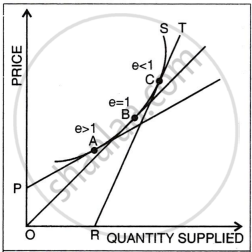
Diagram:

  • See the supply curve graph below.
  • Draw tangents at various points:
    If tangent passes through the origin: Es=1 (Unitary elastic)
    If tangent cuts the Y-axis: Es>1 (Elastic)
    If tangent cuts the X-axis: Es<1 (Inelastic)

CISCE: Class 12

Time Period and Elasticity

Elasticity of supply depends on time:

  1. Short Period: Supply is usually less elastic; producers can’t change output quickly.
  2. Long Period: Supply is more elastic; producers have time to adjust.
CISCE: Class 12

Real-Life Application

  • Imagine a farmer who grows wheat. If the price of wheat rises, the farmer might plant more wheat next season. The percentage method helps us measure how much more wheat the farmer produces due to a price change.
  • Think of the supply curve as a slope. Where the curve is flatter, supply is less elastic. Where it's steeper, supply is more elastic.

Test Yourself

Advertisements
Share
Notifications

Englishहिंदीमराठी


      Forgot password?
Use app×