Topics
National Income and Related Aggregates
- Macroeconomics Vs Microeconomics
- Representative Goods and Sectors
- Macroeconomic Agents and Government Role
- Emergence of Macroeconomics
- Context of the Present Book of Macroeconomics
- Meaning of Economic Wealth and Final Goods
- Stocks, Flows, and Depreciation
- Capital Formation, Trade-off & Circular Flow of Income
- Circular Flow of Income and Methods of Calculating National Income
- Output Method/Product Method
- Expenditure Method
- Income Method
- Factor Cost, Basic Prices and Market Prices
- Some Macroeconomic Identities
- National Disposable Income
- Private Income
- National Income Aggregates
- Real GDP and Nominal GDP
- GDP and Welfare
Introductory Macroeconomics
Introduction
- A Simple Economy
- Central Problems of an Economy
- Concepts of Production Possibility Frontier
- Organisation of Economic Activities
- Positive and Normative Economics
- Macroeconomics Vs Microeconomics
Development Experience (1947-90) and Economic Reforms since 1991
- India's Economy Before Independence
- Low Level of Economic Development Under the Colonial Rule
- Agricultural Sector in India
- Industrial Sector
- Foreign Trade of India
- Demographic Condition
- Occupational Structure
- Infrastructure
- Post-Independence Economic Systems and Planning
- Five Year Plans (FYP)
- Agriculture
- Industry and Trade
- Trade Policy: Import Substitution
- The 1991 Economic Crisis and Reforms
- Background of the New Economic Policy
- Liberalisation
- Privatisation
- Globalisation
- World Trade Organisation (WTO)
- Impact of the Economic Reforms
Money and Banking
- Concept of Money
- Functions of Money
- Demand for Money and Supply of Money
- Money Creation by Banking System
- Limits to Credit Creation and Money Multiplier
- Policy Tools To Control Money Supply
- Demand and Supply for Money : A Detailed Discussion
- The Transaction Motive
- The Speculative Motive
- Various Measures of Supply of Money
- Narrow and Broad Money
- Demonetisation
Theory of Consumer Behaviour
- Consumer Behaviour: The Problem of Choice
- Basic Concepts of Microeconomics > Utility
- Cardinal Approach (Utility Analysis)
- Derivation of Demand Curve in the Case of a Single Commodity
- Ordinal Utility Analysis/Indifference Curve Analysis
Indian Economic Development
Current Challenges Facing Indian Economy
- Concept of Human Capital
- Sources of Human Capital
- Human Capital and Economic Growth
- Human Capital and Human Development
- State of Human Capital Formation in India
- Growth of Education Sector in India
- Challenges and Future Prospects in Education
- Rural Development in India
- Credit and Marketing in Rural Areas
- Agricultural Market System
- Diversification into Productive Activities
- Sustainable Development and Organic Farming
- The Nature and Importance of Work in Society
- Workers and Employment
- Participation of People in Employment
- Self-employed and Hired Workers
- Employment in Firms, Factories and Offices
- Growth and Changing Structure of Employment
- Informalisation of Indian Workforce
- Concept of Unemployment
- Government and Employment Generation
- Environment and Sustainable Development in India
- State of India’s Environment
- Concept of Sustainable Development
- Strategies for Sustainable Development
Development Experience of India – a Comparison with Neighbours
Determination of Income and Employment
- Aggregate Demand and Its Components
- Consumption
- Investment
- Determination of Income in Two-sector Model
- Determination of Equilibrium Income in the Short Run
- Macroeconomic Equilibrium with Price Level Fixed
- Effect of an Autonomous Change in Aggregate Demand on Income and Output
- The Multiplier Mechanism
- Paradox of Thrift
- Equilibrium Output and Employment
Introductory Microeconomics
Production and Costs
- Production Function
- Concept of Production
- Some Basic Concepts - Total, Average and Marginal Physical Products
- Relation Between Total, Average and Marginal Product
- Law of Variable Proportions
- Average and Marginal Physical Products
- Changes in Production
- Fixed Cost and Variable Cost
- Behaviour of Cost in the Short - Run
- Relationship Between Average Variable Cost and Average Total Cost and Marginal Cost
- Opportunity Cost
- Revenue Concepts
- Producer's Equilibrium
- Law of Supply
- Supply Schedule
- Distinction Between Supply and Stock
- Determinants of Supply
- Movement Along the Supply Curve Or Expansion and Contraction of Supply
- Measurement of Elasticity of Supply > Percentage Method
- Methods of Measurement of National Income
- Marginal Cost (MC)
- The Law of Diminishing Marginal Product
- Shapes of Product Curves
- Costs in Long Run Period
- Returns to Scale
Government Budget and the Economy
The Theory of the Firm Under Perfect Competition
- Concept of Market
- Market Equilibrium
- Determination of Market Equilibrium
- Effects of Changes (Shifts) in Demand on Equilibrium Price and Equilibrium Quantity
- Perfect Competition
- Imperfect Competition
- Factors Determining Market Forms
- Oligopoly
- Market Forms - Perfect Oligopoly
- Market Forms - Imperfect Oligopoly
- Equilibrium Price
- Applications of Tools of Demand and Supply Price Control
- Price Ceiling
- Price Floor
- Revenue Concepts
- Profit Maximisation Objective
- Determinants of a Firm’s Supply Curve
- Supply Schedule
- Price Elasticity of Supply
Balance of Payments
- Open Economy and Its Linkages
- Concept of Balance of Payments
- Current Account
- Capital Account
- Balance of Payments Surplus and Deficit
- Foreign Exchange Market
- Foreign Exchange Rate
- Determination of the Exchange Rate
- Merits and Demerits of Flexible and Fixed Exchange Rate Systems
- Managed Floating Exchange Rate System
Market Equilibrium
- Simple Monopoly in the Commodity Market
- Other Non - Perfectly Competitive Markets
Estimated time: 15 minutes
CBSE: Class 12
National Testing Agency: Class 12
National Testing Agency: Class 12
Circular Flow of Income
- Circular flow of income is the unending flow of production, income, and expenditure between sectors of an economy.
- Income circulates continuously - firms pay factor incomes to households, and households spend that income back on goods and services produced by firms.
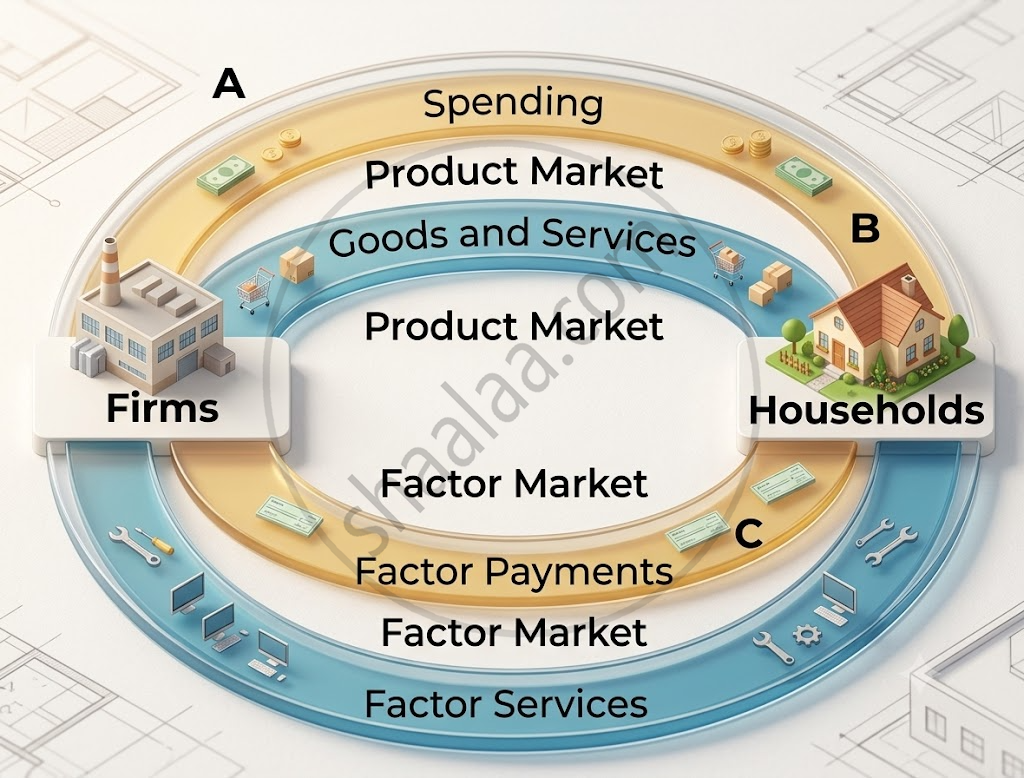
Circular Flow of Income
CBSE: Class 12
Simple Two-Sector Economy (Basic Model)
This model involves only two sectors: Households and Firms, with the following assumptions:
- No government
- No foreign trade
- No saving - households spend their entire income on goods and services.
How It Works
- Firms pay factor payments to households → wages, interest, profit, rent.
- Households spend all income back on goods and services from firms.
- This creates a continuous, circular movement of income.
CBSE: Class 12
National Testing Agency: Class 12
National Testing Agency: Class 12
Three Methods of Measuring National Income
The same aggregate income can be measured at three different points in the circular flow:
| Method | Measured As |
|---|---|
| Product Method | Total value of final output produced |
| Income Method | Total factor payments made (wages + interest + profit + rent) |
| Expenditure Method | Total expenditure on final goods and services |
CBSE: Class 12
National Testing Agency: Class 12
National Testing Agency: Class 12
Three Phases of Circular Flow
| Phase | Description |
|---|---|
| Production Phase | Goods and services are produced by firms. |
| Income Phase | Factor incomes (wages, rent, interest, profit) are paid to households. |
| Expenditure Phase | Households spend income on goods and services. |
National Testing Agency: Class 12
Four Sectors of the Economy
In the complete model (beyond the basic two-sector), four sectors participate:
- Household Sector
- Producing Sector (Firms)
- Government Sector
- Rest of the World
National Testing Agency: Class 12
Real Flow vs. Money Flow
| Type | What Flows |
|---|---|
| Real Flow | Physical flow of factor services (labour, capital, land, enterprise) and goods/services between sectors. |
| Money Flow | Monetary payments made in exchange for those factor services and goods. |
National Testing Agency: Class 12
Leakages and Injections
| Leakages (Withdraw from Flow) | Injections (Add to Flow) |
|---|---|
| Savings | Investment |
| Taxes | Government Spending |
| Imports | Exports |
- Leakages reduce the flow of income circulating in the economy.
- Injections increase the flow of income circulating in the economy.
CBSE: Class 12
National Testing Agency: Class 12
National Testing Agency: Class 12
Key Points: Circular Flow of Income and Methods of Calculating National Income
- Circular flow = unending flow of production → income → expenditure between sectors.
- In a two-sector economy (no govt., no foreign trade, no saving): firms pay factor incomes → households spend all income back on goods.
- National income can be measured equally by the product, income, or expenditure method - all three give the same result in the simplified model.
- Three phases: Production → Income → Expenditure.
- Real flow = physical movement of goods/factor services; Money flow = monetary payments for those goods/services.
- Leakages (savings, taxes, imports) withdraw from the flow; Injections (investment, govt. spending, exports) add to it.
- Four sectors in the full model: Households, Firms, Government, and Rest of the World.
