Topics
National Income and Related Aggregates
- Macroeconomics Vs Microeconomics
- Representative Goods and Sectors
- Macroeconomic Agents and Government Role
- Emergence of Macroeconomics
- Context of the Present Book of Macroeconomics
- Meaning of Economic Wealth and Final Goods
- Stocks, Flows, and Depreciation
- Capital Formation, Trade-off & Circular Flow of Income
- Circular Flow of Income and Methods of Calculating National Income
- Output Method/Product Method
- Expenditure Method
- Income Method
- Factor Cost, Basic Prices and Market Prices
- Some Macroeconomic Identities
- National Disposable Income
- Private Income
- National Income Aggregates
- Real GDP and Nominal GDP
- GDP and Welfare
Introductory Macroeconomics
Introduction
- A Simple Economy
- Central Problems of an Economy
- Concepts of Production Possibility Frontier
- Organisation of Economic Activities
- Positive and Normative Economics
- Macroeconomics Vs Microeconomics
Development Experience (1947-90) and Economic Reforms since 1991
- India's Economy Before Independence
- Low Level of Economic Development Under the Colonial Rule
- Agricultural Sector in India
- Industrial Sector
- Foreign Trade of India
- Demographic Condition
- Occupational Structure
- Infrastructure
- Post-Independence Economic Systems and Planning
- Five Year Plans (FYP)
- Agriculture
- Industry and Trade
- Trade Policy: Import Substitution
- The 1991 Economic Crisis and Reforms
- Background of the New Economic Policy
- Liberalisation
- Privatisation
- Globalisation
- World Trade Organisation (WTO)
- Impact of the Economic Reforms
Money and Banking
- Concept of Money
- Functions of Money
- Demand for Money and Supply of Money
- Money Creation by Banking System
- Limits to Credit Creation and Money Multiplier
- Policy Tools To Control Money Supply
- Demand and Supply for Money : A Detailed Discussion
- The Transaction Motive
- The Speculative Motive
- Various Measures of Supply of Money
- Narrow and Broad Money
- Demonetisation
Theory of Consumer Behaviour
- Consumer Behaviour: The Problem of Choice
- Basic Concepts of Microeconomics > Utility
- Cardinal Approach (Utility Analysis)
- Derivation of Demand Curve in the Case of a Single Commodity
- Ordinal Utility Analysis/Indifference Curve Analysis
Indian Economic Development
Current Challenges Facing Indian Economy
- Concept of Human Capital
- Sources of Human Capital
- Human Capital and Economic Growth
- Human Capital and Human Development
- State of Human Capital Formation in India
- Growth of Education Sector in India
- Challenges and Future Prospects in Education
- Rural Development in India
- Credit and Marketing in Rural Areas
- Agricultural Market System
- Diversification into Productive Activities
- Sustainable Development and Organic Farming
- The Nature and Importance of Work in Society
- Workers and Employment
- Participation of People in Employment
- Self-employed and Hired Workers
- Employment in Firms, Factories and Offices
- Growth and Changing Structure of Employment
- Informalisation of Indian Workforce
- Concept of Unemployment
- Government and Employment Generation
- Environment and Sustainable Development in India
- State of India’s Environment
- Concept of Sustainable Development
- Strategies for Sustainable Development
Development Experience of India – a Comparison with Neighbours
Determination of Income and Employment
- Aggregate Demand and Its Components
- Consumption
- Investment
- Determination of Income in Two-sector Model
- Determination of Equilibrium Income in the Short Run
- Macroeconomic Equilibrium with Price Level Fixed
- Effect of an Autonomous Change in Aggregate Demand on Income and Output
- The Multiplier Mechanism
- Paradox of Thrift
- Equilibrium Output and Employment
Introductory Microeconomics
Production and Costs
- Production Function
- Concept of Production
- Some Basic Concepts - Total, Average and Marginal Physical Products
- Relation Between Total, Average and Marginal Product
- Law of Variable Proportions
- Average and Marginal Physical Products
- Changes in Production
- Fixed Cost and Variable Cost
- Behaviour of Cost in the Short - Run
- Relationship Between Average Variable Cost and Average Total Cost and Marginal Cost
- Opportunity Cost
- Revenue Concepts
- Producer's Equilibrium
- Law of Supply
- Supply Schedule
- Distinction Between Supply and Stock
- Determinants of Supply
- Movement Along the Supply Curve Or Expansion and Contraction of Supply
- Measurement of Elasticity of Supply > Percentage Method
- Methods of Measurement of National Income
- Marginal Cost (MC)
- The Law of Diminishing Marginal Product
- Shapes of Product Curves
- Costs in Long Run Period
- Returns to Scale
Government Budget and the Economy
The Theory of the Firm Under Perfect Competition
- Concept of Market
- Market Equilibrium
- Determination of Market Equilibrium
- Effects of Changes (Shifts) in Demand on Equilibrium Price and Equilibrium Quantity
- Perfect Competition
- Imperfect Competition
- Factors Determining Market Forms
- Oligopoly
- Market Forms - Perfect Oligopoly
- Market Forms - Imperfect Oligopoly
- Equilibrium Price
- Applications of Tools of Demand and Supply Price Control
- Price Ceiling
- Price Floor
- Revenue Concepts
- Profit Maximisation Objective
- Determinants of a Firm’s Supply Curve
- Supply Schedule
- Price Elasticity of Supply
Balance of Payments
- Open Economy and Its Linkages
- Concept of Balance of Payments
- Current Account
- Capital Account
- Balance of Payments Surplus and Deficit
- Foreign Exchange Market
- Foreign Exchange Rate
- Determination of the Exchange Rate
- Merits and Demerits of Flexible and Fixed Exchange Rate Systems
- Managed Floating Exchange Rate System
Market Equilibrium
- Simple Monopoly in the Commodity Market
- Other Non - Perfectly Competitive Markets
Background & Context
In India, GDP at factor cost was previously the primary national income measure, reported by the Central Statistics Office (CSO).
After the January 2015 revision, the CSO changed its reporting standard:
- Now reports GVA at basic prices (replacing GVA at factor cost).
- Now reports GDP at market prices — simply referred to as GDP.
Formula: Gross Value Added (GVA)
GVA = Total Output − Intermediate Consumption
- Total Output: Value of all goods and services produced.
- Intermediate Consumption: Value of goods and services used up in the production process.
- GVA represents the value added by producers during production.
Types of Taxes
1. Production Taxes
- Taxes paid in relation to production and not dependent on the quantity produced.
- Examples: Land revenue, stamp duty, registration fees.
2. Product Taxes
- Taxes levied per unit of a good or service.
- Examples: GST (earlier excise duty/service tax), customs duties, export and import duties.
Net Taxes = Taxes − Subsidies
The Three Price Concepts
| Price Concept | What It Includes | Taxes / Subsidies |
|---|---|---|
| Factor Cost | Factor payments only | No taxes at all |
| Basic Prices | Factor cost + net production taxes | Includes production taxes minus subsidies |
| Market Prices | Basic prices + net product taxes | Includes product taxes minus subsidies |
Key Relationships & Formulas
Step 1: From Factor Cost to Basic Prices
GVA at Factor Cost + Net Production Taxes = GVA at Basic Prices
Step 2: From Basic Prices to Market Prices
GVA at Basic Prices + Net Product Taxes = GVA at Market Prices (GDP at Market Prices)
Price Ladder
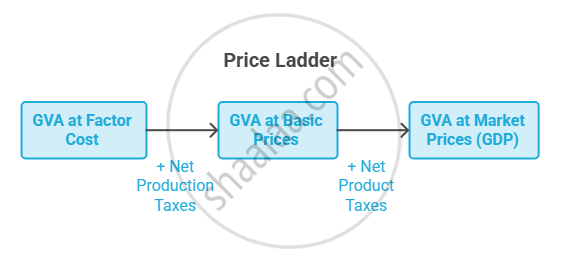
Key Points: Factor Cost, Basic Prices and Market Prices
- Before 2015, India's principal measure was GDP at Factor Cost.
- Since the January 2015 revision, the CSO reports GVA at Basic Prices and GDP at Market Prices (simply called GDP).
- GVA = Total Output − Intermediate Consumption.
- Factor Cost includes only payments to factors of production.
- Basic Prices = Factor Cost + Net Production Taxes.
- Market Prices = Basic Prices + Net Product Taxes.
- Net Taxes = Taxes − Subsidies.
- Production taxes and product taxes are added at different stages to arrive at GDP at market prices.
Test Yourself
Related QuestionsVIEW ALL [9]
Study the following information and compare the Economies of India and Singapore on the grounds of ‘Investment in infrastructure as a percentage of GDP’
| Some Infrastructure in India and other Countries, 2018 | |||||
| Country | Investment* in Infrastructure as a % GDP | Percentage of people using safely managed | Mobile Subscribers/100 People | Consumption of energy (mL tonnes of oil equivalent) | |
| Drinking Water Sources | Sanitation Services | ||||
| China | 44 | 96 | 72 | 115 | 3274 |
| Hong Kong | 22 | 100 | 92 | 259 | 31 |
| India | 30 | 94 | 40 | 87 | 809 |
| South Korea | 31 | 98 | 100 | 130 | 301 |
| Pakistan | 16 | 35 | 64 | 73 | 85 |
| Singapore | 28 | 100 | 100 | 146 | 88 |
| Indonesia | 34 | 87 | 61 | 120 | 186 |
Sources: World Development Indicators 2019, World Bank website: www.worldbank.org.; BP Statistical Review of World Energy 2019. 69th Edition.
Note: (*) refers to Gross Capital Formation.
