Topics
National Income and Related Aggregates
- Macroeconomics Vs Microeconomics
- Representative Goods and Sectors
- Macroeconomic Agents and Government Role
- Emergence of Macroeconomics
- Context of the Present Book of Macroeconomics
- Meaning of Economic Wealth and Final Goods
- Stocks, Flows, and Depreciation
- Capital Formation, Trade-off & Circular Flow of Income
- Circular Flow of Income and Methods of Calculating National Income
- Output Method/Product Method
- Expenditure Method
- Income Method
- Factor Cost, Basic Prices and Market Prices
- Some Macroeconomic Identities
- National Disposable Income
- Private Income
- National Income Aggregates
- Real GDP and Nominal GDP
- GDP and Welfare
Introductory Macroeconomics
Introduction
- A Simple Economy
- Central Problems of an Economy
- Concepts of Production Possibility Frontier
- Organisation of Economic Activities
- Positive and Normative Economics
- Macroeconomics Vs Microeconomics
Development Experience (1947-90) and Economic Reforms since 1991
- India's Economy Before Independence
- Low Level of Economic Development Under the Colonial Rule
- Agricultural Sector in India
- Industrial Sector
- Foreign Trade of India
- Demographic Condition
- Occupational Structure
- Infrastructure
- Post-Independence Economic Systems and Planning
- Five Year Plans (FYP)
- Agriculture
- Industry and Trade
- Trade Policy: Import Substitution
- The 1991 Economic Crisis and Reforms
- Background of the New Economic Policy
- Liberalisation
- Privatisation
- Globalisation
- World Trade Organisation (WTO)
- Impact of the Economic Reforms
Money and Banking
- Concept of Money
- Functions of Money
- Demand for Money and Supply of Money
- Money Creation by Banking System
- Limits to Credit Creation and Money Multiplier
- Policy Tools To Control Money Supply
- Demand and Supply for Money : A Detailed Discussion
- The Transaction Motive
- The Speculative Motive
- Various Measures of Supply of Money
- Narrow and Broad Money
- Demonetisation
Theory of Consumer Behaviour
- Consumer Behaviour: The Problem of Choice
- Basic Concepts of Microeconomics > Utility
- Cardinal Approach (Utility Analysis)
- Derivation of Demand Curve in the Case of a Single Commodity
- Ordinal Utility Analysis/Indifference Curve Analysis
Indian Economic Development
Current Challenges Facing Indian Economy
- Concept of Human Capital
- Sources of Human Capital
- Human Capital and Economic Growth
- Human Capital and Human Development
- State of Human Capital Formation in India
- Growth of Education Sector in India
- Challenges and Future Prospects in Education
- Rural Development in India
- Credit and Marketing in Rural Areas
- Agricultural Market System
- Diversification into Productive Activities
- Sustainable Development and Organic Farming
- The Nature and Importance of Work in Society
- Workers and Employment
- Participation of People in Employment
- Self-employed and Hired Workers
- Employment in Firms, Factories and Offices
- Growth and Changing Structure of Employment
- Informalisation of Indian Workforce
- Concept of Unemployment
- Government and Employment Generation
- Environment and Sustainable Development in India
- State of India’s Environment
- Concept of Sustainable Development
- Strategies for Sustainable Development
Development Experience of India – a Comparison with Neighbours
Determination of Income and Employment
- Aggregate Demand and Its Components
- Consumption
- Investment
- Determination of Income in Two-sector Model
- Determination of Equilibrium Income in the Short Run
- Macroeconomic Equilibrium with Price Level Fixed
- Effect of an Autonomous Change in Aggregate Demand on Income and Output
- The Multiplier Mechanism
- Paradox of Thrift
- Equilibrium Output and Employment
Introductory Microeconomics
Production and Costs
- Production Function
- Concept of Production
- Some Basic Concepts - Total, Average and Marginal Physical Products
- Relation Between Total, Average and Marginal Product
- Law of Variable Proportions
- Average and Marginal Physical Products
- Changes in Production
- Fixed Cost and Variable Cost
- Behaviour of Cost in the Short - Run
- Relationship Between Average Variable Cost and Average Total Cost and Marginal Cost
- Opportunity Cost
- Revenue Concepts
- Producer's Equilibrium
- Law of Supply
- Supply Schedule
- Distinction Between Supply and Stock
- Determinants of Supply
- Movement Along the Supply Curve Or Expansion and Contraction of Supply
- Measurement of Elasticity of Supply > Percentage Method
- Methods of Measurement of National Income
- Marginal Cost (MC)
- The Law of Diminishing Marginal Product
- Shapes of Product Curves
- Costs in Long Run Period
- Returns to Scale
Government Budget and the Economy
The Theory of the Firm Under Perfect Competition
- Concept of Market
- Market Equilibrium
- Determination of Market Equilibrium
- Effects of Changes (Shifts) in Demand on Equilibrium Price and Equilibrium Quantity
- Perfect Competition
- Imperfect Competition
- Factors Determining Market Forms
- Oligopoly
- Market Forms - Perfect Oligopoly
- Market Forms - Imperfect Oligopoly
- Equilibrium Price
- Applications of Tools of Demand and Supply Price Control
- Price Ceiling
- Price Floor
- Revenue Concepts
- Profit Maximisation Objective
- Determinants of a Firm’s Supply Curve
- Supply Schedule
- Price Elasticity of Supply
Balance of Payments
- Open Economy and Its Linkages
- Concept of Balance of Payments
- Current Account
- Capital Account
- Balance of Payments Surplus and Deficit
- Foreign Exchange Market
- Foreign Exchange Rate
- Determination of the Exchange Rate
- Merits and Demerits of Flexible and Fixed Exchange Rate Systems
- Managed Floating Exchange Rate System
Market Equilibrium
- Simple Monopoly in the Commodity Market
- Other Non - Perfectly Competitive Markets
Estimated time: 12 minutes
CBSE: Class 12
Equilibrium of Income
- Equilibrium is determined where the AD curve intersects the 45° line.
- At this point: Output = Aggregate Demand
- The 45° line represents all points where income equals expenditure.
CBSE: Class 12
Effect of an Increase in Autonomous Expenditure
- When autonomous investment rises, the AD curve shifts upward (AD₁ → AD₂).
- At the old equilibrium point E₁, AD₂ lies above the 45° line, creating excess demand.
- To clear the excess demand, firms increase output.
- A new equilibrium E₂ is established at a higher level of income.
CBSE: Class 12
Example
| Parameter | Initial | After Change |
|---|---|---|
| Autonomous Investment \[\overline{I}\] | 10 | 20 |
| Equilibrium Income (Y) | 250 | 300 |
- Consumption Function: \[C = 40 + 0.8Y\]
- Change in Investment (ΔI) = 10
- Change in Income (ΔY) = 50
CBSE: Class 12
Graphical Interpretation (Fixed Price Model)
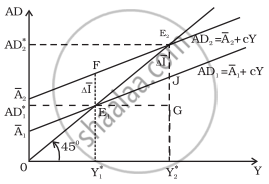
Equilibrium Output and Aggregate Demand in the Fixed Price Model
- X-axis: Income / Output
- Y-axis: Aggregate Demand
- AD₁ shifts to AD₂ (parallel upward shift) due to an increase in autonomous investment.
- E₁ = Old equilibrium (Y = 250)
- E₂ = New equilibrium (Y = 300)
- Vertical distance between AD₁ and AD₂ = Initial increase in autonomous expenditure \[(\Delta\bar{I}=10)\].
- At the old equilibrium, E₁F measures the excess demand created by the increase in autonomous expenditure.
- Increase in output and aggregate demand is shown by E₁G = E₂G, which is greater than the initial increase in autonomous expenditure.
CBSE: Class 12
Multiplier Observation
- The final increase in output and aggregate demand is greater than the initial increase in autonomous expenditure.
- Thus, an initial increment in autonomous expenditure seems to have a multiplier effect on equilibrium output and aggregate demand.
CBSE: Class 12
Key Points: Effect of an Autonomous Change in Aggregate Demand on Income and Output
- Equilibrium income is where the AD curve cuts the 45° line (AD = Output).
- An autonomous rise in investment shifts the AD curve upward, creating excess demand.
- Firms increase output in response to excess demand, raising income.
- The final increase in equilibrium income is greater than the initial increase in autonomous expenditure, indicating a multiplier effect.
