Advertisements
Online Mock Tests
Chapters
2: Physics and Mathematics
3: Rest and Motion: Kinematics
4: The Forces
5: Newton's Laws of Motion
6: Friction
7: Circular Motion
8: Work and Energy
9: Centre of Mass, Linear Momentum, Collision
10: Rotational Mechanics
11: Gravitation
12: Simple Harmonics Motion
13: Fluid Mechanics
14: Some Mechanical Properties of Matter
15: Wave Motion and Waves on a String
16: Sound Waves
17: Light Waves
18: Geometrical Optics
19: Optical Instruments
20: Dispersion and Spectra
21: Speed of Light
22: Photometry
23: Heat and Temperature
24: Kinetic Theory of Gases
25: Calorimetry
26: Laws of Thermodynamics
▶ 27: Specific Heat Capacities of Gases
28: Heat Transfer
29: Electric Field and Potential
30: Gauss’s Law
31: Capacitors
32: Electric Current in Conductors
33: Thermal and Chemical Effects of Current
34: Magnetic Field
35: Magnetic Field due to a Current
36: Permanent Magnets
37: Magnetic Properties of Matter
38: Electromagnetic Induction
39: Alternating Current
40: Electromagnetic Waves
41: Electric Current through Gases
42: Photoelectric Effect and Wave-Particle Duality
43: Bohr’s Model and Physics of Atom
44: X-rays
45: Semiconductors and Semiconductor Devices
46: The Nucleus
47: The Special Theory of Relativity
![HC Verma solutions for कॉनसेप्टस् ऑफ फिज़िक्स वॉल्यूम १ एण्ड २ [अंग्रेजी] chapter 27 - Specific Heat Capacities of Gases - Shaalaa.com](/images/concepts-of-physics-volume-1-and-2-english_6:9bad16cab2dd4ae1a1a6bac3add1eb27.jpg "HC Verma solutions for कॉनसेप्टस् ऑफ फिज़िक्स वॉल्यूम १ एण्ड २ [अंग्रेजी] chapter 27 - Specific Heat Capacities of Gases")
Advertisements
Solutions for Chapter 27: Specific Heat Capacities of Gases
Below listed, you can find solutions for Chapter 27 of CBSE, Karnataka Board PUC HC Verma for कॉनसेप्टस् ऑफ फिज़िक्स वॉल्यूम १ एण्ड २ [अंग्रेजी].
HC Verma solutions for कॉनसेप्टस् ऑफ फिज़िक्स वॉल्यूम १ एण्ड २ [अंग्रेजी] 27 Specific Heat Capacities of Gases Short Answers [Page 76]
Does a gas have just two specific heat capacities or more than two? Is the number of specific heat capacities of a gas countable?
Can we define specific heat capacity at constant temperature?
Can we define specific heat capacity for an adiabatic process?
Does a solid also have two kinds of molar heat capacities Cp and Cv? If yes, is Cp > Cv? Or is Cp − Cv = R?
In a real gas, the internal energy depends on temperature and also on volume. The energy increases when the gas expands isothermally. Examining the derivation of Cp − Cv = R, find whether Cp − Cv will be more than R, less than R or equal to R for a real gas.
Can a process on an ideal gas be both adiabatic and isothermal?
Show that the slope of the p−V diagram is greater for an adiabatic process compared to an isothermal process.
Is a slow process always isothermal? Is a quick process always adiabatic?
Can two states of an ideal gas be connected by an isothermal process as well as an adiabatic process?
The ratio Cp / Cv for a gas is 1.29. What is the degree of freedom of the molecules of this gas?
HC Verma solutions for कॉनसेप्टस् ऑफ फिज़िक्स वॉल्यूम १ एण्ड २ [अंग्रेजी] 27 Specific Heat Capacities of Gases MCQ [Pages 76 - 77]
Work done by a sample of an ideal gas in a process A is double the work done in another process B. The temperature rises through the same amount in the two processes. If CAand CB be the molar heat capacities for the two processes,
CA = CB
CA < CB
CA > CB
CA and CB cannot be defined.
For a solid with a small expansion coefficient,
Cp − Cv = R
Cp = Cv
Cp is slightly greater than Cv
Cp is slightly less than Cv
The value of Cp − Cv is 1.00 R for a gas sample in state A and 1.08 R in state B. Let pAand pB denote the pressures and TA and TB denote the temperatures of the states A and B, respectively. It is most likely that
pA < pB and TA > TB
pA > pB and TA < TB
pA = pB and TA < TB
pA > pB and TA = TB
Let Cv and Cp denote the molar heat capacities of an ideal gas at constant volume and constant pressure respectively. Which of the following is a universal constant?
`("C"_"P")/("C"_"P")`
CpCv
Cp − Cv
Cp + Cv
70 calories of heat are required to raise the temperature of 2 mole of an ideal gas at constant pressure from 30° C to 35° C. The amount of heat required to raise the temperature of the same gas through the same range at constant volume is
30 calories
50 calories
70 calories
90 calories
The figure shows a process on a gas in which pressure and volume both change. The molar heat capacity for this process is C.
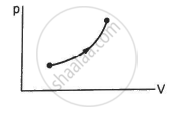
C = 0
C = Cv
C > Cv
C < Cv
The molar heat capacity for the process shown in the figure is
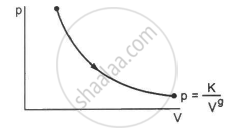
C = Cp
C = Cv
C > Cv
C = 0.
In an isothermal process on an ideal gas, the pressure increases by 0.5%. The volume decreases by about
0.25%
0.5%
0.7%
1%.
In an adiabatic process on a gas with γ = 1.4, the pressure is increased by 0.5%. The volume decreases by about
0.36%
0.5%
0.7%
1%
Two samples A and B are initially kept in the same state. Sample A is expanded through an adiabatic process and the sample B through an isothermal process. The final volumes of the samples are the same. The final pressures in A and B are pA and pBrespectively.
pA > pB
pA = pB
pA < pB
The relation between pA and pB cannot be deduced.
Let Ta and Tb be the final temperatures of the samples A and B, respectively, in the previous question.
Ta < Tb
Ta = Tb
Ta > Tb
The relation between Ta and Tb cannot be deduced.
Let ∆Wa and ∆Wb be the work done by the systems A and B, respectively, in the previous question.
∆Wa > ∆Wb
∆Wa = ∆Wb
∆Wa < ∆Wb
The relation between ∆Wa and ∆Wb cannot be deduced.
The molar heat capacity of oxygen gas at STP is nearly 2.5 R. As the temperature is increased, it gradually increases and approaches 3.5 R. The most appropriate reason for this behaviour is that at high temperatures
oxygen does not behave as an ideal gas
oxygen molecules dissociate in atoms
the molecules collide more frequently
molecular vibrations gradually become effective
HC Verma solutions for कॉनसेप्टस् ऑफ फिज़िक्स वॉल्यूम १ एण्ड २ [अंग्रेजी] 27 Specific Heat Capacities of Gases MCQ [Page 77]
A gas kept in a container of finite conductivity is suddenly compressed. The process
(a) must be very nearly adiabatic
(b) must be very nearly isothermal
(c) may be very nearly adiabatic
(d) may be very nearly isothermal
Let Q and W denote the amount of heat given to an ideal gas and the work done by it in an isothermal process.
Q = 0
W = 0
Q ≠ W
Q = W
Let Q and W denote the amount of heat given to an ideal gas and the work done by it in an adiabatic process.
(a) Q = 0
(b) W = 0
(c) Q = W
(d) Q ≠ W
Consider the processes A and B shown in the figure. It is possible that
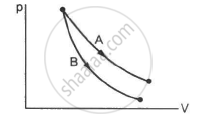
both the processes are isothermal
both the processes are adiabatic
A is isothermal and B is adiabatic
A is adiabatic and B is isothermal
Three identical adiabatic containers A, B and C contain helium, neon and oxygen, respectively, at equal pressure. The gases are pushed to half their original volumes.
(a) The final temperatures in the three containers will be the same.
(b) The final pressures in the three containers will be the same.
(c) The pressures of helium and neon will be the same but that of oxygen will be different.
(d) The temperatures of helium and neon will be the same but that of oxygen will be different.
A rigid container of negligible heat capacity contains one mole of an ideal gas. The temperature of the gas increases by 1° C if 3.0 cal of heat is added to it. The gas may be
(a) helium
(b) argon
(c) oxygen
(d) carbon dioxide
Four cylinders contain equal number of moles of argon, hydrogen, nitrogen and carbon dioxide at the same temperature. The energy is minimum in
argon
hydrogen
nitrogen
carbon dioxide
HC Verma solutions for कॉनसेप्टस् ऑफ फिज़िक्स वॉल्यूम १ एण्ड २ [अंग्रेजी] 27 Specific Heat Capacities of Gases Exercises [Pages 77 - 80]
A vessel containing one mole of a monatomic ideal gas (molecular weight = 20 g mol−1) is moving on a floor at a speed of 50 m s−1. The vessel is stopped suddenly. Assuming that the mechanical energy lost has gone into the internal energy of the gas, find the rise in its temperature.
5 g of a gas is contained in a rigid container and is heated from 15°C to 25°C. Specific heat capacity of the gas at constant volume is 0.172 cal g−1 °C−1 and the mechanical equivalent of heat is 4.2 J cal−1. Calculate the change in the internal energy of the gas
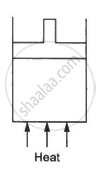
The figure shows a cylindrical container containing oxygen (γ = 1.4) and closed by a 50-kg frictionless piston. The area of cross-section is 100 cm2, atmospheric pressure is 100 kPa and g is 10 m s−2. The cylinder is slowly heated for some time. Find the amount of heat supplied to the gas if the piston moves out through a distance of 20 cm.
The specific heat capacities of hydrogen at constant volume and at constant pressure are 2.4 cal g−1 °C−1 and 3.4 cal g−1 °C−1 respectively. The molecular weight of hydrogen is 2 g mol−1 and the gas constant, R = 8.3 × 10⁷ erg °C−1 mol−1. Calculate the value of J.
The ratio of the molar heat capacities of an ideal gas is Cp/Cv = 7/6. Calculate the change in internal energy of 1.0 mole of the gas when its temperature is raised by 50 K (a) keeping the pressure constant (b) keeping the volume constant and (c) adiaba
A sample of air weighing 1.18 g occupies 1.0 × 103 cm3 when kept at 300 K and 1.0 × 10⁵ Pa. When 2.0 cal of heat is added to it at constant volume, its temperature increases by 1°C. Calculate the amount of heat needed to increase the temperature of air by 1°C at constant pressure if the mechanical equivalent of heat is 4.2 × 10⁷ erg cal−1. Assume that air behaves as an ideal gas.
An ideal gas expands from 100 cm3 to 200 cm3 at a constant pressure of 2.0 × 10⁵ Pa when 50 J of heat is supplied to it. Calculate (a) the change in internal energy of the gas (b) the number of moles in the gas if the initial temperature is 300 K (c) the molar heat capacity Cp at constant pressure and (d) the molar heat capacity Cv at constant volume.
An amount Q of heat is added to a monatomic ideal gas in a process in which the gas performs a work Q/2 on its surrounding. Find the molar heat capacity for the process
An ideal gas is taken through a process in which the pressure and the volume are changed according to the equation p = kV. Show that the molar heat capacity of the gas for the process is given by `"C" ="C"_"v" +"R"/2.`
An ideal gas (Cp / Cv = γ) is taken through a process in which the pressure and the volume vary as p = aVb. Find the value of b for which the specific heat capacity in the process is zero.
Two ideal gases have the same value of Cp / Cv = γ. What will be the value of this ratio for a mixture of the two gases in the ratio 1 : 2?
A mixture contains 1 mole of helium (Cp = 2.5 R, Cv = 1.5 R) and 1 mole of hydrogen (Cp= 3.5 R, Cv = 2.5 R). Calculate the values of Cp, Cv and γ for the mixture.
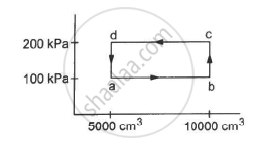
Half mole of an ideal gas (γ = 5/3) is taken through the cycle abcda, as shown in the figure. Take `"R" = 25/3"J""K"^-1 "mol"^-1 `. (a) Find the temperature of the gas in the states a, b, c and d. (b) Find the amount of heat supplied in the processes ab and bc. (c) Find the amount of heat liberated in the processes cd and da.
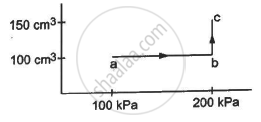
An ideal gas (γ = 1.67) is taken through the process abc shown in the figure. The temperature at point a is 300 K. Calculate (a) the temperatures at b and c (b) the work done in the process (c) the amount of heat supplied in the path ab and in the path bcand (d) the change in the internal energy of the gas in the process.
In Joly's differential steam calorimeter, 3 g of an ideal gas is contained in a rigid closed sphere at 20°C. The sphere is heated by steam at 100°C and it is found that an extra 0.095 g of steam has condensed into water as the temperature of the gas becomes constant. Calculate the specific heat capacity of the gas in J g−1 K−1. The latent heat of vaporisation of water = 540 cal g−1
The volume of an ideal gas (γ = 1.5) is changed adiabatically from 4.00 litres to 3.00 litres. Find the ratio of (a) the final pressure to the initial pressure and (b) the final temperature to the initial temperature.
An ideal gas at pressure 2.5 × 10⁵ Pa and temperature 300 K occupies 100 cc. It is adiabatically compressed to half its original volume. Calculate (a) the final pressure (b) the final temperature and (c) the work done by the gas in the process. Take γ = 1.5
Air (γ = 1.4) is pumped at 2 atm pressure in a motor tyre at 20°C. If the tyre suddenly bursts, what would be the temperature of the air coming out of the tyre? Neglect any mixing with the atmospheric air.
A gas is enclosed in a cylindrical can fitted with a piston. The walls of the can and the piston are adiabatic. The initial pressure, volume and temperature of the gas are 100 kPa, 400 cm3 and 300 K, respectively. The ratio of the specific heat capacities of the gas, Cp / Cv = 1.5. Find the pressure and the temperature of the gas if it is (a) suddenly compressed (b) slowly compressed to 100 cm3.
The initial pressure and volume of a given mass of a gas (Cp/Cv = γ) are p0 and V0. The gas can exchange heat with the surrounding. (a) It is slowly compressed to a volume V0/2 and then suddenly compressed to V0/4. Find the final pressure. (b) If the gas is suddenly compressed from the volume V0 to V0/2 and then slowly compressed to V0/4, what will be the final pressure?
Consider a given sample of an ideal gas (Cp/Cv = γ) having initial pressure p0 and volume V0. (a) The gas is isothermally taken to a pressure p0/2 and from there, adiabatically to a pressure p0/4. Find the final volume. (b) The gas is brought back to its initial state. It is adiabatically taken to a pressure p0/2 and from there, isothermally to a pressure p0/4. Find the final volume.
A sample of an ideal gas (γ = 1.5) is compressed adiabatically from a volume of 150 cm3 to 50 cm3. The initial pressure and the initial temperature are 150 kPa and 300 K. Find (a) the number of moles of the gas in the sample (b) the molar heat capacity at constant volume (c) the final pressure and temperature (d) the work done by the gas in the process and (e) the change in internal energy of the gas.
Three samples A, B and C of the same gas (γ = 1.5) have equal volumes and temperatures. The volume of each sample is doubled, the process being isothermal for A, adiabatic for B and isobaric for C. If the final pressures are equal for the three samples, find the ratio of the initial pressures.
Two samples A and B, of the same gas have equal volumes and pressures. The gas in sample A is expanded isothermally to double its volume and the gas in B is expanded adiabatically to double its volume. If the work done by the gas is the same for the two cases, show that γ satisfies the equation 1 − 21−γ = (γ − 1) ln2.
1 litre of an ideal gas (γ = 1.5) at 300 K is suddenly compressed to half its original volume. (a) Find the ratio of the final pressure to the initial pressure. (b) If the original pressure is 100 kPa, find the work done by the gas in the process. (c) What is the change in internal energy? (d) What is the final temperature? (e) The gas is now cooled to 300 K keeping its pressure constant. Calculate the work done during the process. (f) The gas is now expanded isothermally to achieve its original volume of 1 litre. Calculate the work done by the gas. (g) Calculate the total work done in the cycle.
Figure shows a cylindrical tube with adiabatic walls and fitted with an adiabatic separator. The separator can be slid into the tube by an external mechanism. An ideal gas (γ = 1.5) is injected in the two sides at equal pressures and temperatures. The separator remains in equilibrium at the middle. It is now slid to a position where it divides the tube in the ratio 1 : 3. Find the ratio of the temperatures in the two parts of the vessel.

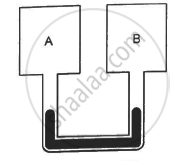
Figure shows two rigid vessels A and B, each of volume 200 cm3, containing an ideal gas (Cv = 12.5 J K−1 mol−1). The vessels are connected to a manometer tube containing mercury. The pressure in both the vessels is 75 cm of mercury and the temperature is 300 K. (a) Find the number of moles of the gas in each vessel. (b) 5.0 J of heat is supplied to the gas in vessel A and 10 J to the gas in vessel B. Assuming there's no appreciable transfer of heat from A to B, calculate the difference in the heights of mercury in the two sides of the manometer. Gas constant, R = 8.3 J K−1 mol−1.
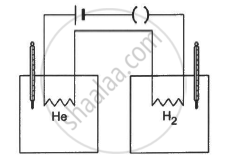
The figure shows two vessels with adiabatic walls, one containing 0.1 g of helium (γ = 1.67, M = 4 g mol−1) and the other containing some amount of hydrogen (γ = 1.4, M = 2 g mol−1). Initially, the temperatures of the two gases are equal. The gases are electrically heated for some time during which equal amounts of heat are given to the two gases. It is found that the temperatures rise through the same amount in the two vessels. Calculate the mass of hydrogen.
Two vessels A and B of equal volume V0 are connected by a narrow tube that can be closed by a valve. The vessels are fitted with pistons that can be moved to change the volumes. Initially, the valve is open and the vessels contain an ideal gas (Cp/Cv = γ) at atmospheric pressure p0 and atmospheric temperature T0. The walls of vessel A are diathermic and those of B are adiabatic. The valve is now closed and the pistons are slowly pulled out to increase the volumes of the vessels to double the original value. (a) Find the temperatures and pressures in the two vessels. (b) The valve is now opened for sufficient time so that the gases acquire a common temperature and pressure. Find the new values of the temperature and pressure.
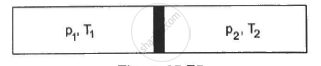
The figure shows an adiabatic cylindrical tube of volume V0 divided in two parts by a frictionless adiabatic separator. Initially, the separator is kept in the middle, an ideal gas at pressure p1 and temperature T1 is injected into the left part and another ideal gas at pressure p2 and temperature T2 is injected into the right part. Cp/Cv = γ is the same for both the gases. The separator is slid slowly and is released at a position where it can stay in equilibrium. Find (a) the volumes of the two parts (b) the heat given to the gas in the left part and (c) the final common pressure of the gases.
An adiabatic cylindrical tube of cross-sectional area 1 cm2 is closed at one end and fitted with a piston at the other end. The tube contains 0.03 g of an ideal gas. At 1 atm pressure and at the temperature of the surrounding, the length of the gas column is 40 cm. The piston is suddenly pulled out to double the length of the column. The pressure of the gas falls to 0.355 atm. Find the speed of sound in the gas at atmospheric temperature.
The speed of sound in hydrogen at 0°C is 1280 m s−1. The density of hydrogen at STP is 0.089 kg m−3. Calculate the molar heat capacities Cp and Cv of hydrogen.
4.0 g of helium occupies 22400 cm3 at STP. The specific heat capacity of helium at constant pressure is 5.0 cal K−1 mol−1. Calculate the speed of sound in helium at STP.
An ideal gas of density 1.7 × 10⁻³ g cm−3 at a pressure of 1.5 × 10⁵ Pa is filled in a Kundt's tube. When the gas is resonated at a frequency of 3.0 kHz, nodes are formed at a separation of 6.0 cm. Calculate the molar heat capacities Cp and Cv of the gas.
Standing waves of frequency 5.0 kHz are produced in a tube filled with oxygen at 300 K. The separation between the consecutive nodes is 3.3 cm. Calculate the specific heat capacities Cp and Cv of the gas.
Solutions for 27: Specific Heat Capacities of Gases
HC Verma solutions for कॉनसेप्टस् ऑफ फिज़िक्स वॉल्यूम १ एण्ड २ [अंग्रेजी] chapter 27 - Specific Heat Capacities of Gases
Shaalaa.com has the CBSE, Karnataka Board PUC Mathematics कॉनसेप्टस् ऑफ फिज़िक्स वॉल्यूम १ एण्ड २ [अंग्रेजी] CBSE, Karnataka Board PUC solutions in a manner that help students grasp basic concepts better and faster. The detailed, step-by-step solutions will help you understand the concepts better and clarify any confusion. HC Verma solutions for Mathematics कॉनसेप्टस् ऑफ फिज़िक्स वॉल्यूम १ एण्ड २ [अंग्रेजी] CBSE, Karnataka Board PUC 27 (Specific Heat Capacities of Gases) include all questions with answers and detailed explanations. This will clear students' doubts about questions and improve their application skills while preparing for board exams.
Further, we at Shaalaa.com provide such solutions so students can prepare for written exams. HC Verma textbook solutions can be a core help for self-study and provide excellent self-help guidance for students.
Concepts covered in कॉनसेप्टस् ऑफ फिज़िक्स वॉल्यूम १ एण्ड २ [अंग्रेजी] chapter 27 Specific Heat Capacities of Gases are Specific Heat Capacities - Gases, Mean Free Path, Kinetic Theory of Gases - Concept of Pressure, Introduction of Kinetic Theory of an Ideal Gas, Interpretation of Temperature in Kinetic Theory, Gases and Its Characteristics, Equation of State of a Perfect Gas, Work Done in Compressing a Gas, Assumptions of Kinetic Theory of Gases, RMS Speed of Gas Molecules, Degrees of Freedom, Avogadro's Number, Law of Equipartition of Energy.
Using HC Verma कॉनसेप्टस् ऑफ फिज़िक्स वॉल्यूम १ एण्ड २ [अंग्रेजी] solutions Specific Heat Capacities of Gases exercise by students is an easy way to prepare for the exams, as they involve solutions arranged chapter-wise and also page-wise. The questions involved in HC Verma Solutions are essential questions that can be asked in the final exam. Maximum CBSE, Karnataka Board PUC कॉनसेप्टस् ऑफ फिज़िक्स वॉल्यूम १ एण्ड २ [अंग्रेजी] students prefer HC Verma Textbook Solutions to score more in exams.
Get the free view of Chapter 27, Specific Heat Capacities of Gases कॉनसेप्टस् ऑफ फिज़िक्स वॉल्यूम १ एण्ड २ [अंग्रेजी] additional questions for Mathematics कॉनसेप्टस् ऑफ फिज़िक्स वॉल्यूम १ एण्ड २ [अंग्रेजी] CBSE, Karnataka Board PUC, and you can use Shaalaa.com to keep it handy for your exam preparation.
