हिंदी
कर्नाटक बोर्ड पी.यू.सी.पीयूसी विज्ञान कक्षा ११

The Figure Shows a Process on a Gas in Which Pressure and Volume Both Change. the Molar Heat Capacity for this Process is C. - Physics

Advertisements
Advertisements

प्रश्न

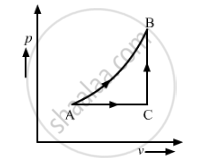
The figure shows a process on a gas in which pressure and volume both change. The molar heat capacity for this process is C.
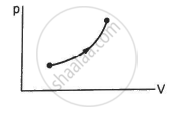
विकल्प

  • C = 0

  •  C = Cv

  • C > Cv

  •  C < Cv

MCQ
Advertisements

उत्तर

C > C​v

Consider two processes AB and ACB; let W be the work done. C is the molar heat capacity of process AB. Process ACB can be considered as the sum of the two processes, AC and CB. The molar heat capacity of process AC is Cp, as pressure is constant in this process and the molar heat capacity of process CB is Cv, as volume is constant in it. 
Internal energy, U, is a state function, i.e. it doesn't depend on the path followed. Therefore,

UAB = UACB

WAB > WACB

Work done in the p-V diagram is the area enclosed under the curve.

⇒ WAB + UAB > WACB + UACB

⇒ C > CV + CP

Molar heat capacity is the heat supplied per mole to change the temperature by a degree Kelvin and according to the first law of thermodynamics, dQ = dU + dW, where dQ is the heat supplied to the system in a process.

⇒ C > CV 

shaalaa.com
Molecular Nature of Matter
  क्या इस प्रश्न या उत्तर में कोई त्रुटि है?
अध्याय 5: Specific Heat Capacities of Gases - MCQ [पृष्ठ ७६]

APPEARS IN

एचसी वर्मा Concepts of Physics Vol. 2 [English] Class 11 and 12
अध्याय 5 Specific Heat Capacities of Gases
MCQ | Q 6 | पृष्ठ ७६

संबंधित प्रश्न

Estimate the fraction of molecular volume to the actual volume occupied by oxygen gas at STP. Take the diameter of an oxygen molecule to be 3Å.


An air bubble of volume 1.0 cm3 rises from the bottom of a lake 40 m deep at a temperature of 12 °C. To what volume does it grow when it reaches the surface, which is at a temperature of 35 °C?


The density of an ideal gas is 1.25 × 10⁻³ g cm−3 at STP. Calculate the molecular weight of the gas.

Use R=8.31J K-1 mol-1


Consider a sample of oxygen at 300 K. Find the average time taken by a molecule to travel a distance equal to the diameter of the earth.

Use R=8.314 JK-1 mol-1


Figure shows a vessel partitioned by a fixed diathermic separator. Different ideal gases are filled in the two parts. The rms speed of the molecules in the left part equals the mean speed of the molecules in the right part. Calculate the ratio of the mass of a molecule in the left part to the mass of a molecule in the right part.


Estimate the number of collisions per second suffered by a molecule in a sample of hydrogen at STP. The mean free path (average distance covered by a molecule between successive collisions) = 1.38 × 105 cm.

Use R = 8.31 JK−1 mol−1


Hydrogen gas is contained in a closed vessel at 1 atm (100 kPa) and 300 K. (a) Calculate the mean speed of the molecules. (b) Suppose the molecules strike the wall with this speed making an average angle of 45° with it. How many molecules strike each square metre of the wall per second?

Use R = 8.31 JK-1 mol-1


A vertical cylinder of height 100 cm contains air at a constant temperature. The top is closed by a frictionless light piston. The atmospheric pressure is equal to 75 cm of mercury. Mercury is slowly poured over the piston. Find the maximum height of the mercury column that can be put on the piston.


A uniform tube closed at one end, contains a pellet of mercury 10 cm long. When the tube is kept vertically with the closed-end upward, the length of the air column trapped is 20 cm. Find the length of the air column trapped when the tube is inverted so that the closed-end goes down. Atmospheric pressure = 75 cm of mercury.


Work done by a sample of an ideal gas in a process A is double the work done in another process B. The temperature rises through the same amount in the two processes. If CAand CB be the molar heat capacities for the two processes,


For a solid with a small expansion coefficient,


Let Cv and Cp denote the molar heat capacities of an ideal gas at constant volume and constant pressure respectively. Which of the following is a universal constant?


70 calories of heat are required to raise the temperature of 2 mole of an ideal gas at constant pressure from 30° C to 35° C. The amount of heat required to raise the temperature of the same gas through the same range at constant volume is


The molar heat capacity for the process shown in the figure is


The molar heat capacity of oxygen gas at STP is nearly 2.5 R. As the temperature is increased, it gradually increases and approaches 3.5 R. The most appropriate reason for this behaviour is that at high temperatures


A sample of an ideal gas (γ = 1.5) is compressed adiabatically from a volume of 150 cm3 to 50 cm3. The initial pressure and the initial temperature are 150 kPa and 300 K. Find (a) the number of moles of the gas in the sample (b) the molar heat capacity at constant volume (c) the final pressure and temperature (d) the work done by the gas in the process and (e) the change in internal energy of the gas.


Share
Notifications

Englishहिंदीमराठी


      Forgot password?
Use app×