मराठी
कर्नाटक बोर्ड पी.यू.सी.पीयूसी विज्ञान इयत्ता ११

The Figure Shows a Process on a Gas in Which Pressure and Volume Both Change. the Molar Heat Capacity for this Process is C. - Physics

Advertisements
Advertisements

प्रश्न

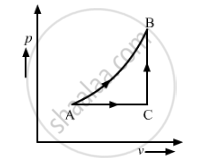
The figure shows a process on a gas in which pressure and volume both change. The molar heat capacity for this process is C.
पर्याय

  • C = 0

  •  C = Cv

  • C > Cv

  •  C < Cv

MCQ
Advertisements

उत्तर

C > C​v

Consider two processes AB and ACB; let W be the work done. C is the molar heat capacity of process AB. Process ACB can be considered as the sum of the two processes, AC and CB. The molar heat capacity of process AC is Cp, as pressure is constant in this process and the molar heat capacity of process CB is Cv, as volume is constant in it. 
Internal energy, U, is a state function, i.e. it doesn't depend on the path followed. Therefore,

UAB = UACB

WAB > WACB

Work done in the p-V diagram is the area enclosed under the curve.

⇒ WAB + UAB > WACB + UACB

⇒ C > CV + CP

Molar heat capacity is the heat supplied per mole to change the temperature by a degree Kelvin and according to the first law of thermodynamics, dQ = dU + dW, where dQ is the heat supplied to the system in a process.

⇒ C > CV 

shaalaa.com
Molecular Nature of Matter
  या प्रश्नात किंवा उत्तरात काही त्रुटी आहे का?
पाठ 5: Specific Heat Capacities of Gases - MCQ [पृष्ठ ७६]

APPEARS IN

एचसी वर्मा Concepts of Physics Vol. 2 [English] Class 11 and 12
पाठ 5 Specific Heat Capacities of Gases
MCQ | Q 6 | पृष्ठ ७६

संबंधित प्रश्‍न

A gas in equilibrium has uniform density and pressure throughout its volume. This is strictly true only if there are no external influences. A gas column under gravity, for example, does not have the uniform density (and pressure). As you might expect, its density decreases with height. The precise dependence is given by the so-called law of atmospheres

n2 = n1 exp [-mg (h– h1)/ kBT]

Where n2, n1 refer to number density at heights h2 and h1 respectively. Use this relation to derive the equation for sedimentation equilibrium of a suspension in a liquid column:

n2 = n1 exp [-mg NA(ρ - P′) (h2 –h1)/ (ρRT)]

Where ρ is the density of the suspended particle, and ρ’ that of surrounding medium. [NA is Avogadro’s number, and R the universal gas constant.] [Hint: Use Archimedes principle to find the apparent weight of the suspended particle.]


Consider a collision between an oxygen molecule and a hydrogen molecule in a mixture of oxygen and hydrogen kept at room temperature. Which of the following are possible?
(a) The kinetic energies of both the molecules increase.
(b) The kinetic energies of both the molecules decrease.
(c) kinetic energy of the oxygen molecule increases and that of the hydrogen molecule decreases.
(d) The kinetic energy of the hydrogen molecule increases and that of the oxygen molecule decreases.


Consider a mixture of oxygen and hydrogen kept at room temperature. As compared to a hydrogen molecule an oxygen molecule hits the wall


Calculate the mass of 1 cm3 of oxygen kept at STP.


An electric bulb of volume 250 cc was sealed during manufacturing at a pressure of 10−3 mm of mercury at 27°C. Compute the number of air molecules contained in the bulb. Avogadro constant = 6 × 10²³ mol−1, density of mercury = 13600 kg m−3 and g = 10 m s−2.

Use R=8.314J K-1 mol-1


The density of an ideal gas is 1.25 × 10⁻³ g cm−3 at STP. Calculate the molecular weight of the gas.

Use R=8.31J K-1 mol-1


Figure shows a vessel partitioned by a fixed diathermic separator. Different ideal gases are filled in the two parts. The rms speed of the molecules in the left part equals the mean speed of the molecules in the right part. Calculate the ratio of the mass of a molecule in the left part to the mass of a molecule in the right part.


Estimate the number of collisions per second suffered by a molecule in a sample of hydrogen at STP. The mean free path (average distance covered by a molecule between successive collisions) = 1.38 × 105 cm.

Use R = 8.31 JK−1 mol−1


Hydrogen gas is contained in a closed vessel at 1 atm (100 kPa) and 300 K. (a) Calculate the mean speed of the molecules. (b) Suppose the molecules strike the wall with this speed making an average angle of 45° with it. How many molecules strike each square metre of the wall per second?

Use R = 8.31 JK-1 mol-1


Work done by a sample of an ideal gas in a process A is double the work done in another process B. The temperature rises through the same amount in the two processes. If CAand CB be the molar heat capacities for the two processes,


For a solid with a small expansion coefficient,


  The value of Cp − Cv is 1.00 R for a gas sample in state A and 1.08 R in state B. Let pAand pB denote the pressures and TA and TB denote the temperatures of the states A and B, respectively. It is most likely that


70 calories of heat are required to raise the temperature of 2 mole of an ideal gas at constant pressure from 30° C to 35° C. The amount of heat required to raise the temperature of the same gas through the same range at constant volume is


The molar heat capacity for the process shown in the figure is


A sample of an ideal gas (γ = 1.5) is compressed adiabatically from a volume of 150 cm3 to 50 cm3. The initial pressure and the initial temperature are 150 kPa and 300 K. Find (a) the number of moles of the gas in the sample (b) the molar heat capacity at constant volume (c) the final pressure and temperature (d) the work done by the gas in the process and (e) the change in internal energy of the gas.


One mole of gas expands obeying the relation as shown in the P-V diagram. The maximum temperature in this process is equal to ______.


Share
Notifications

Englishहिंदीमराठी


      Forgot password?
Use app×