Advertisements
Advertisements
When 1 mole of benzene is mixed with 1 mole of toluene? (vapour pressure of benzene – 12.8 kPa, Toluene = 3.85 kPa)
Concept: undefined >> undefined
Assertion: When methyl alcohol is added to water, the boiling point of water increases.
Reason: When a volatile solute is added to a volatile solvent elevation in boiling point is observed.
Concept: undefined >> undefined
Advertisements
Arrange the following compounds in the increasing order of their densities.
(a)

(b)

(c)
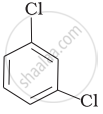
(d)

Concept: undefined >> undefined
Which of the following isomer has the highest melting point?
Concept: undefined >> undefined
Which reagents are required for one step conversion of chlorobenzene to toluene?
Concept: undefined >> undefined
The reaction of toluene with Cl2 in presence of FeCl3 gives ‘X’ while the of toluene with Cl2 in presence of light gives ‘Y’. Thus ‘X’ and ‘Y’are ______.
Concept: undefined >> undefined
Which of the following statement is not true about the hexagonal close packing?
Concept: undefined >> undefined
Match the type of packing given in Column I with the items given in Column II.
| Column I | Column II |
| (i) Square close packing in two dimensions |
(a) Triangular voids |
| (ii) Hexagonal close packing in two dimensions |
(b) Pattern of spheres is repeated in every fourth layer |
| (iii) Hexagonal close packing in three dimensions |
(c) Coordination number 4 |
| (iv) Cubic close packing in three dimensions |
(d) Pattern of sphere is repeated in alternate layers |
Concept: undefined >> undefined
With the help of a labelled diagram show that there are four octahedral voids per unit cell in a cubic close packed structure.
Concept: undefined >> undefined
Match the items of Column I and Column II.
| Column I | Column II |
| (i) Lechlanche cell | (a) cell reaction \[\ce{2H2 + O2 -> 2H2O}\] |
| (ii) Ni–Cd cell | (b) does not involve any ion in solution and is used in hearing aids. |
| (iii) Fuel cell | (c) rechargeable |
| (iv) Mercury cell | (d) reaction at anode, \[\ce{Zn -> Zn^{2+} + 2e^{-}}\] |
| (e) converts energy of combustion into electrical energy |
Concept: undefined >> undefined
What is the relationship between Gibbs free energy of the cell reaction in a galvanic cell and the emf of the cell? When will the maximum work be obtained from a galvanic cell?
Concept: undefined >> undefined
Activation energy of a chemical reaction can be determined by ______.
Concept: undefined >> undefined
Consider figure and mark the correct option.
Concept: undefined >> undefined
Which of the following graphs represents exothermic reaction?
(a)

(b)
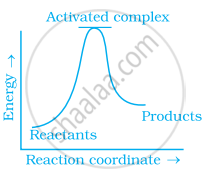
(c)
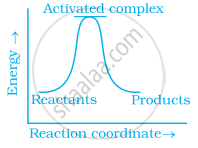
Concept: undefined >> undefined
During decomposition of an activated complex:
(i) energy is always released
(ii) energy is always absorbed
(iii) energy does not change
(iv) reactants may be formed
Concept: undefined >> undefined
Which of the following statements are in accordance with the Arrhenius equation?
(i) Rate of a reaction increases with increase in temperature.
(ii) Rate of a reaction increases with decrease in activation energy.
(iii) Rate constant decreases exponentially with increase in temperature.
(iv) Rate of reaction decreases with decrease in activation energy.
Concept: undefined >> undefined
Mark the incorrect statements:
(i) Catalyst provides an alternative pathway to reaction mechanism.
(ii) Catalyst raises the activation energy.
(iii) Catalyst lowers the activation energy.
(iv) Catalyst alters enthalpy change of the reaction.
Concept: undefined >> undefined
The reaction between \[\ce{H2(g)}\] and \[\ce{O2(g)}\] is highly feasible yet allowing the gases to stand at room temperature in the same vessel does not lead to the formation of water. Explain.
Concept: undefined >> undefined
Why does the rate of a reaction increase with rise in temperature?
Concept: undefined >> undefined
Oxygen is available in plenty in air yet fuels do not burn by themselves at room temperature. Explain.
Concept: undefined >> undefined
