Advertisements
Advertisements
प्रश्न
You are rushing to attend to an important work and you witness an accident on your way. Will you go to the rescue of the injured person? Share your views with the class.
Advertisements
उत्तर
There is nothing more valuable than a human life. I would suspend whatever important work I have in hand and call 108 and summon the ambulance. I will try to get the contact number. of the next of kin of the injured person if he/she is conscious. I will inform them the incident without causing panic. I will accompany the injured person to the hospital. In our NSS team, we have blood donors WhatsApp group. I will find out if blood is required and inform my blood donor group to ensure blood donation to the injured person. Only after the doctor confirms that the injured person is out of danger, I will leave the place.
I draw my inspiration to help people in distress from the life of Abraham Lincoln. He was a budding lawyer. He had to walk for 2 hours to reach the court. On his way, he found a pig sinking in the mud and grunting in agony. It was scared that it would die. Abraham Lincoln was on his only best dress. He just got into the mud, lifted the pig, and left him safely on the hard surface. As he reached the court everyone laughed at his dirty coat but Abraham Lincoln just smiled and argued well in favor of his innocent client and got him acquitted too.
APPEARS IN
संबंधित प्रश्न
Form groups and use the following topic for discussion. Take the help of your college library and your teacher.
Equality before law
Deliver a short speech for about five minutes on the following.
Imagine what will happen if all the trees in the earth disappear. Discuss with your friends and share it with your classmates.
How do trees access the internet?
They simply ___________ in.
Work in groups of four. Discuss how the story would have been different if.
Pongo had arrived on the scene before the last orange was eaten.
Identify the character or speaker of the following line.
She stood petrified with astonishment peering over her glasses.
On the first day of school ______.
I have never visited ______.
Read the following dialogue and report it.
| Johnson | “What are you doing here, Suganthi? I haven’t seen you since June.” |
| Suganthi | “I’ve just come back from my holiday in Ooty.” |
| Johnson | “Did you enjoy it?” |
| Suganthi | “I love Ooty. And the people were so friendly.” |
| Johnson | “Did you go to Coakers Walk?” |
| Suganthi | “It was my first trip. I can show you some pictures. Are you doing anything tomorrow?” |
| Johnson | “I must arrange a couple of things. But I am free tonight.” |
| Suganthi | “You might come to my place. At what time shall we meet?” |
| Johnson | “I’ll be there at eight. Is it all right?” |
Johnson asked Suganthi ______. And he said ______ since June. Suganthi explained that ______ back from her holiday in Ooty. Johnson wondered if ______ it. Suganthi told him that she ______ Ooty and that the people ______ so friendly. Johnson wanted to know ______ to the Coakers Walk. Suganthi said that its first trip and that she some pictures. And then she asked him if he Johnson explained that he ______ a couple of things. But he added that he ______ free at night. Suganthi suggested that he ______ place and asked him at what time ______. Johnson said he ______ there at eight. And finally, he asked ______ all right.
Read the different verb form where they remain the same in the direct and indirect speech in the following case. Fill in the blank with missing indirect speech.
We do not usually change the modal verbs must and needn’t. But must can become had to or would have to and needn’t can become didn’t have to or wouldn’t have to if we want to express an obligation. Would/wouldn’t have to are used to talk about future obligations.

Do you work individually or in pairs?
Change the following into Indirect Speech.
“Bring me a glass of milk,” said the swami to the villagers.
Change the following into Indirect Speech.
“Halt!” shouted the officer to his men.
Change the following into Direct Speech.
Mervin said that he wanted to be a soldier.
Change the following into Direct Speech.
Ebin asked me what I wanted.
Identify a sentence and a phrase which tells us that the story took place in summer.
In groups of five, discuss what you enjoy doing alone and what you like doing in a group. Now prepare a list as shown below.
| Things I like doing alone | Things I like doing in a group |
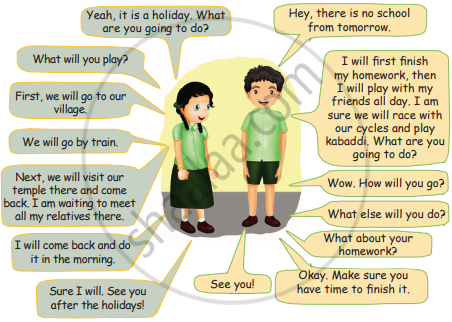
A boy and a girl are talking about their holidays.
Betty bought a bit of butter,
But the bit of butter that Betty bought was bitter.
So Betty bought some better butter,
To make the bitter butter better.
Some letter are missing in each word.
tr __ __ s
Imagine you are Alice and your partner is a rabbit. What would you do?
Have you ever been very frightened? Tell your partner about it.
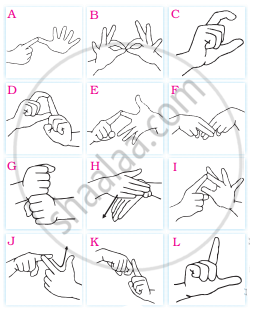
Look at the signs for the letters of the alphabet.

Do you think that –
Hiawatha called the birds ‘chickens’ and the beasts ‘brothers’? What do you think this shows?
Do you know any other language? Do you know a joke in English? Tell your friends.
All cultures have their own folk songs in which each line is repeated. This line is sung in a chorus. Sing a folk song in your own language.
Every member contributes to forming a happy family. Share your views for a minute or two with your class.
In groups of five, discuss the following topic taking examples from Mary Kom’s life.
Athletes cannot run with money in their pockets. They must run with hope in their heart and dreams in their head.
The following expressions may help you in connecting ideas and presenting your views to the class.
- In my opinion…
- I wholeheartedly support…
- At the outset, let me say…
- I should like to draw your attention to…
Prepare a formal five minute speech on the topic ‘The Importance of Education’ and deliver it at your School Assembly.
How will you organize or plan for a trip or an event? Do you have the habit of preparing a check-list? Discuss.
