Advertisements
Advertisements
प्रश्न
The line `x/a + y/b` = 1 moves in such a way that `1/a^2 + 1/b^2 = 1/c^2`, where c is a constant. The locus of the foot of the perpendicular from the origin on the given line is x2 + y2 = c2.
विकल्प
True
False
Advertisements
उत्तर
This statement is True.
Explanation:
The given equation is `x/b - y/a` = 0 .......(i)
Equation of the line passing through (0, 0) and perpendicular to equation (i) is
`x/b - y/a` = 0 .....(ii)
Squaring and adding equation (i) and (ii) we get
`(x/a + y/b)^2 + (x/b - y/a)^2` = 1 + 0
⇒ `x^2/a^2 + y^2/b^2 + (2xy)/(ab) + x^2/b^2 + y^2/a^2 - (2xy)/(ab)` = 1
⇒ `x^2(1/a^2 + 1/b^2) + y^2(1/b^2 + 1/a^2)` = 1
⇒ `(x^2 + y^2) (1/a^2 + 1/b^2)` = 1
⇒ `(x^2 + y^2)(1/c^2)` = 1 ....`[because 1/a^2 + 1/b^2 = 1/c^2]`
⇒ x2 + y2 = c2
APPEARS IN
संबंधित प्रश्न
Draw a quadrilateral in the Cartesian plane, whose vertices are (–4, 5), (0, 7), (5, –5) and (–4, –2). Also, find its area.
The base of an equilateral triangle with side 2a lies along they y-axis such that the mid point of the base is at the origin. Find vertices of the triangle.
Find the distance between P (x1, y1) and Q (x2, y2) when :
- PQ is parallel to the y-axis,
- PQ is parallel to the x-axis
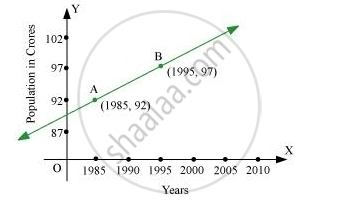
Consider the given population and year graph. Find the slope of the line AB and using it, find what will be the population in the year 2010?
Find the equation of a line drawn perpendicular to the line `x/4 + y/6 = 1`through the point, where it meets the y-axis.
Find the slope of the lines which make the following angle with the positive direction of x-axis:
\[\frac{3\pi}{4}\]
Find the slope of a line passing through the following point:
\[(a t_1^2 , 2 a t_1 ) \text { and } (a t_2^2 , 2 a t_2 )\]
Using the method of slope, show that the following points are collinear A (4, 8), B (5, 12), C (9, 28).
Show that the line joining (2, −5) and (−2, 5) is perpendicular to the line joining (6, 3) and (1, 1).
If three points A (h, 0), P (a, b) and B (0, k) lie on a line, show that: \[\frac{a}{h} + \frac{b}{k} = 1\].
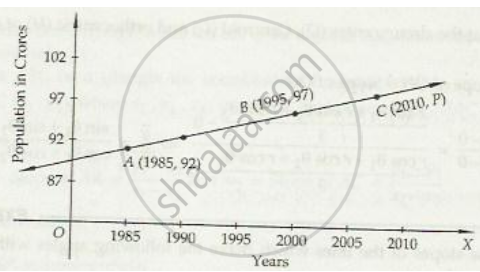
Consider the following population and year graph:
Find the slope of the line AB and using it, find what will be the population in the year 2010.
Find the angle between X-axis and the line joining the points (3, −1) and (4, −2).
Find the equation of a straight line with slope − 1/3 and y-intercept − 4.
Find the equation of the perpendicular to the line segment joining (4, 3) and (−1, 1) if it cuts off an intercept −3 from y-axis.
Find the equations of the straight lines which cut off an intercept 5 from the y-axis and are equally inclined to the axes.
Find the angles between the following pair of straight lines:
3x − y + 5 = 0 and x − 3y + 1 = 0
Find the angles between the following pair of straight lines:
3x + 4y − 7 = 0 and 4x − 3y + 5 = 0
Prove that the points (2, −1), (0, 2), (2, 3) and (4, 0) are the coordinates of the vertices of a parallelogram and find the angle between its diagonals.
Prove that the straight lines (a + b) x + (a − b ) y = 2ab, (a − b) x + (a + b) y = 2ab and x + y = 0 form an isosceles triangle whose vertical angle is 2 tan−1 \[\left( \frac{a}{b} \right)\].
Find the tangent of the angle between the lines which have intercepts 3, 4 and 1, 8 on the axes respectively.
Show that the tangent of an angle between the lines \[\frac{x}{a} + \frac{y}{b} = 1 \text { and } \frac{x}{a} - \frac{y}{b} = 1\text { is } \frac{2ab}{a^2 - b^2}\].
Write the coordinates of the image of the point (3, 8) in the line x + 3y − 7 = 0.
Point of the curve y2 = 3(x – 2) at which the normal is parallel to the line 2y + 4x + 5 = 0 is ______.
A ray of light coming from the point (1, 2) is reflected at a point A on the x-axis and then passes through the point (5, 3). Find the coordinates of the point A.
If one diagonal of a square is along the line 8x – 15y = 0 and one of its vertex is at (1, 2), then find the equation of sides of the square passing through this vertex.
The two lines ax + by = c and a′x + b′y = c′ are perpendicular if ______.
The equation of the line passing through (1, 2) and perpendicular to x + y + 7 = 0 is ______.
The reflection of the point (4, – 13) about the line 5x + y + 6 = 0 is ______.
Show that the tangent of an angle between the lines `x/a + y/b` = 1 and `x/a - y/b` = 1 is `(2ab)/(a^2 - b^2)`
If the equation of the base of an equilateral triangle is x + y = 2 and the vertex is (2, – 1), then find the length of the side of the triangle.
A variable line passes through a fixed point P. The algebraic sum of the perpendiculars drawn from the points (2, 0), (0, 2) and (1, 1) on the line is zero. Find the coordinates of the point P.
If p is the length of perpendicular from the origin on the line `x/a + y/b` = 1 and a2, p2, b2 are in A.P, then show that a4 + b4 = 0.
The coordinates of the foot of perpendiculars from the point (2, 3) on the line y = 3x + 4 is given by ______.
Equations of diagonals of the square formed by the lines x = 0, y = 0, x = 1 and y = 1 are ______.
If the vertices of a triangle have integral coordinates, then the triangle can not be equilateral.
If the line joining two points A (2, 0) and B (3, 1) is rotated about A in anticlockwise direction through an angle of 15°, then the equation of the line in new position is ______.
