Advertisements
Advertisements
प्रश्न
Equations of diagonals of the square formed by the lines x = 0, y = 0, x = 1 and y = 1 are ______.
विकल्प
y = x, y + x = 1
y = x, x + y = 2
2y = x, y + x = `1/3`
y = 2x, y + 2x = 1
Advertisements
उत्तर
Equations of diagonals of the square formed by the lines x = 0, y = 0, x = 1 and y = 1 are y = x, y + x = 1.
Explanation:

Given equation x = 0, y = 0
x = 1 and y = 1 form a square of side 1 unit
From figure, we get that OABC is square having corners O(0, 0), A(1, 0), B(1, 1) and C(0, 1)
Equation of diagonal AC
y – 0 = `(1 - 0)/(0 - 1) (x - 1)`
⇒ y = – (x – 1)
⇒ y = – x + 1
⇒ y + x = 1
Equation of diagonal OB is y – 0 = `(1 - 0)/(1 - 0) (x - 0)`
⇒ y = x
APPEARS IN
संबंधित प्रश्न
Find the angle between the x-axis and the line joining the points (3, –1) and (4, –2).
The slope of a line is double of the slope of another line. If tangent of the angle between them is `1/3`, find the slopes of the lines.
A line passes through (x1, y1) and (h, k). If slope of the line is m, show that k – y1 = m (h – x1).
Find the value of p so that the three lines 3x + y – 2 = 0, px + 2y – 3 = 0 and 2x – y – 3 = 0 may intersect at one point.
Find the slope of the lines which make the following angle with the positive direction of x-axis:
\[\frac{3\pi}{4}\]
Find the slope of the lines which make the following angle with the positive direction of x-axis: \[\frac{\pi}{3}\]
State whether the two lines in each of the following are parallel, perpendicular or neither.
Through (9, 5) and (−1, 1); through (3, −5) and (8, −3)
State whether the two lines in each of the following is parallel, perpendicular or neither.
Through (3, 15) and (16, 6); through (−5, 3) and (8, 2).
Find the slope of a line (i) which bisects the first quadrant angle (ii) which makes an angle of 30° with the positive direction of y-axis measured anticlockwise.
Show that the line joining (2, −5) and (−2, 5) is perpendicular to the line joining (6, 3) and (1, 1).
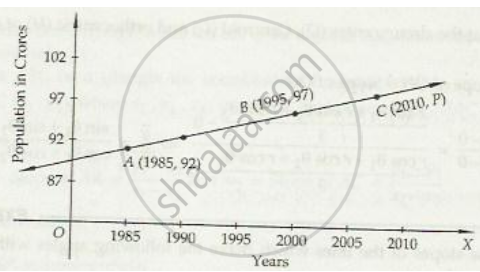
Consider the following population and year graph:
Find the slope of the line AB and using it, find what will be the population in the year 2010.
By using the concept of slope, show that the points (−2, −1), (4, 0), (3, 3) and (−3, 2) are the vertices of a parallelogram.
Find the equation of a straight line with slope 2 and y-intercept 3 .
Find the equation of a straight line with slope −2 and intersecting the x-axis at a distance of 3 units to the left of origin.
Find the equation of the perpendicular to the line segment joining (4, 3) and (−1, 1) if it cuts off an intercept −3 from y-axis.
Find the equations of the straight lines which cut off an intercept 5 from the y-axis and are equally inclined to the axes.
Find the image of the point (3, 8) with respect to the line x + 3y = 7 assuming the line to be a plane mirror.
Find the acute angle between the lines 2x − y + 3 = 0 and x + y + 2 = 0.
Prove that the points (2, −1), (0, 2), (2, 3) and (4, 0) are the coordinates of the vertices of a parallelogram and find the angle between its diagonals.
Find the tangent of the angle between the lines which have intercepts 3, 4 and 1, 8 on the axes respectively.
Show that the tangent of an angle between the lines \[\frac{x}{a} + \frac{y}{b} = 1 \text { and } \frac{x}{a} - \frac{y}{b} = 1\text { is } \frac{2ab}{a^2 - b^2}\].
The equation of the line with slope −3/2 and which is concurrent with the lines 4x + 3y − 7 = 0 and 8x + 5y − 1 = 0 is
The coordinates of the foot of the perpendicular from the point (2, 3) on the line x + y − 11 = 0 are
The equation of a line passing through the point (7, - 4) and perpendicular to the line passing through the points (2, 3) and (1 , - 2 ) is ______.
If one diagonal of a square is along the line 8x – 15y = 0 and one of its vertex is at (1, 2), then find the equation of sides of the square passing through this vertex.
Find the angle between the lines y = `(2 - sqrt(3)) (x + 5)` and y = `(2 + sqrt(3))(x - 7)`
Find the equation of one of the sides of an isosceles right angled triangle whose hypotenuse is given by 3x + 4y = 4 and the opposite vertex of the hypotenuse is (2, 2).
Slope of a line which cuts off intercepts of equal lengths on the axes is ______.
Equation of the line passing through (1, 2) and parallel to the line y = 3x – 1 is ______.
The points A(– 2, 1), B(0, 5), C(– 1, 2) are collinear.
The vertex of an equilateral triangle is (2, 3) and the equation of the opposite side is x + y = 2. Then the other two sides are y – 3 = `(2 +- sqrt(3)) (x - 2)`.
The lines whose vector equations are `r = 2hati - 3hatj + 7hatk + lambda (2hati + phatj + 5hatk) and r = hati - 2hatj + 3hatk + µ(3hati + phatj + phatk)` are perpendicular for all values of λ and µ if p =
