Advertisements
Advertisements
प्रश्न
Given below are a few proverb. Prepare a short speech of two minutes on one of the proverb.
Nothing is impossible.
Advertisements
उत्तर
The word ‘impossible’ means it is possible. You can do anything. “The word impossible is found only in the dictionary of fools,” says Napoleon Bonaparte. In this word, everything is possible on the basis of willpower, determination, and sacrifice. To accomplish the most difficult tasks, you need to put in a lot of hard work, extra perseverance, and concentration on a simple objective. You should have determination, dedication, and devotion to attain success. Never bother about the results keep on going even if the pace is slow. Just ensure it remains steady.
APPEARS IN
संबंधित प्रश्न
Pick out two words from the article on folk culture and folklore of Tamil Nadu with which you can form anagrams. Take turns and ask your partner to solve the anagram and come out with the right words.
Read the clues given below and develop your story. Narrate your story to the class.
Robert Bruce - King - lying on the ground in a dejected mood - failed to defeat his enemies - was thinking of giving up the attempt - saw a spider falling down from the ceiling - the ceiling far away - wondered how it would get there - the spider fell back again - again it tried - again it fell - it made nine such attempts - no success - climbed up once more - at last succeeded in reaching the roof - Bruce imitated its example - he too tried once again - was successful.
Ms. Pavithra Rao, the squash player who won the gold medal at the recent Asian Games, is holding a press conference. Let the discussion focus more on the strategies that helped her to win.
Mock anchoring for annual day celebration.
Read the following dialogue and report it.
| Johnson | “What are you doing here, Suganthi? I haven’t seen you since June.” |
| Suganthi | “I’ve just come back from my holiday in Ooty.” |
| Johnson | “Did you enjoy it?” |
| Suganthi | “I love Ooty. And the people were so friendly.” |
| Johnson | “Did you go to Coakers Walk?” |
| Suganthi | “It was my first trip. I can show you some pictures. Are you doing anything tomorrow?” |
| Johnson | “I must arrange a couple of things. But I am free tonight.” |
| Suganthi | “You might come to my place. At what time shall we meet?” |
| Johnson | “I’ll be there at eight. Is it all right?” |
Johnson asked Suganthi ______. And he said ______ since June. Suganthi explained that ______ back from her holiday in Ooty. Johnson wondered if ______ it. Suganthi told him that she ______ Ooty and that the people ______ so friendly. Johnson wanted to know ______ to the Coakers Walk. Suganthi said that its first trip and that she some pictures. And then she asked him if he Johnson explained that he ______ a couple of things. But he added that he ______ free at night. Suganthi suggested that he ______ place and asked him at what time ______. Johnson said he ______ there at eight. And finally, he asked ______ all right.
Read the different verb form where they remain the same in the direct and indirect speech in the following case. Fill in the blank with missing indirect speech.
When we report a universal truth (something that is always true)
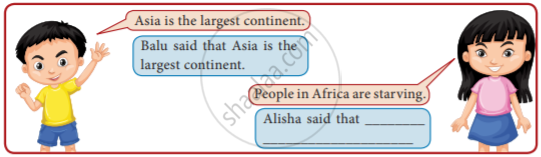
Read the different verb form where they remain the same in the direct and indirect speech in the following case. Fill in the blank with missing indirect speech.
We do not usually change the modal verbs must and needn’t. But must can become had to or would have to and needn’t can become didn’t have to or wouldn’t have to if we want to express an obligation. Would/wouldn’t have to are used to talk about future obligations.

Mathew is a very busy man.
What do you do in that session?
Answer the following
Complete this poem on your own with a abab rhyme scheme.
Peas porridge hot,
Peas porridge cold,
__________________
__________________
Identify a sentence and a phrase which tells us that the story took place in summer.
Imagine that you and your friend have decided to spend a day together in your house. You have planned your schedule from morning till night. Discuss in pairs and speak about it in the class. You can start like this:
I like to go for a walk but my friend wants to work out in the gym.
Imagine you are Mowgli. Which animal would you befriend? What kind of adventure would you like in the forest? Make use of the hints below to talk about it.
- Hi, I’m Mowgli. The only human being living in the jungle.
- I have been raised by a pack of wolves, in an Indian forest.
- I go and hunt with my friends for food.
- My close buddy is a ______.
- His/ Her name is______.
- He/ She guides and accompanies me ______.
- We enjoy loitering in the jungle by ______.
- The jungle where we live is______.
- On the whole, I am ______.
I have a robot big and______.
Write the full form for the following.
she’ll - ______
Work in pairs.
- Ask your friend questions about all the things he does.
- Use question words such as where, what, how, who, when, why. One is done for you.
| Anu | I watch TV in the evening. |
| Amit | When do you watch TV? |
| Anu | I play games. |
| Amit | |
| Anu | |
| Amit | |
| Anu | |
| Amit | |
| Anu | |
| Amit |
Answer these questions about yourself.
- What is your name?
- What languages do you speak?
- How old are you?
- Which is your favourite food?
- Where did you go yesterday?
- Which country do you belong to?
- When do you go to sleep?
- Why do you drink milk?
Sometimes we join two words to make a describing word. For example, Rip was a good-natured man, everybody liked him. Here are some more describing words. Use them to complete the given paragraph.
| long-sleeved | high-heeled | well-dressed | open-mouthed |
| sweet-looking | odd-looking | part-time |
Mrs. Das has a _______ job in a clothes shop. Yesterday, an _______ woman walked into the shop. She was wearing _______ . shoes. A _______ dog was with her. “I want a _______ shirt for my dog, please,” she said. “For your dog?” asked Mrs. Das, _______ in surprise. “Yes,” replied the woman. “I want him to be for my next party.”
The people who live in cities often wish they could live in quiet towns. Do you like the place you live in?
Tell your partner two things you like and don't like about the place you live in.
Betty bought a bit of butter,
But the bit of butter that Betty bought was bitter.
So Betty bought some better butter,
To make the bitter butter better.
Look at the picture again. Describe the picture.

|
beneath, breeze, meet, fear, each, meadow. |
Imagine you are Alice and your partner is a rabbit. What would you do?
Have you ever been very frightened? Tell your partner about it.
Where did the tip of the tongue touch?
Spell these words through hand signs
- Helen
- was
Shakespeare describes the characteristics of the various stages of man. You are in the second stage of life. What do you think of your roles and responsibilities at this stage? Discuss with your partner and share your ideas with the class
Now it’s your turn to speak against the motion “Wars create more problem than they solve.” Express your views with valid points.
- The Vellore was h held in 1801.
- The family members of Tippu were imprisoned at Vellore Fort after the fourth Mysore war.
- At the time of Vellore revolt, the Governor of Madras was lord William Bentinck.
- The victory of revolt of Vellore against British was one of the significant event in the history of india.
