Advertisements
Advertisements
प्रश्न
Where did the tip of the tongue touch?
Advertisements
उत्तर
It touches the teeth ridge.
APPEARS IN
संबंधित प्रश्न
Figures of speech
Anaphora: Repetition of a word or a phrase at the beginning of a sequence of sentences, paragraphs, and lines.
(e.g.) How handsome are your gauzy wings, how brilliant are your eyes!
Identify the figures of speech.
”Your eyes are like the diamond bright, but mine are dull as lead!”
Read the following dialogue and report it.
| Johnson | “What are you doing here, Suganthi? I haven’t seen you since June.” |
| Suganthi | “I’ve just come back from my holiday in Ooty.” |
| Johnson | “Did you enjoy it?” |
| Suganthi | “I love Ooty. And the people were so friendly.” |
| Johnson | “Did you go to Coakers Walk?” |
| Suganthi | “It was my first trip. I can show you some pictures. Are you doing anything tomorrow?” |
| Johnson | “I must arrange a couple of things. But I am free tonight.” |
| Suganthi | “You might come to my place. At what time shall we meet?” |
| Johnson | “I’ll be there at eight. Is it all right?” |
Johnson asked Suganthi ______. And he said ______ since June. Suganthi explained that ______ back from her holiday in Ooty. Johnson wondered if ______ it. Suganthi told him that she ______ Ooty and that the people ______ so friendly. Johnson wanted to know ______ to the Coakers Walk. Suganthi said that its first trip and that she some pictures. And then she asked him if he Johnson explained that he ______ a couple of things. But he added that he ______ free at night. Suganthi suggested that he ______ place and asked him at what time ______. Johnson said he ______ there at eight. And finally, he asked ______ all right.
Mathew is a very busy man.
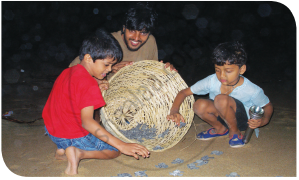
Look at the picture. Work in groups and give a short talk about it using the words given below.
- sand
- waves
- when
- as soon as
- collect
- enjoy
- hatchlings
- basket
- boys
- night
- rough sea
- many
- eggs
- incubate
- hatchery
- after
|
Volunteers of the Students Sea Turtle Conservation Network (SSTCN) release Olive Ridley hatchlings into the sea. |
Change the following into Indirect Speech.
“Run away, children,” said their mother.
Present your sport to the class in four to five sentences.
These phrases will help you.
- I like to play ______.
- I play______ regularly with my friends.
- ______is an indoor/outdoor game.
- ______game requires______ players.
- ______has ______these equipments.
- ______ generally played in a court/ground.
- I enjoy playing______ game.
Travelling can help a person to understand and appreciate different places. Discuss in groups and talk about the places you have visited recently. Present your experiences to the class.
See how they speak at this situation and practise as if you were in that situation.
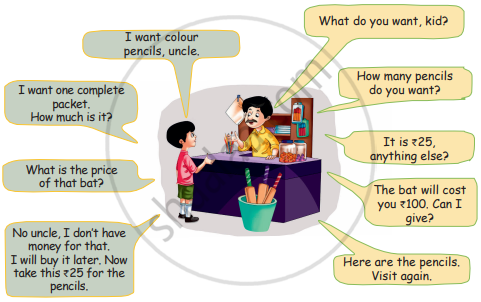
Speak and win.
Join any group. Pick and support any one of the characters. Say some sentences for the one you support and say some sentences against another one to win.
| I support the archer ______ |
| I support the old man ______ |
The Maharaja was a wise man and ordered the cook to use the vegetable scraps instead of throwing them away.
- Name some of the things which are thrown away at home or in school.
- Sit in groups of four and think of interesting ways in which they can be made useful.
- Put up your findings on the class board.
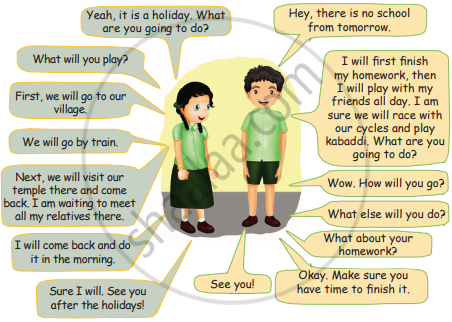
A boy and a girl are talking about their holidays.
Have you ever been very frightened? Tell your partner about it.
Do you think that –
Hiawatha called the birds ‘chickens’ and the beasts ‘brothers’? What do you think this shows?
What are the different kinds of books in this bookshop or in any other bookshop you have seen? Tell the class.
What do you think the naughty boy would see in India?
Have you ever seen a puppet?
‘Forgetfulness is the beginning of happiness’- Do you agree or disagree? Discuss in class.
Now, write a set of 8 to 10 instruction for the following situation.
A doctor instructing a patient regarding a healthy diet and proper care after a surgery.
Conduct a debate for and against the motion.“Mobile phone - a big boon”
