Advertisements
Advertisements
प्रश्न
What is the word that starts with 'c' , rhymes with ‘near’ and ‘fear’, and means easy to see, hear and understand?
Advertisements
उत्तर
Clear
APPEARS IN
संबंधित प्रश्न
Figures of speech
Anaphora: Repetition of a word or a phrase at the beginning of a sequence of sentences, paragraphs, and lines.
(e.g.) How handsome are your gauzy wings, how brilliant are your eyes!
Identify the figures of speech.
”Your eyes are like the diamond bright, but mine are dull as lead!”
Figures of speech
Consonance: Repetition of similar consonant sounds in the neighbouring words.
(e.g.) It's the prettiest little parlour that ever you did spy; Pick out one more instance of consonance from the poem.
Divide the students into groups of five and conduct a group discussion on the topic "Importance of Mathematics in Our Everyday Life". The teacher will act as a moderator.
As a child I spent my free time ______.
Collect images of some electronic gadgets and play a JAM (just a minute) game by picking one image and talking for a minute about it in your classroom.
“Where does Helen live?”
Jim wants to know where ______.
“Do you know why she is unhappy?”
He asked me if ______ unhappy.
“How many photos have you got?”
He wants to know how many ______.
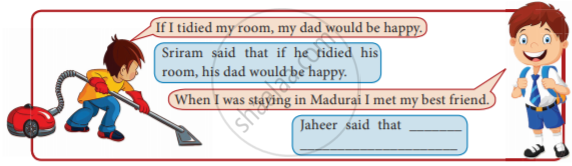
Read the different verb form where they remain the same in the direct and indirect speech in the following case. Fill in the blank with missing indirect speech.
In if-clauses and time-clauses.
Read the conversation of the simple machines. Take roles to play. Then discuss in pairs to describe any simple machine. Create your own storyboard and take roles to play.
Jack: Don't you know how simple machines make your life easy?
Jimmy: Um... I don't know what simple machines are.
Jack: Simple machines are mechanical devices for applying force like a wedge or ramp.
Jimmy: Oh! wow! How I did not know this!
Jack: Like the wheels on hospital bed and IV pole. They help you move people faster by reducing the friction.
Jimmy: Is the stick over there that the TV is attached to, is that a simple machine too?
Jack: Yes it is, it's a lever. The wheels on the bus are simple machines, they make the bus move.
Jimmy: What about the doors?
Jack: 'Yeah' the driver pulls a lever and the doors open and you climb up the inclined plane aka the stairs. The cable in the elevator is wrapped around a groove in the wheel and axle, an electric motor pulls the cable, lifting the car between floors.
Jimmy: So the wheels on the rolling chair are too by rolling the chair back instead of lifting the chair back.
Jack: 'Yes' they are, they move the chair and reduce the friction.
Your family has decided to go on a tour during the vacation. You are calling a travel agency and seeking information regarding package, places of visit, cost etc. Work in pairs and role play as a receptionist and a customer.
Imagine that you are going to interview one of the survivors of the Pan Am Hijack. Discuss with your partner and write down the conversation. Then one of you play the role of the interviewer and other the survivor. You can use the sample questions given below.
- Do you have any information regarding the suspects of the hijack?
- Which countries did the hijackers belong?
- What are the details of the hijacked flight?
- How many passengers were aboard?
- What happened in the last few minutes of the hijack drama?
- Do you have information regarding the victims?
- Was there any recorded communication to/from the plane during the hijacking?
- How many terrorists were there?
- How did you feel when you were in the flight?
- Can you recall Neerja’s role in safeguarding the passengers?
Read the story board and take roles as pilot and flight attendants to enact the scene.
Answer the following:
|
A Tiny Little Plant Deep in the heart of a little seed, Out came the bright Sunshine, A little plant woke up to see, |
List the rhyming words in the first three lines.
Change the following into Indirect Speech.
“Halt!” shouted the officer to his men.
Change the following into Indirect Speech.
He said, “Daughter, take my golden jug, and fetch me some water from the Well.”
Using the following clues write about yourself in the space below — name, place you live in, physical features, habits, likes and dislikes, etc.
Betty bought a bit of butter,
But the bit of butter that Betty bought was bitter.
So Betty bought some better butter,
To make the bitter butter better.
Spell these words through hand signs
- Helen
- was
There are many reasons why something happens.
For example
| Event | Reasons |
|
|
