Topics
Introduction to Indian Society
- Study of Indian Society: Sociological Connections with History and Anthropology
- Study of Indian Society
- Religious Beliefs and Practices in Ancient India
- Religion in Ancient Indian Civilizations
- Jainism and Buddhism in Ancient India
- Religious Beliefs and Practices in Medieval India
- Status of Women in Indian Society
- Nature of Education in Ancient and Medieval India
- Social Life in Ancient and Medieval India
- Urbanisation in Ancient India
- Concept of Sociological Imagination
- Colonial Period in India
- Effects of Colonialisation in India
- Factors Affecting Post-Independence India
- Overview of Introduction to Indian Society
Segments of Indian Society
- Introduction to Segments of Indian Society
- The Tribal Community in India
- Tribal Development in India
- Exploitation and Problems of the Indian Tribal Community
- The Rural Community in India
- Rural Development in India (Sociological Perspective)
- The Urban Community in India
- Urban Development in India
- Overview of Segments of Indian Society
Diversity and Unity in Indian Society
- Introduction of Diversity and Unity in Indian Society
- Diversity in Indian Society
- Unity in Diversity
- Challenges to National Unity
- Factors that Are Responsible for Economic Inequality in Society
- Overview of Diversity and Unity in Indian Society
Processes of Social Change in India
- Industrialisation
- Urbanisation in India
- Modernisation
- Digitalisation
- Factors Responsible for Social Change
- Overview of Processes of Social Change in India
Social Movements in India
- Meaning and Nature of Social Movement
- Types of Social Movements
- Causes of Social Movements
- Social Movements and Social Change
- Womens’ Movement in India
- Workers’ Movements
- Farmer's Movements
- Environmental Movement in India
- Overview of Social Movements in India
Social Problems in India
- Social Problem
- Ageing
- The Problems of Ageing
- Measures to Tackle the Problems of Ageing
- Concept of Unemployment
- Causes of Unemployment
- General Measures to Reduce Unemployment
- Farmers’ Suicide
- Causes of Farmers’ Suicide
- Consequences of Farmers’ Suicides
- Measures to Tackle the Problem of Farmer Suicides
- Domestic Violence
- Causes of Domestic Violence
- Consequences of Domestic Violence
- Measures to Deal with Domestic Violence
- Addiction (Substance, Internet, Mobile)
- Types of Addiction
- Causes of Addiction
- Consequences of Addiction
- Measures to Tackle Addiction Problems
- Overview of Social Problems in India
Passages
- Passages
- Definition: Tribal Development
- Definition: Panchsheel Principles for Tribal Development
- Overview: Panchsheel Principles for Tribal Development
- Panchsheel Principles for Tribal Development Explained
- Timeline: India’s Changing Tribal Policies
- Overview: Government's Efforts for Tribal Development
- Major Tribal Development Schemes and Programmes
- Constitutional Provisions for Tribal Welfare
- Key Takeaways
Definition : Tribal Development
Tribal development means improving the lives of tribal people by giving them better education, health, jobs, and living facilities while also protecting their culture, land, and traditions
Definition : Panchsheel Principles for Tribal Development
The Panchsheel principles for tribal development mean guiding tribal progress in a way that helps them grow with dignity and self-reliance, protects their land and culture, and measures success by the improvement in their quality of life rather than by statistics.
Overview : Panchsheel Principles for Tribal Development
- The Panchsheel Principles for Tribal Development were created by Pandit Jawaharlal Nehru, India’s first prime minister, to guide how the government works with tribal communities.
- He wanted these principles to make sure that tribal people could progress in ways that respect their traditions and dignity and that programs for their development would actually improve their everyday lives, not just look good on paper.
- These ideas encourage the government to support tribals in a fair and caring way, focusing on their needs, rights, and the kind of growth that matters most to them.
Panchsheel Principles for Tribal Development Explained
| Principle | Description |
|---|---|
| Development along their own genius |
|
| Protect rights to land and forests |
|
| Train local people for leadership | Encourage and educate tribal youth to take up administrative, teaching, and development roles. |
| Avoid overadministration. | Policies must not overwhelm tribal areas with too many schemes or external officials. |
| Focus on quality of life | Measure success by better living conditions, health, and dignity—not by statistics. |
Timeline: India’s Changing Tribal Policies
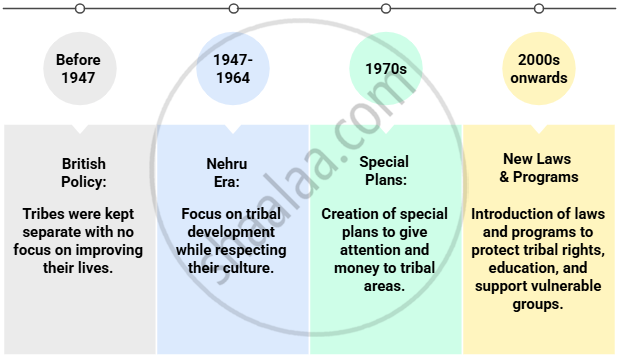
Overview : Government's Efforts for Tribal Development
- After India became independent, the government made helping tribal communities a top priority by protecting their unique culture and giving them support for education, health, jobs, and better living conditions.
- Special plans were created, like the Tribal Sub-Plan and Eklavya Schools, and laws were passed to protect tribal land rights and provide reservations in government jobs and schools.
- The government also set up councils and special funds to make sure tribal voices are heard and their areas get extra attention and support, aiming for their progress without forcing them to give up their traditions or way of life.
Major Tribal Development Schemes and Programmes
| Scheme/Programme Name | Objective |
|---|---|
| Tribal Sub-Plan (TSP) | Started in 1974–75 to earmark funds for tribal-dominated regions. |
| Integrated Tribal Development Projects (ITDP) | Focused on area-based growth. |
| Eklavya Model Residential Schools (EMRS) | Provide quality education to tribal children. |
| Adivasi Mahila Sashaktikaran Yojana (AMSY) | Empowers tribal women through skill development. |
| Vanbandhu Kalyan Yojana (VKY) | Focus on livelihood, education, and infrastructure. |
| Pradhan Mantri PVTG Mission | Focused on Particularly Vulnerable Tribal Groups |
| Pradhan Mantri Van Dhan Yojana | Promotes tribal entrepreneurship |
| Forest Rights Act (2006) | Legal recognition of tribal land rights |
| PM Janjatiya Gram Utkarsh Abhiyan | Strengthening rural tribal income & infrastructure |
| 10 Tribal Freedom Fighters’ Museums (2022) | Preserve and celebrate tribal heritage |
Constitutional Provisions for Tribal Welfare
| Article No. | What it Means for Tribals |
|---|---|
| 14 | All people, including tribals, have equal rights and opportunities. |
| 15 | No citizen can be treated unfairly because of their sex, religion, race, or caste. |
| 15(4) | The government can make extra policies to help tribals and other weaker groups progress. |
| 16(4) | Tribals can get reserved government jobs when they are not well represented. |
| 46 | The state must protect tribal education and economy and guard them from injustice. |
| 244(1) | Tribal areas get special rules for local administration and control. |
| 275 | The central government gives extra funds to states for the welfare of tribals. |
| 330 | Some Parliament seats are reserved for tribals. |
| 332 | State Assembly seats are also reserved for tribals. |
| 335 | Tribal job applicants are considered fairly, while keeping government work efficient. |
Key Takeaways
-
Tribal development supports better education, health, jobs, and dignity for tribal communities while respecting their land and traditions.
-
Nehru’s Panchsheel principles guide tribal progress with respect, self-reliance, and human values.
-
The government launched special schemes (like TSP, ITDP, EMRS, Van Dhan Yojana, VKY, and FRA) to help tribals in education, livelihood, women’s empowerment, and land rights.
-
Major policies evolved from British isolation to Nehru’s inclusive vision, then to rights-based and integrated development.
-
Constitutional articles (like 14, 15(4), 16(4), 46, 244, 275, 330, 332, and 335) ensure equal rights, protection, political representation, and special support for tribes.
