Topics
Introduction to Indian Society
- Study of Indian Society: Sociological Connections with History and Anthropology
- Study of Indian Society
- Religious Beliefs and Practices in Ancient India
- Religion in Ancient Indian Civilizations
- Jainism and Buddhism in Ancient India
- Religious Beliefs and Practices in Medieval India
- Status of Women in Indian Society
- Nature of Education in Ancient and Medieval India
- Social Life in Ancient and Medieval India
- Urbanisation in Ancient India
- Concept of Sociological Imagination
- Colonial Period in India
- Effects of Colonialisation in India
- Factors Affecting Post-Independence India
- Overview of Introduction to Indian Society
Segments of Indian Society
- Introduction to Segments of Indian Society
- The Tribal Community in India
- Tribal Development in India
- Exploitation and Problems of the Indian Tribal Community
- The Rural Community in India
- Rural Development in India (Sociological Perspective)
- The Urban Community in India
- Urban Development in India
- Overview of Segments of Indian Society
Diversity and Unity in Indian Society
- Introduction of Diversity and Unity in Indian Society
- Diversity in Indian Society
- Unity in Diversity
- Challenges to National Unity
- Factors that Are Responsible for Economic Inequality in Society
- Overview of Diversity and Unity in Indian Society
Processes of Social Change in India
- Industrialisation
- Urbanisation in India
- Modernisation
- Digitalisation
- Factors Responsible for Social Change
- Overview of Processes of Social Change in India
Social Movements in India
- Meaning and Nature of Social Movement
- Types of Social Movements
- Causes of Social Movements
- Social Movements and Social Change
- Womens’ Movement in India
- Workers’ Movements
- Farmer's Movements
- Environmental Movement in India
- Overview of Social Movements in India
Social Problems in India
- Social Problem
- Ageing
- The Problems of Ageing
- Measures to Tackle the Problems of Ageing
- Concept of Unemployment
- Causes of Unemployment
- General Measures to Reduce Unemployment
- Farmers’ Suicide
- Causes of Farmers’ Suicide
- Consequences of Farmers’ Suicides
- Measures to Tackle the Problem of Farmer Suicides
- Domestic Violence
- Causes of Domestic Violence
- Consequences of Domestic Violence
- Measures to Deal with Domestic Violence
- Addiction (Substance, Internet, Mobile)
- Types of Addiction
- Causes of Addiction
- Consequences of Addiction
- Measures to Tackle Addiction Problems
- Overview of Social Problems in India
Passages
- Passages
- Overview
- Definition: The Constitution of India
- The Constitution’s Impact on Independent India
- The Constitution vs. Other Indian Laws
- Examples: The Constitution’s Impact on Independent India
- Definition: Legislation
- Legislation’s Impact on Independent India
- Examples: Legislation's Impact on Independent India
- Overview: Government Economic Decisions in Post-Independence India
- Examples: Effects of Some Government Economic Decisions
- Overview: Major Government Decisions on Education
- Examples: Major Government Decisions on Education
- Definition: Polity
- Polity in Post-Independence India
- Examples: Polity in Post-Independence India
- Key Takeaways
Overview: Factors Affecting Post-Independence India
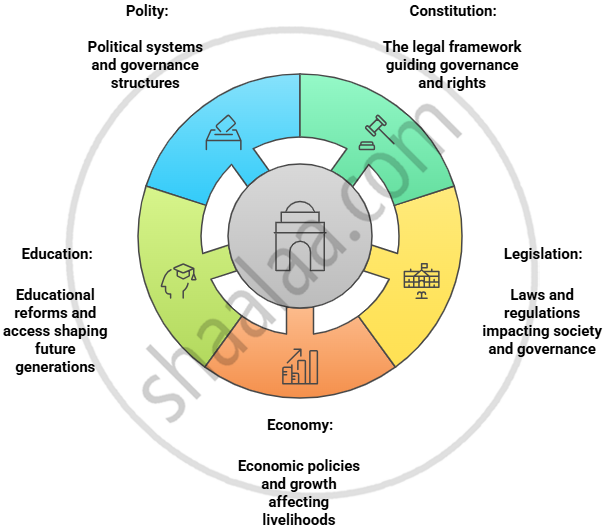
Definition : The Constitution of India
The Constitution of India is the supreme law of our country that explains how the government works, what rights and duties citizens have, and ensures that everyone in India is treated equally, fairly, and freely.
The Constitution’s Impact on Independent India
-
The Constitution ensures all citizens are equal in the eyes of the law (equality before the law).
-
It divides power among the three branches — the Legislature, Executive, and Judiciary — to avoid misuse.
-
It gives power to central and state governments to share responsibilities (federal system).
-
It guarantees fundamental rights like freedom of speech, religion, and education.
-
Directive Principles guide the government to make policies for social welfare and justice.
-
Amendments allow adaptation to changing needs of society.
The Constitution vs. Other Indian Laws
| Aspect | Indian Constitution | Ordinary Laws/Acts |
|---|---|---|
| Nature | Supreme law of the land – the foundation of all other laws | Made under the Constitution; must follow constitutional rules |
| Authority | Drawn up by the Constituent Assembly (1946–1950) | Made by Parliament or State Legislatures |
| Purpose | Defines the structure, powers, and functions of the government; protects citizens’ rights | Regulates specific areas such as education, transport, or health |
| Amendment Process | Can be amended only by a special process (parts require a two-thirds majority) | Can be modified or repealed by a simple parliamentary majority |
| Applicability | Applies to the entirety of India and forms the base of governance | Applies only to specific subjects or fields |
| Judicial Review | All laws must comply with the Constitution; courts can strike down unconstitutional acts | Can be invalidated if they violate constitutional provisions |
Examples : The Constitution’s Impact on Independent India
| Aspect | Constitutional Influence | Post‑Independence Example |
|---|---|---|
| Democracy | Ensures free and fair elections | Conduct of national and state elections by the Election Commission |
| Federal Structure | Divides power between Centre and the states | States have their own governments and legislatures |
| Judicial Review | Courts can check misuse of power | Supreme Court judgments like the Kesavananda Bharati (1973) case established the “basic structure” doctrine |
| Rights & Freedom | Fundamental Rights protect citizens | Right to Education Act (2009) upholds Article 21‑A |
| Social Reforms | Directive Principles influence governance | Abolition of untouchability and introduction of welfare schemes like MGNREGA |
Definition : Legislation
Legislation means the rules and laws made by the government or parliament that everyone in the country must follow.
Overview: Impact of Legislations on Independent India
- After independence, legislation (laws made by Parliament and State Assemblies) became the main tool to implement the Constitution’s ideals.
- Laws have helped shape India’s political, social, and economic systems by ensuring justice, equality, and development for all citizens.
- They provide structure to daily life — from
- These laws protect women and children and manage education, environment, and the economy.
- They help in making India a modern democratic society where all are governed by laws, not by individuals.
Examples: Impact of Legislations on Independent India
| Area of Impact | How Legislation Helped | Key Example Laws/Acts |
|---|---|---|
| Social Justice | Reduced discrimination, promoted equality in society |
|
| Women & Child Protection | Ensured safety, dignity, and rights for women and children |
|
| Economic Development | Created fair rules for trade, planning, and industry |
|
| Education & Health | Made education and healthcare accessible and fair |
|
| Labor & Employment | Protected workers’ rights and improved work conditions |
|
| Environmental Protection | Controlled pollution and promoted sustainability |
|
| Good Governance | Improved transparency and accountability in government |
|
| Others (Safety & Drugs) | Controlled drugs and protected health and society | Narcotic Drugs and Psychotropic Substances Act (1985) |
Overview: Government Economic Decisions in Post-Independence India
- After independence, the Indian government's decisions shaped how the economy grew, who benefited, and how problems were tackled.
- Early choices focused on planning and government control; later, reforms opened the country to more markets, trade, and private enterprise.
- These policies had big effects on jobs, growth, business opportunities, and people's daily lives.
Examples: Effects of Some Government Economic Decisions
| Government Decision | Short-Term Effect | Long-Term Impact |
|---|---|---|
| Creation of Five-Year Plans | Growth of public-sector industries | Industrial base, but less focus on health/education |
| License Raj (strict control of businesses) | Protected Indian companies, jobs | Slowed innovation, enabled corruption |
| Green Revolution policies (1960s–70s) | Increased food production, helped avoid famines | Boosted agriculture, but benefits uneven |
| 1991 Economic Reforms (Liberalization) | Higher economic growth, more jobs, new companies | India became a major world economy |
| GST Implementation (2017) | Simplified taxes, but initial confusion, state losses | Easier inter-state trade, but state revenues down |
| Make in India | More focus on manufacturing, foreign investment | Still mixed results on job creation |
| Demonetisation (2016) | Disrupted cash businesses, especially small firms | Boosted digital payments, but some lasting slowdowns |
Overview: Major Government Decisions on Education
- After independence, the Indian government's choices about education—like setting up new schools and colleges, changing the curriculum, funding infrastructure and teacher training, and passing laws—helped more people get an education and improved the overall quality of learning across the country.
- These policies encouraged social equality, prepared young Indians for modern jobs, and supported economic growth.
Examples: Major Government Decisions on Education
| Government Decision | Impact |
|---|---|
| Establishment of IITs, IIMs, AIIMS | Created world-class engineers, managers, and doctors |
| Sarva Shiksha Abhiyan (SSA, 2001) | Universalized access to elementary education |
| Kothari Commission (1964–66) | Led to reforms and creation of NCERT for curriculum |
| Right to Education Act (2009) | Made schooling a right for children aged 6–14 |
| National Education Policy 2020 | Focus on quality, skills, flexibility, digital learning |
| Funding through Five-Year Plans | Expanded schools, colleges, and universities |
| Moving education to Concurrent List (1976) | Central and state governments share responsibility for education, improving coordination and resources |
| Investment in teacher training | Improved teaching quality and student outcomes |
Definition : Polity
Polity means the way a group, state, or country organizes itself to make decisions, run its government, and ensure everyone follows the rules.
Overview: Polity in Post-Independence India
- After independence, India chose democracy as the foundation of its government.
- This means everyone is equal under the law, people vote to pick leaders and laws, and power is divided among the executive (government), legislature (parliament/assemblies), and judiciary (courts).
- Citizens can vote and even contest in elections from the age of 18. Power is shared between central and state governments, and multiple political parties compete to run the government.
- The opposition ensures the ruling party is kept in check, and everyone's voices are respected to build agreement (consensus).
Examples : Polity in Post-Independence India
| Feature/Principle | Real-Life Example |
|---|---|
| Universal Adult Franchise | All Indians aged 18+ can vote in Lok Sabha elections |
| Multi-Party System | Multiple parties contest elections |
| Federal System | States have their own governments |
| Decentralization | Local self-government through Panchayati Raj and Municipalities |
| Equality before Law | Abolition of royal titles (no more princes, nawabs, rajas); everyone is a citizen |
| Role of Opposition | Parties not in power question government and offer alternatives |
| Free & Fair Elections | Regular peaceful elections supervised by the Election Commission of India |
| Consensus & Plurality | Policies discussed and shaped by different political and social groups before final decisions |
Key Takeaways
- After independence, India shaped its future through democracy, laws, economic plans, and education reforms.
-
The Constitution gave India a foundation of equality, rights, secularism, and distributed power, guiding all other laws.
-
Legislation turned constitutional ideals into real-life improvements—protecting women, children, workers, and the environment and supporting social justice.
-
Government economic policies (Five-Year Plans, liberalization, GST, Make in India) enabled industrial growth, more jobs, and better living standards but also caused new challenges for some groups.
-
Education reforms (IITs/IIMs, Right to Education Act, NEP 2020) expanded access, improved quality, and helped India create a skilled workforce.
-
Polity (form of government) ensured free and fair elections, equality for all citizens, multiple parties, power-sharing between Centre and states, and local self-government.
-
All these decisions built a more inclusive, empowered, and dynamic society.
