Topics
Introduction to Indian Society
- Study of Indian Society: Sociological Connections with History and Anthropology
- Study of Indian Society
- Religious Beliefs and Practices in Ancient India
- Religion in Ancient Indian Civilizations
- Jainism and Buddhism in Ancient India
- Religious Beliefs and Practices in Medieval India
- Status of Women in Indian Society
- Nature of Education in Ancient and Medieval India
- Social Life in Ancient and Medieval India
- Urbanisation in Ancient India
- Concept of Sociological Imagination
- Colonial Period in India
- Effects of Colonialisation in India
- Factors Affecting Post-Independence India
- Overview of Introduction to Indian Society
Segments of Indian Society
- Introduction to Segments of Indian Society
- The Tribal Community in India
- Tribal Development in India
- Exploitation and Problems of the Indian Tribal Community
- The Rural Community in India
- Rural Development in India (Sociological Perspective)
- The Urban Community in India
- Urban Development in India
- Overview of Segments of Indian Society
Diversity and Unity in Indian Society
- Introduction of Diversity and Unity in Indian Society
- Diversity in Indian Society
- Unity in Diversity
- Challenges to National Unity
- Factors that Are Responsible for Economic Inequality in Society
- Overview of Diversity and Unity in Indian Society
Processes of Social Change in India
- Industrialisation
- Urbanisation in India
- Modernisation
- Digitalisation
- Factors Responsible for Social Change
- Overview of Processes of Social Change in India
Social Movements in India
- Meaning and Nature of Social Movement
- Types of Social Movements
- Causes of Social Movements
- Social Movements and Social Change
- Womens’ Movement in India
- Workers’ Movements
- Farmer's Movements
- Environmental Movement in India
- Overview of Social Movements in India
Social Problems in India
- Social Problem
- Ageing
- The Problems of Ageing
- Measures to Tackle the Problems of Ageing
- Concept of Unemployment
- Causes of Unemployment
- General Measures to Reduce Unemployment
- Farmers’ Suicide
- Causes of Farmers’ Suicide
- Consequences of Farmers’ Suicides
- Measures to Tackle the Problem of Farmer Suicides
- Domestic Violence
- Causes of Domestic Violence
- Consequences of Domestic Violence
- Measures to Deal with Domestic Violence
- Addiction (Substance, Internet, Mobile)
- Types of Addiction
- Causes of Addiction
- Consequences of Addiction
- Measures to Tackle Addiction Problems
- Overview of Social Problems in India
Passages
- Passages
- Definition: Sangham Period
- Religious Beliefs in the Sangham Period
- Definition: Schools of Indian Philosophy
- Types of Schools of Indian Philosophy
- Jainism and Buddhism as Protest Religions
- Spread of Buddhism in Ancient India
- Sects in Jainism and Buddhism
- Period of Religious Flux in Ancient India
- Key Takeaways
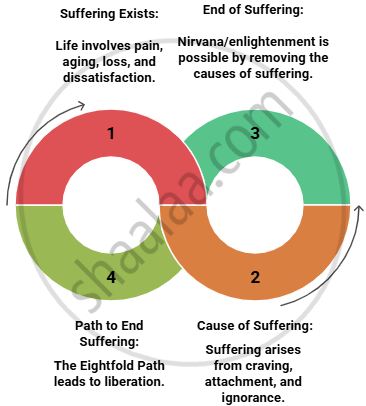
The Four Noble Truths
The Eight Fold Path
| Aspect | What It Means |
|---|---|
| Right View | Understand the Four Noble Truths and reality as it really is |
| Right Intention | Cultivate good motives and intentions |
| Right Speech | Speak truthfully; avoid lies and harmful talk |
| Right Action | Behave ethically; do not harm living beings, steal, or act immorally |
| Right Livelihood | Choose honest and non-harmful work |
| Right Effort | Work to improve yourself and avoid negative thoughts |
| Right Mindfulness | Be aware of your body, mind, and surroundings |
| Right Concentration | Practice focused meditation and deep mental clarity |
The Jataka Tales in Buddhism
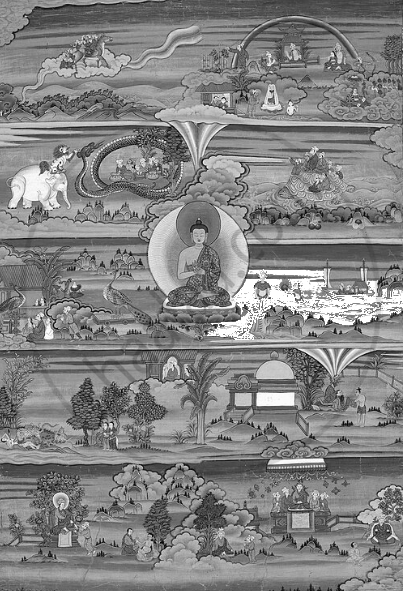
The Jataka Tales are a famous collection of stories from Buddhism that describe the previous lives of the Buddha, where he was sometimes born as a human and sometimes as an animal, and in each story he shows a virtue—like kindness, honesty, or self-sacrifice—to teach moral lessons and inspire people to do good deeds.
These tales are among the oldest Buddhist literature and are still told and illustrated in Buddhist art and texts to teach values in an easy-to-understand way
Definition : Sangham Period
The Sangham Period (around 300 BCE to 300 CE) was a golden age of Tamil literature, poetry, and culture in South India, centered on academies called Sanghams.
Religious Beliefs in the Sangham Period
-
The Sangham (Tamilakam) period in South India saw the coexistence of Hindu, Jain, and Buddhist traditions.
-
Major Tamil deities were Murugan (Seyon), Vishnu (Mayon), Indra (Vendan), Varuna, and the goddess Korravai.
-
Worship centered on nature, hero stones (nadu kal), and local spirits, reflecting animistic traditions.
-
Religion stressed virtue, bravery, and ancestor worship; women poets like Avvaiyar also expressed devotional themes.
-
The people believed in life after death and the immortality of the soul, connecting moral conduct with the afterlife.
Definition : Anthropology
Anthropology is the scientific study of human beings, their societies, cultures, and physical traits, which began as a formal discipline in the 19th century.
Connection between Anthropology and Sociology
| Aspect | Anthropology | Sociology | Connection |
|---|---|---|---|
| What it studies | Human beings, cultures, evolution, traditions | Human societies, groups, interactions, institutions | Both study people, their behavior, and cultures |
| Focus level | Individual, family, and community (micro-level) | Society and groups (macro-level) | Both examine how people connect and organize |
| Main methods | Qualitative (fieldwork, observation, ethnography) | Qualitative and quantitative (surveys, stats, interviews) | Share some research methods, but sociology uses more data/stats |
| Goal | Understand cultural differences, evolution, origins | Solve social issues, understand institutions | Both can help improve understanding of societies |
| Subject overlap | Society, kinship, religion, customs, language, art | Social classes, movements, politics, economics | Often study same topics from different angles |
- Anthropology and sociology are closely related social sciences;
- Both study human life, culture, and behavior
- Anthropology focuses more on cultures and their evolution
- Sociology examines society, groups, and institutions, often using similar research approaches.
Definition : Schools of Indian Philosophy
The Schools of Indian Philosophy, known as Darśanas (meaning “ways of seeing” or “philosophical views”), are the major branches of thought that developed in ancient India to explain reality, knowledge, ethics, and liberation (moksha).
Types of Schools of Indian Philosophy
| Type | Description | Major Schools |
|---|---|---|
| Orthodox (Āstika) | Accept the authority of the Vedas and focus on spiritual knowledge, logic, and liberation | Nyāya, Vaiśeṣika, Sāṃkhya, Yoga, Pūrvamīmāṃsā, Vedānta |
| Heterodox (Nāstika) | Reject the authority of the Vedas and propose different paths to truth and salvation | Charvaka, Ajivika |
Jainism and Buddhism as Protest Religions
- The term “protest religions” refers to religious movements that arose as a reaction against the rigid and ritualistic practices of Vedic Brahminism.
-
Jainism and Buddhism (6th century BCE) protested the dominance of Brahmins, the Vedic emphasis on animal sacrifice, and the caste-based discrimination.
-
Both religions focused on ethical living, non-violence (ahimsa), and salvation through personal conduct rather than ritual purity or birth.
-
They democratized religion by teaching in local languages (Pali and Prakrit) and opening the path of liberation to all, regardless of caste or gender.
Spread of Buddhism in Ancient India
-
Buddhism spread rapidly in India due to its simple teachings, moral appeal, and accessibility.
-
The organized community of monks and nuns, known as the Sangha, played a key role in spreading Buddha’s message.
-
Emperor Ashoka (273–232 BCE) greatly promoted Buddhism after the Kalinga War by sending missions within India and abroad—to Sri Lanka, Myanmar, Central Asia, and the Mediterranean.
-
Trade routes like the Silk Route helped Buddhist ideas and art spread widely.
-
Stupas and monasteries at Sanchi, Sarnath, and Nalanda became important centers of learning.
Sects in Jainism and Buddhism
| Religion | Major Sects | Founder/Period | Key Features |
|---|---|---|---|
| Jainism | Digambara (sky-clad) | Led by Bhadrabahu (4th century BCE) | Monks remain unclothed and practice stricter ascetic practices; women cannot attain salvation. |
| Shvetambara (White-clad) | Led by Sthulabhadra (4th century BCE) | Monks wear white robes; this sect allows women monks (nuns) to attain salvation and preserves canonical texts. | |
| Buddhism | Hinayana (Theravada) | Early Buddhism | Emphasized monastic life and individual salvation, written in Pali, and prevalent in Sri Lanka and Southeast Asia. |
| Mahayana | 1st century BCE onward | Emphasized compassion (bodhisattva ideal), collective salvation, and worship of Buddha as divine. | |
| Vajrayana | 8th century CE | Esoteric form blending rituals and meditation; popular in Tibet and Nepal. |
Period of Religious Flux in Ancient India
- After the decline of early Buddhism and Jainism (around 3rd century BCE–8th century CE), India entered a period of religious flux, where no new major religions arose but many sects and local cults emerged.
- Scholar R. S. Sharma described it as a time of fragmentation and decentralization in religion and polity.
- There was growth of Bhakti movements, blending of local and Vedic gods, and revival of Hinduism with emphasis on devotion (Bhakti) and temple worship.
- This period prepared the ground for medieval Hindu traditions.
Key Takeaways
- Harappan Religion: Early urban culture worshipped nature, mother goddesses, and animal spirits, using figurines and symbols without formal temple or idol worship.
- Vedic Religion: Began with flexible rituals honoring nature gods; evolved into complex ceremonies and rigid social divisions (varna, later jati); introduced core ideas like karma and rebirth.
- Law of Karma & Purusharthas: Ancient Indians believed your actions determine future outcomes (karma); Hinduism teaches four aims—dharma (duty), artha (wealth), kama (desire), and moksha (liberation).
- Jainism & Buddhism: Emerged as "protest religions" against Brahmin dominance and ritualism, caste—focused instead on ethical living, nonviolence, and spiritual equality.
- Jainism: Led by 24 Tirthankaras. Core practices include absolute non-violence (ahimsa), penance (tapas), and the pursuit of nirvana. The Sola Sati (sixteen virtuous women) are ideals of faith and purity.
- Buddhism: Founded by Buddha; teaches the Four Noble Truths and the Eightfold Path; emphasizes ending suffering, compassion, and meditation.
- Jataka Tales: Buddhist stories about Buddha’s past lives, teaching virtues through easy-to-understand animal and human fables.
- Schools of Indian philosophy are organized traditions of thought from ancient India that systematically explore questions about reality, knowledge, ethics, and spiritual liberation, each offering distinctive ways to understand life and the universe
- Spread of Buddhism: Buddhism spread widely via royal patronage (Ashoka), monastic communities, and trade routes across India and beyond.
- Sects in Jainism & Buddhism: Jainism is split into Digambara (sky-clad) and Shvetambara (white-clad); Buddhism is split into Hinayana (Theravada), Mahayana, and Vajrayana.
- Sangam Period Beliefs: The South Indian Sangam era saw worship of nature, ancestors, hero stones, and local deities, blending Hindu, Jain, and Buddhist traditions.
- Anthropology & Sociology Connection: Both study society, culture, and human behavior, using similar methods but focusing on different levels and topics.
- Period of Religious Flux: Following the rise of Buddhism and Jainism, India experienced centuries of religious diversity, with the emergence of numerous new sects and the blending of local and mainstream beliefs.
