Topics
Introduction to Indian Society
- Study of Indian Society: Sociological Connections with History and Anthropology
- Study of Indian Society
- Religious Beliefs and Practices in Ancient India
- Religion in Ancient Indian Civilizations
- Jainism and Buddhism in Ancient India
- Religious Beliefs and Practices in Medieval India
- Status of Women in Indian Society
- Nature of Education in Ancient and Medieval India
- Social Life in Ancient and Medieval India
- Urbanisation in Ancient India
- Concept of Sociological Imagination
- Colonial Period in India
- Effects of Colonialisation in India
- Factors Affecting Post-Independence India
- Overview of Introduction to Indian Society
Segments of Indian Society
- Introduction to Segments of Indian Society
- The Tribal Community in India
- Tribal Development in India
- Exploitation and Problems of the Indian Tribal Community
- The Rural Community in India
- Rural Development in India (Sociological Perspective)
- The Urban Community in India
- Urban Development in India
- Overview of Segments of Indian Society
Diversity and Unity in Indian Society
- Introduction of Diversity and Unity in Indian Society
- Diversity in Indian Society
- Unity in Diversity
- Challenges to National Unity
- Factors that Are Responsible for Economic Inequality in Society
- Overview of Diversity and Unity in Indian Society
Processes of Social Change in India
- Industrialisation
- Urbanisation in India
- Modernisation
- Digitalisation
- Factors Responsible for Social Change
- Overview of Processes of Social Change in India
Social Movements in India
- Meaning and Nature of Social Movement
- Types of Social Movements
- Causes of Social Movements
- Social Movements and Social Change
- Womens’ Movement in India
- Workers’ Movements
- Farmer's Movements
- Environmental Movement in India
- Overview of Social Movements in India
Social Problems in India
- Social Problem
- Ageing
- The Problems of Ageing
- Measures to Tackle the Problems of Ageing
- Concept of Unemployment
- Causes of Unemployment
- General Measures to Reduce Unemployment
- Farmers’ Suicide
- Causes of Farmers’ Suicide
- Consequences of Farmers’ Suicides
- Measures to Tackle the Problem of Farmer Suicides
- Domestic Violence
- Causes of Domestic Violence
- Consequences of Domestic Violence
- Measures to Deal with Domestic Violence
- Addiction (Substance, Internet, Mobile)
- Types of Addiction
- Causes of Addiction
- Consequences of Addiction
- Measures to Tackle Addiction Problems
- Overview of Social Problems in India
Passages
- Passages
- Definition: Rural Development
- A.R. Desai’s View on Rural Social Change
- Major Government Efforts for Rural Development
- Land Reforms in Rural India
- Definition: The Rural-Urban Continuum
- Mutual Influences Between Rural and Urban Areas
- Major Social Changes in Rural India
- Challenges for Rural Development
- Future Steps for Rural Development
- Key Takeaways
Definition : Rural Development
Rural development means improving the living conditions, income, and opportunities of people in villages by providing better education, jobs, healthcare, and infrastructure like roads and electricity
A.R. Desai’s View on Rural Social Change
- Sociologist A.R. Desai studied how Indian villages changed after independence due to developmental efforts.
- He identified four major trends in rural transformation:
| Trend | Meaning |
|---|---|
| From Subsistence to Market Economy | Shift from growing food for self-use to commercial production |
| Modern Technology | Use of modern tools, irrigation, fertilizers, etc. |
| End of Intermediaries | Zamindari system abolished, giving land to actual cultivators |
| New Associations | Formation of organizations linked to urban and national institutions |
Major Government Efforts for Rural Development
| Scheme/Programme | Year | Purpose/Outcome |
|---|---|---|
| Community Development Programme (CDP) | 1952 | Holistic village development, people’s participation |
| Panchayati Raj | 1957–1959 | Three-tier local self-government (Village → Block → District) |
| Integrated Rural Development Programme (IRDP) | 1979 | Sustainable livelihood for poor families |
| MGNREGA | 2005 | 100 days of wage employment for rural households |
| Pradhan Mantri Gram Sadak Yojana | 2000 | Rural road connectivity |
| Deen Dayal Upadhyaya Grameen Kaushalya Yojana | 2014 | Skill training for rural youth |
| Swarnjayanti Gram Swarozgar Yojana (SGSY) / NRLM | 1999 / 2011 | Self-employment, now part of National Rural Livelihood Mission |
| PM Awaas Yojana-Gramin | 2016 | Houses for poor families |
| Antyodaya Anna Yojana (AAY) | 2000 | Food security for poorest families |
Land Reforms in Rural India
- Land reforms aimed to make land ownership fairer and increase productivity.
| Component | Explanation |
|---|---|
| Abolition of Zamindari system | Old landlords (zamindars) lost their control over village lands. |
| Fixing of land ceilings | There’s a maximum limit on how much land one person can own. |
| Protection of tenant farmers | Farmers renting land from others get more rights and security. |
| Consolidation of fragmented lands | Small, scattered land pieces are joined together to make farming easier. |
Definition : The Rural-Urban Continuum
The rural-urban continuum means that villages and cities are closely connected and blend into each other, with no sharp boundary, and they share ideas, jobs, lifestyles, and influences as people and things move between them.
Mutual Influences Between Rural and Urban Areas
| Aspect | Rural to Urban Influence | Urban to Rural Influence |
|---|---|---|
| Economic | Food, raw materials | Technology, goods, capital |
| Social | Migration of labor, cultural festivals | Media, education, lifestyle changes |
Major Social Changes in Rural India
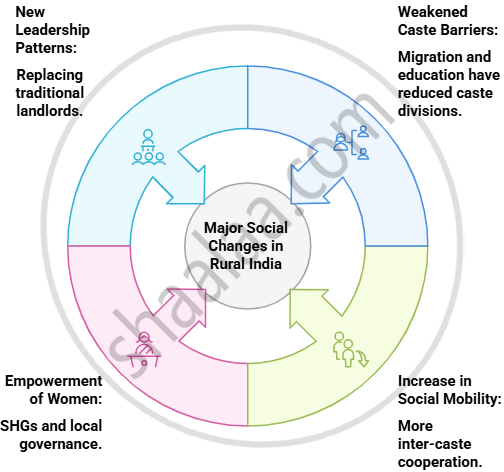
What is an SHG?
- A Self-Help Group (SHG) is a small, informal association of people - usually from similar backgrounds - who pool their money to save, lend, and support each other, often to improve their income or solve common problems.
- SHGs empower women by giving them financial independence, confidence, and a voice in decision-making, helping them start small businesses and improve their status in family and society.
Challenges for Rural Development
| Challenge | Explanation |
|---|---|
| Poverty and unemployment | Many villagers are still poor and don’t have enough jobs. |
| Rural youth migration to cities | Young people leave villages to find work in cities. |
| Environmental issues (chemicals) | Overuse of chemicals in farming harms soil and nature. |
| Gender inequality in property | Women still face unfair rules in owning and inheriting land. |
Future Steps for Rural Development
| Future Step | Explanation |
|---|---|
| Digital literacy & rural entrepreneurship | Teach villagers how to use computers and help them start their own businesses. |
| Strengthening Panchayati Raj Institutions | Give more power and training to local village leaders for better decision-making. |
| Sustainable and organic farming | Support natural farming methods that protect the environment and health. |
Key Takeaways
-
Rural development means improving life in villages by providing better jobs, education, healthcare, and basic facilities.
-
Key government schemes like MGNREGA, Gram Sadak Yojana, IRDP, and Panchayati Raj aim to create jobs, infrastructure, and self-governance in rural areas.
-
Land reforms included ending zamindari, setting limits on land ownership, protecting tenants, and joining scattered farming plots to help make land distribution fairer and farming more efficient.
-
The rural-urban continuum shows there is no strict divide between villages and cities; they are connected by movement of people, jobs, ideas, and lifestyles.
-
SHGs (Self-Help Groups) are small groups where members, mainly women, save money together and support each other to improve their livelihoods.
-
Challenges ahead include poverty, youth moving to cities, environmental problems from chemical farming, and women still having less access to property.
-
Future solutions should focus on digital education in villages, strengthening local decision-making through Panchayati Raj, and encouraging natural and eco-friendly farming.
