Topics
Introduction to Indian Society
- Study of Indian Society: Sociological Connections with History and Anthropology
- Study of Indian Society
- Religious Beliefs and Practices in Ancient India
- Religion in Ancient Indian Civilizations
- Jainism and Buddhism in Ancient India
- Religious Beliefs and Practices in Medieval India
- Status of Women in Indian Society
- Nature of Education in Ancient and Medieval India
- Social Life in Ancient and Medieval India
- Urbanisation in Ancient India
- Concept of Sociological Imagination
- Colonial Period in India
- Effects of Colonialisation in India
- Factors Affecting Post-Independence India
- Overview of Introduction to Indian Society
Segments of Indian Society
- Introduction to Segments of Indian Society
- The Tribal Community in India
- Tribal Development in India
- Exploitation and Problems of the Indian Tribal Community
- The Rural Community in India
- Rural Development in India (Sociological Perspective)
- The Urban Community in India
- Urban Development in India
- Overview of Segments of Indian Society
Diversity and Unity in Indian Society
- Introduction of Diversity and Unity in Indian Society
- Diversity in Indian Society
- Unity in Diversity
- Challenges to National Unity
- Factors that Are Responsible for Economic Inequality in Society
- Overview of Diversity and Unity in Indian Society
Processes of Social Change in India
- Industrialisation
- Urbanisation in India
- Modernisation
- Digitalisation
- Factors Responsible for Social Change
- Overview of Processes of Social Change in India
Social Movements in India
- Meaning and Nature of Social Movement
- Types of Social Movements
- Causes of Social Movements
- Social Movements and Social Change
- Womens’ Movement in India
- Workers’ Movements
- Farmer's Movements
- Environmental Movement in India
- Overview of Social Movements in India
Social Problems in India
- Social Problem
- Ageing
- The Problems of Ageing
- Measures to Tackle the Problems of Ageing
- Concept of Unemployment
- Causes of Unemployment
- General Measures to Reduce Unemployment
- Farmers’ Suicide
- Causes of Farmers’ Suicide
- Consequences of Farmers’ Suicides
- Measures to Tackle the Problem of Farmer Suicides
- Domestic Violence
- Causes of Domestic Violence
- Consequences of Domestic Violence
- Measures to Deal with Domestic Violence
- Addiction (Substance, Internet, Mobile)
- Types of Addiction
- Causes of Addiction
- Consequences of Addiction
- Measures to Tackle Addiction Problems
- Overview of Social Problems in India
Passages
- Passages
- Overview
- Definition: Harappan period in India
- Religious Beliefs in the Harappan Period
- Definition: Vedic Period in India
- Religious Beliefs in the Vedic Period
- Early Vedic Period vs. Later Vedic Period
- The Law of Karma in Hinduism
- The Purusharthas (Four Aims of Hindu Life)
- Varna System vs. Jati System
- Key Takeaways
Overview
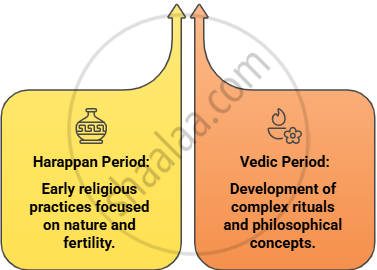
Definition : Harappan Period in India
The Harappan Period, also called the Indus Valley Civilization, was an urban Bronze Age civilization in northwest India and Pakistan, lasting from about 3300 BCE to 1300 BCE, with its mature phase from 2600 BCE to 1900 BCE.
Religious Beliefs in the Harappan Period
The Harappans worshipped:
- Nature (sun, fire, water)
- The Mother Goddess (symbolizing fertility)
- A male god like Pashupati (an early form of Shiva),
- Animals,
- Trees
They practised rituals, possibly without temples or idol worship, using figurines and seals for their beliefs.
Definition : Vedic Period in India
The Vedic Period (about 1500 BCE to 500 BCE) was the era after the Harappan decline, marked by the composition of the Vedas and the rise of early Hindu beliefs and rituals in northern India.
Religious Beliefs in the Vedic Period
In the Vedic period, people
- performed large fire sacrifices led by Brahmin priests, recited hymns to gods like Indra, Agni, and Surya
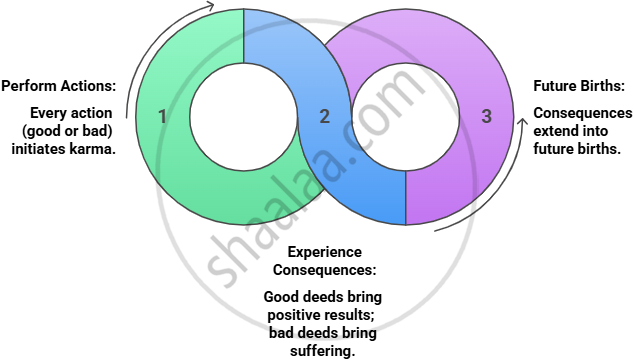
- gradually formed beliefs about karma (actions) and rebirth, with social divisions becoming more rigid over time through the varna and jati system.
Early Vedic Period vs. Later Vedic Period
| Aspect | Early Vedic Period (c. 1500 – 1000 BCE) | Later Vedic Period (c. 1000 – 600 BCE) |
|---|---|---|
| Society | Simple, tribal, and mostly pastoral; flexible social structure | Became agricultural and settled; social divisions hardened |
| Economy | Based on cattle rearing and limited farming; barter system common | Agriculture, trade, and use of coins (Krishnala) expanded |
| Political System | Tribal chiefs (Rajan) chosen by assemblies like Samiti | Hereditary kingship became powerful and monarchical |
| Religion | Nature gods like Indra, Agni, Varuna worshipped; simple rituals | New deities like Vishnu and Shiva emerged; rituals became complex |
| Texts | Rigveda composed | Yajurveda, Samaveda, Atharvaveda, Brahmanas, and Upanishads composed |
| Women’s Status | Women enjoyed respect and freedom and could attend assemblies | Women's status declined; limited participation in rituals |
| Social Order | Caste based on occupation; flexible | Varna system became rigid and birth-based |
| Philosophy | Focus on ritual sacrifices for worldly gains | Shift towards philosophical thought in the Upanishads on Atman and Brahman |
Important Terms:
-
Krishnala:
The Krishnala was a small, ancient coin made of metal, used for buying and selling goods in North India during the Later Vedic period. -
The 4 Vedas:
The four Vedas—Rigveda, Samaveda, Yajurveda, and Atharvaveda—are the oldest and most important Hindu scriptures, written between about 1500 BCE and 500 BCE, containing hymns, rituals, and spiritual knowledge. -
Brahmanas and Upanishads:
Brahmanas are texts explaining Vedic rituals and sacrifices, while Upanishads are philosophical writings that explore deep ideas like the soul (atman) and ultimate reality (brahman), both created after the main Veda hymns. -
Atman and Brahman:
In Hinduism, 'atman' means an individual’s soul or true self, and 'brahman' is the universal spiritual reality; the Upanishads teach that realising atman’s unity with brahman brings ultimate freedom.
The Law of Karma in Hinduism
The Purusharthas (Four Aims of Hindu Life)
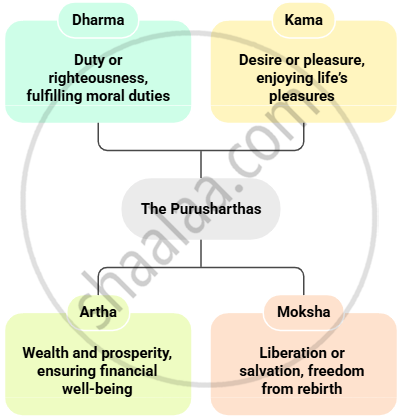
These four aims are meant to guide Hindus toward a well-balanced moral, material, and spiritual life
Varna System vs. Jati System
| Aspect | Varna System | Jati System |
|---|---|---|
| Meaning | The four broad social classes described in ancient texts | The thousands of local birth-based sub-castes within varnas |
| Basis | Division by occupation and function (Brahmin, Kshatriya, Vaishya, Shudra) | Division by birth, community, or region |
| Nature | Ideal social classification in theory | Real, lived social organization in practice |
| Flexibility | Initially fluid; people could change by skill or merit | Rigid and hereditary; defined one’s status from birth |
| Texts Mentioned In | Vedas and Dharmashastras | Mentioned in later social records and customs |
Key Takeaways
- Ancient Indian civilisations laid the foundation for major religious traditions, evolving complex beliefs about cosmic order, morality, rebirth, and liberation.
- The Harappan (Indus Valley) civilisation worshipped nature elements, fertility goddesses, and proto-Shiva figures, practising rituals without temples.
- The Vedic period (1500–500 BCE) introduced ritual fire sacrifices devoted to gods like Indra and Agni and developed core Hindu concepts, including karma, rebirth, and the varna-jati social system.
- Later Vedic society became more settled and rigid, with new deities (Vishnu, Shiva), complex rituals, declining women’s status, and an expanded economy using coins like Krishnala.
- The four Vedas, Brahmanas, and Upanishads are key texts; they outline ritual practices and deep philosophical teachings about atman (self) and brahman (universal spirit).
- The law of karma teaches that all actions have consequences extending across lifetimes.
- The Purusharthas (duty, pleasure, wealth, liberation) guide a balanced Hindu life.
- The varna system is a theoretical four-class hierarchy, while the jati system refers to thousands of hereditary sub-castes defining social identity.
Test Yourself
Related concepts
- Religious Beliefs and Practices in Ancient India - Period of Religious Flux
- Religious Beliefs and Practices in Ancient India - Christianity
