Topics
Linear Equations in Two Variables
Quadratic Equations
- Quadratic Equations
- Factorisation Method
- Completing the Square Method
- Quadratic Formula (Shreedharacharya's Rule)
- Nature of Roots of a Quadratic Equation
- Relation Between Zeroes (Roots) and Coefficients of a Quadratic Equation
- Formation of a Quadratic Equation with Given Roots
- Application of Quadratic Equation
Arithmetic Progression
Financial Planning
- Mathematical Study of GST (Goods and Services Tax)
- GST Structure for Calculations
- Tax Invoice Under GST(Mathematics)
- GST in Trading Chain
- Input Tax Credit (ITC) in Mathematics
- Computational Mechanisms under GST
- Saving and Investment
- Shares
- Brokerage and Taxes on Share Trading
- Mutual Funds and Systematic Investment Plan
Probability
Statistics
Definition: Linear Inequations in Two Variables
An equation which contains two variables and the degree of each term containing a variable is one is called a linear equation in two variables.
General Form:
ax + by + c = 0
Definition: Linear Inequations in One Variables
A linear inequality or inequation, which has only one variable, is called a linear inequality or inequation in one variable.
e.g. ax + b < 0, where a ≠ 0, 3x + 4 > 0
Definition: Linear Inequations
An inequality or inequation is said to be linear if each variable occurs in the first degree only and there is no term involving the product of the variables.
e.g. ax + b ≤ 0, ax + by + c > 0, x ≤ 4
Definition: Convex Set
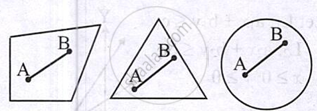
A set of points in a plane is called a convex set if the line segment joining any two points in the set lies entirely within the set.
Definition: Non-Convex Set
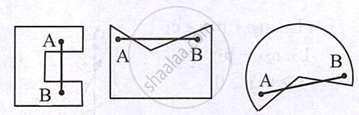
If the line segment joining any two points in the set does not completely lie in the set, then it is a non-convex set.