Advertisements
Chapters
1: Rational and Irrational Numbers
Unit 2: Commercial Mathematics
2: Compound Interest (Stage 1) [Basic Concepts]
3: Compound Interest (Stage 2) [Applications]
Unit 3: Algebra
4: Expansions
5: Factorisation
6: Simultaneous (Linear) Equations [Including Problems]
7: Indices [Exponents]
8: Logarithms
Unit 4: Geometry
9: Triangles [Congruency in Triangles]
10: Isosceles Triangles [Including Inequalities]
▶ 11: Mid-point Theorem and Its Converse [Including Intercept Theorem]
12: Pythagoras Theorem [Proof and Simple Applications with Converse]
13: Rectilinear Figures [Quadrilaterals: Parallelogram, Rectangle, Rhombus, Square and Trapezium]
14: Construction of Polygons (Using ruler and compass only)
15: Area Theorems [Proof and Use]
16: Circle
Unit 5: Statistics and Graph Work
17: Statistics
18: Mean and Median [For Ungrouped Data Only]
Unit 6: Mensuration
19: Area and Perimeter of Plane Figures
20: Solids [Surface Area and Volume of 3-D Solids]
Unit 7: Trigonometry
21: Trigonometrical Ratios [Sine, Consine, Tangent of an Angle and their Reciprocals]
22: Solution of Right Triangles [Simple 2-D Problems Involving One Right-angled Triangle]
Unit 8: Co-Ordinate
23: Co-ordinate Geometry
24: Graphical Solution [Solution of Simultaneous Linear Equations, Graphically]
25: Distance Formula
![Selina solutions for Concise Mathematics [English] Class 9 ICSE chapter 11 - Mid-point Theorem and Its Converse [Including Intercept Theorem] - Shaalaa.com](/images/concise-mathematics-english-class-9-icse_6:e09935b48e334a1e8f06ebb2011509f8.jpg "Selina solutions for Concise Mathematics [English] Class 9 ICSE chapter 11 - Mid-point Theorem and Its Converse [Including Intercept Theorem]")
Advertisements
Solutions for Chapter 11: Mid-point Theorem and Its Converse [Including Intercept Theorem]
Below listed, you can find solutions for Chapter 11 of CISCE Selina for Concise Mathematics [English] Class 9 ICSE.
Selina solutions for Concise Mathematics [English] Class 9 ICSE 11 Mid-point Theorem and Its Converse [Including Intercept Theorem] Exercise 11 (A) [Pages 168 - 169]
Multiple Choice Type: Choose the correct answer from the options given below.
In the given figure, ABCD is a rectangle. As per the given information, the length of PQ is:
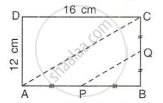
12 cm
14 cm
20 cm
10 cm
The quadrilateral obtained by joining the mid-points (in order) of the sides of quadrilateral ABCD is a ______.
rectangle
rhombus
parallelogram
square
If BC = 12 cm, AB = 14.8 cm. AC = 12.8 cm, the perimeter of quadrilateral BCYX is ______.
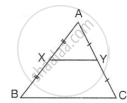
31.8 cm
15.9 cm
29.8 cm
32.8 cm
In the given figure, AB = AC, P, Q and R are mid-points of sides BC, CA and AB, respectively, then ΔPQR is ______.
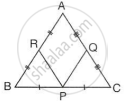
scalene
isosceles
equilateral
obtuse angled
P, Q, R and S are the midpoints of sides AB, BС, CD and DA, respectively, of rectangle ABCD; then quadrilateral PQRS is a ______.
rectangle
rhombus
square
parallelogram
In triangle ABC, M is mid-point of AB and a straight line through M and parallel to BC cuts AC in N. Find the lengths of AN and MN if Bc = 7 cm and Ac = 5 cm.
Prove that the figure obtained by joining the mid-points of the adjacent sides of a rectangle is a rhombus.
D, E, and F are the mid-points of the sides AB, BC and CA of an isosceles ΔABC in which AB = BC.
Prove that ΔDEF is also isosceles.
The following figure shows a trapezium ABCD in which AB // DC. P is the mid-point of AD and PR // AB. Prove that:
PR = `[1]/[2]` ( AB + CD)

The figure, given below, shows a trapezium ABCD. M and N are the mid-point of the non-parallel sides AD and BC respectively. Find:
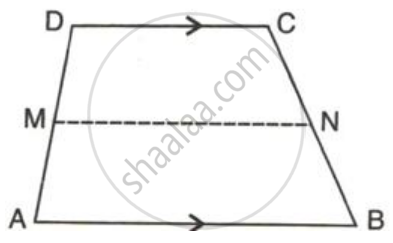
- MN, if AB = 11 cm and DC = 8 cm.
- AB, if DC = 20 cm and MN = 27 cm.
- DC, if MN = 15 cm and AB = 23 cm.
The diagonals of a quadrilateral intersect at right angles. Prove that the figure obtained by joining the mid-points of the adjacent sides of the quadrilateral is rectangle.
L and M are the mid-point of sides AB and DC respectively of parallelogram ABCD. Prove that segments DL and BM trisect diagonal AC.
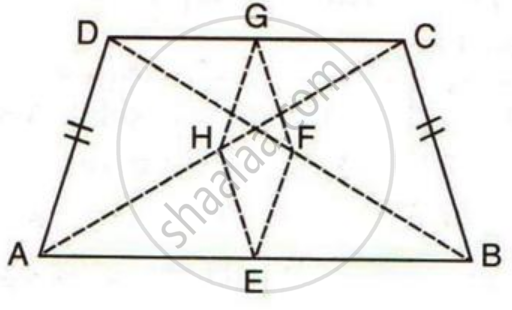
ABCD is a quadrilateral in which AD = BC. E, F, G and H are the mid-points of AB, BD, CD and Ac respectively. Prove that EFGH is a rhombus.
A parallelogram ABCD has P the mid-point of Dc and Q a point of Ac such that
CQ = `[1]/[4]`AC. PQ produced meets BC at R.

Prove that
(i)R is the midpoint of BC
(ii) PR = `[1]/[2]` DB
Selina solutions for Concise Mathematics [English] Class 9 ICSE 11 Mid-point Theorem and Its Converse [Including Intercept Theorem] Exercise 11 (B) [Pages 171 - 172]
Multiple Choice Tуре: Choose the correct answer from the options given below.
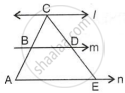
In the given figure, l // m // n and D is mid-point of CE. If AE = 12.6 cm, then BD is ______.
12.6 cm
25.2 cm
6.3 cm
18.9 cm
In a trapezium ABCD, AB//DC, E is midpoint of AD and F is mid-point of BC, then:
2EF = `1/2` (AB + DC)
2EF = AB + DC
EF = AB + DC
EF = `1/2` × AB × DC
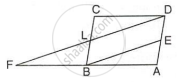
The given figure shows a parallelogram ABCD in which E is mid-point of AD and DL//EB. Then, BF is equal to:
AD
BE
AE
AB
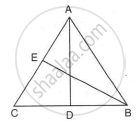
In the given figure, AD and BE are medians; then ED is equal to:
2AB
`1/2` AB
`1/4` AB
`1/8` AB
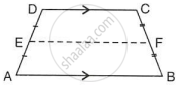
In the quadrilateral ABCD, if AB//CD, E is mid-point of side AD, and F is mid-point of BC. If AB = 20 cm and EF = 16 cm, the length of side DC is:
18 cm
12 cm
24 cm
32 cm
Use the following figure to find:
(i) BC, if AB = 7.2 cm.
(ii) GE, if FE = 4 cm.
(iii) AE, if BD = 4.1 cm
(iv) DF, if CG = 11 cm.

In the figure, give below, 2AD = AB, P is mid-point of AB, Q is mid-point of DR and PR // BS. Prove that:
(i) AQ // BS
(ii) DS = 3 Rs.

The side AC of a triangle ABC is produced to point E so that CE = AC. D is the mid-point of BC and ED produced meets AB at F. Lines through D and C are drawn parallel to AB which meet AC at point P and EF at point R respectively.
Prove that:
- 3DF = EF
- 4CR = AB
In triangle ABC, the medians BP and CQ are produced up to points M and N respectively such that BP = PM and CQ = QN. Prove that:
- M, A, and N are collinear.
- A is the mid-point of MN.
In triangle ABC, angle B is obtuse. D and E are mid-points of sides AB and BC respectively and F is a point on side AC such that EF is parallel to AB. Show that BEFD is a parallelogram.
In parallelogram ABCD, E and F are mid-points of the sides AB and CD respectively. The line segments AF and BF meet the line segments ED and EC at points G and H respectively.
Prove that:
(i) Triangles HEB and FHC are congruent;
(ii) GEHF is a parallelogram.
In triangle ABC, D and E are points on side AB such that AD = DE = EB. Through D and E, lines are drawn parallel to BC which meet side AC at points F and G respectively. Through F and G, lines are drawn parallel to AB which meets side BC at points M and N respectively. Prove that: BM = MN = NC.
In triangle ABC; M is mid-point of AB, N is mid-point of AC and D is any point in base BC. Use the intercept Theorem to show that MN bisects AD.
If the quadrilateral formed by joining the mid-points of the adjacent sides of quadrilateral ABCD is a rectangle,
show that the diagonals AC and BD intersect at the right angle.
Selina solutions for Concise Mathematics [English] Class 9 ICSE 11 Mid-point Theorem and Its Converse [Including Intercept Theorem] TEST YOURSELF [Pages 172 - 174]
Multiple Choice Type: Choose the correct answer from the options given below.
The mid-points of the sides of a triangle are joined together to get four triangles. These four triangles are ______.
not equal to each other.
congruent to each other.
not congruent to each other.
none of these
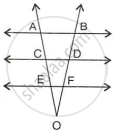
In the given figure, AB//CD//EF. If AC = 7 cm, AE = 14 cm and BF = 20 cm. then DF is equal to:
7 cm
14 cm
10 cm
16 cm
In the given figure, AB//DC//EF and E is mid-point of side AD, then:
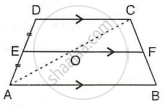
OE : OF = 11 : 3
OE = OF
OF = 2 × OE
CF = FB
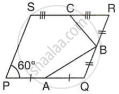
In rhombus PQRS, A, B and C are midpoints of sides PQ. QR and RS, respectively. If ∠P = 60°, the angle PQR is equal to:
60°
90°
120°
none of these
Statement (1): The diagonals of a quadrilateral are perpendicular to each other; P, Q, R and S are mid-points of sides AB, BC, CD and DA, respectively. Then PQRS will be a rectangle.
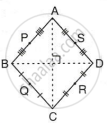
Statement (2): Quadrilateral PQRS will be a square as each of its angles will be 90°.
Both the statements are true.
Both the statements are false.
Statement 1 is true, and statement 2 is false.
Statement 1 is false, and statement 2 is true.
Statement (1): AD is median of triangle ABC and DE is parallel to BA. Then DE will bisect AC.
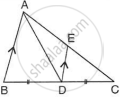
Statement (2): DE is the median of ΔADC.
Both the statements are true.
Both the statements are false.
Statement 1 is true, and statement 2 is false.
Statement 1 is false, and statement 2 is true.
Assertion (A): The figure formed by joining the midpoints of the sides of a quadrilateral ABCD is a square.
Reason (R): Diagonals of the quadrilateral ABCD are not given to be equal and perpendicular to each other.
A is true, R is false.
A is false, R is true.
Both A and R are true, and R is the correct reason for A.
Both A and R are true, and R is the incorrect reason for A.
Assertion (A): R, S, D and E are midpoints of OС, ОВ, АВ, and AC, respectively; then DERS is a parallelogram.
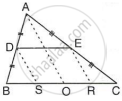
Reason (R): DS//AO//ER and DS = ER = `1/2` AO.
A is true, R is false.
A is false, R is true.
Both A and R are true, and R is the correct reason for A.
Both A and R are true, and R is the incorrect reason for A.
In triangle ABC, D and E are mid-points of the sides AB and AC, respectively. Through E, a straight line is drawn parallel to AB to meet BC at F. Prove that BDEF is a parallelogram. If AB = 8 cm and BC = 9 cm, find the perimeter of the parallelogram BDEF.
P, Q and R are mid-points of sides AВ, ВС and CD, respectively, of a rhombus ABCD. Show that PQ is perpendicular to QR.
The diagonals of a quadrilateral ABCD are perpendicular to each other. Prove that the quadrilateral obtained by joining the midpoints of its adjacent sides is a rectangle.
In ∆ABC, E is the mid-point of the median AD, and BE produced meets side AC at point Q.
Show that BE: EQ = 3: 1.
In the given figure, M is mid-point of AB and DE, whereas N is mid-point of BC and DF.
Show that: EF = AC.
In triangle ABC, D and E are the mid-points of the sides AB and AC, respectively. Through E, a straight line is drawn parallel to AB to meet BC at F. Prove that BDEF is a parallelogram. If AB = 16 cm, AC = 12 cm and BC = 18 cm, find the perimeter of the parallelogram BDEF.
In the given figure, AD and CE are medians and DF // CE.
Prove that: FB = `1/4` AB.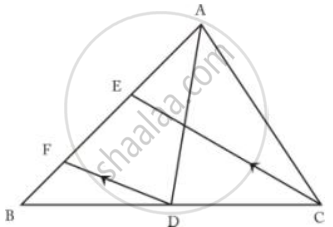
In parallelogram ABCD, E is the mid-point of AB and AP is parallel to EC which meets DC at point O and BC produced at P.
Prove that:
(i) BP = 2AD
(ii) O is the mid-point of AP.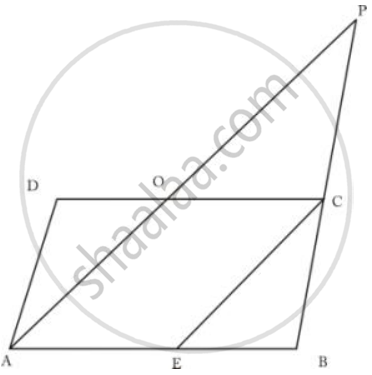
In trapezium ABCD, sides AB and DC are parallel to each other. E is mid-point of AD and F is mid-point of BC.
Prove that: AB + DC = 2EF.
In Δ ABC, AD is the median and DE is parallel to BA, where E is a point in AC. Prove that BE is also a median.
Adjacent sides of a parallelogram are equal and one of the diagonals is equal to any one of the sides of this parallelogram. Show that its diagonals are in ratio √3:1.
Case-Study Based Question
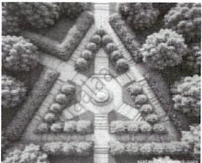
A school is designing a triangular garden ΔАВС. То construct a walking path inside the garden, the gardener marks the mid-points of two sides: point D is the mid-point of side AB and point E is the mid-point of side AC. The path DE is drawn to connect these mid-points. The length of side BC of the triangular garden is 12 m. AB = 10 m and AC = 10 m.
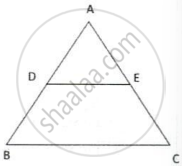
Based on the above information, answer the following:
- What is the length of path DЕ?
- Assign a special name to Quadrilateral BCED and find its perimeter.
Solutions for 11: Mid-point Theorem and Its Converse [Including Intercept Theorem]
Selina solutions for Concise Mathematics [English] Class 9 ICSE chapter 11 - Mid-point Theorem and Its Converse [Including Intercept Theorem]
Shaalaa.com has the CISCE Mathematics Concise Mathematics [English] Class 9 ICSE CISCE solutions in a manner that help students grasp basic concepts better and faster. The detailed, step-by-step solutions will help you understand the concepts better and clarify any confusion. Selina solutions for Mathematics Concise Mathematics [English] Class 9 ICSE CISCE 11 (Mid-point Theorem and Its Converse [Including Intercept Theorem]) include all questions with answers and detailed explanations. This will clear students' doubts about questions and improve their application skills while preparing for board exams.
Further, we at Shaalaa.com provide such solutions so students can prepare for written exams. Selina textbook solutions can be a core help for self-study and provide excellent self-help guidance for students.
Concepts covered in Concise Mathematics [English] Class 9 ICSE chapter 11 Mid-point Theorem and Its Converse [Including Intercept Theorem] are .
Using Selina Concise Mathematics [English] Class 9 ICSE solutions Mid-point Theorem and Its Converse [Including Intercept Theorem] exercise by students is an easy way to prepare for the exams, as they involve solutions arranged chapter-wise and also page-wise. The questions involved in Selina Solutions are essential questions that can be asked in the final exam. Maximum CISCE Concise Mathematics [English] Class 9 ICSE students prefer Selina Textbook Solutions to score more in exams.
Get the free view of Chapter 11, Mid-point Theorem and Its Converse [Including Intercept Theorem] Concise Mathematics [English] Class 9 ICSE additional questions for Mathematics Concise Mathematics [English] Class 9 ICSE CISCE, and you can use Shaalaa.com to keep it handy for your exam preparation.
