Advertisements
Online Mock Tests
Chapters
1: GST [Goods and Service Tax]
2: Banking (Recurring Deposit Account)
3: Shares and Dividend
Unit 2. Algebra
4: Linear Inequations (In one variable)
5: Quadratic Equations
6: Solving (simple) Problems (Based on Quadratic Equations)
7: Ratio and Proportion (Including Properties and Uses)
8: Factorization of Polynomials (Remainder and Factor Theorems)
9: Matrices
10: Arithmetic Progression
11: Geometric Progression
Unit 3. Co-ordinate Geometry
12: Reflection
13: Section Formula and Mid-Point Formula
14: Equation of a Line
Unit 4. Geometry
15: Similarity (With Applications to Maps and Models)
16: Loci (Locus and Its Constructions)
▶ 17: Circles
18: Tangents and Intersecting Chords
19: Constructions (Circles)
Unit 5. Mensuration
20: Cylinder, Cone and Sphere
Unit 6. Trigonometry
21: Trigonometrical Identities
22: Height and Distances
Unit 7. Statistics
23: Graphical Representation
24: Measure of Central Tendency (Mean, Median, Quartiles and Mode)
25: Probability
![Selina solutions for Concise Mathematics [English] Class 10 ICSE chapter 17 - Circles - Shaalaa.com](/images/concise-mathematics-english-class-10-icse_6:7eb8c97e7ccc4a1c956f7ac8305d25e3.jpg "Selina solutions for Concise Mathematics [English] Class 10 ICSE chapter 17 - Circles")
Advertisements
Solutions for Chapter 17: Circles
Below listed, you can find solutions for Chapter 17 of CISCE Selina for Concise Mathematics [English] Class 10 ICSE.
Selina solutions for Concise Mathematics [English] Class 10 ICSE 17 Circles EXERCISE 17 (A) [Pages 257 - 259]
Multiple Choice Type: Choose the correct answer from the options given below.
In the given figure, O is centre of the circle and \[\angle \mathrm{B}=55^{\circ}\]. The angle A is equal to ______.
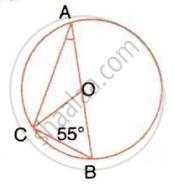
55°
35°
45°
50°
In the given figure, O is centre of the circle and angle OBA = 50°.
The angle P is ______.
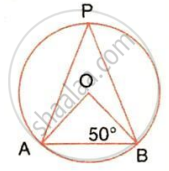
50°
80°
40°
60°
In the given figure, chord AB = chord PB and angle C = 50°. The angle PAB is equal to ______.
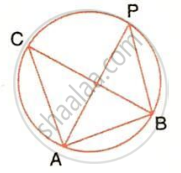
65°
50°
75°
60°
O' and O'' are centres of two circles which intersect each other at points A and B. Then:
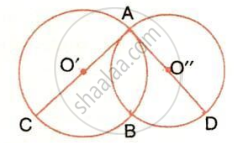
BC = BD
BC is larger than BD.
BC is smaller than BD.
C, B and D are collinear.
In the given figure, O is centre of the circle, AB // DC and ∠ACD = 32°, ∠DAB is equal to:
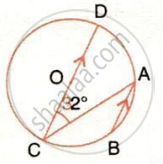
122°
148°
90°
none of the above
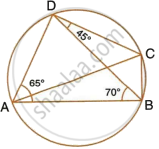
In the given figure, ∠BAD = 65°, ∠ABD = 70°, ∠BDC = 45°
- Prove that AC is a diameter of the circle.
- Find ∠ACB.
In the following figure, O is the centre of the circle. Find the value of a, b, c and d.
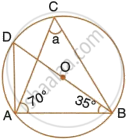
In the following figure, O is the centre of the circle. Find the values of a, b, c and d.
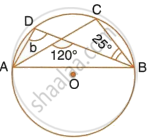
In the following figure, O is the centre of the circle. Find the values of a, b, c and d
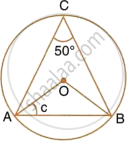
In the following figure, O is the centre of the circle. Find the values of a, b, c and d.
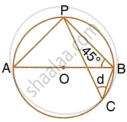
Calculate:
- ∠CDB,
- ∠ABC,
- ∠ACB.
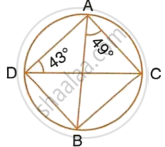
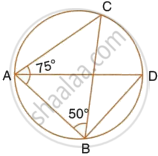
Given: ∠CAB = 75° and ∠CBA = 50°. Find the value of ∠DAB + ∠ABD.
In the figure, given alongside, AOB is a diameter of the circle and ∠AOC = 110°. Find ∠BDC.

In the following figure, O is the centre of the circle, ∠AOB = 60° and ∠BDC = 100°. Find ∠OBC.

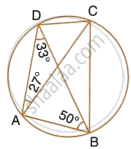
In cyclic quadrilateral ABCD, ∠DAC = 27°; ∠DBA = 50° and ∠ADB = 33°.
Calculate:
- ∠DBC,
- ∠DCB,
- ∠CAB.
In the figure given alongside, AB and CD are straight lines through the centre O of a circle. If ∠AOC = 80° and ∠CDE = 40°, find the number of degrees in:
- ∠DCE,
- ∠ABC.

In the figure, given alongside, AB || CD and O is the centre of the circle. If ∠ADC = 25°; find the angle AEB. Give reasons in support of your answer.

AB is a diameter of the circle APBR as shown in the figure. APQ and RBQ are straight lines. Find : ∠PRB

AB is a diameter of the circle APBR as shown in the figure. APQ and RBQ are straight lines. Find : ∠PBR
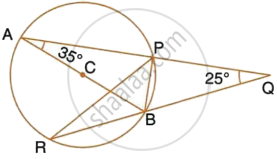
AB is a diameter of the circle APBR, as shown in the figure. APQ and RBQ are straight lines. Find : ∠BPR

In the given figure, A is the centre of the circle, ABCD is a parallelogram and CDE is a straight line. Prove that : ∠BCD = 2∠ABE.

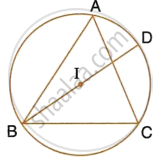
In the given figure, I is the incentre of ΔABC. BI when produced meets the circumcircle of ΔABC at D. ∠BAC = 55° and ∠ACB = 65°; calculate:
- ∠DCA,
- ∠DAC,
- ∠DCI,
- ∠AIC.
In the given figure, AC is a diameter of circle, centre O. Chord BD is perpendicular to AC. Write down the angles p, q and r in terms of x.

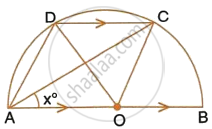
In the given figure, AOB is a diameter and DC is parallel to AB. If ∠CAB = x°; find (in terms of x) the values of :
- ∠COB,
- ∠DOC,
- ∠DAC,
- ∠ADC.
In the given figure, PQ is the diameter of the circle whose centre is O. Given ∠ROS = 42°, calculate ∠RTS.

The given figure shows a circle with centre O and ∠ABP = 42°.
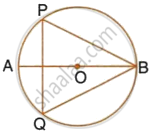
Calculate the measure of:
- ∠PQB
- ∠QPB + ∠PBQ
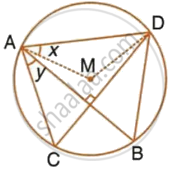
In the given figure, M is the centre of the circle. Chords AB and CD are perpendicular to each other. If ∠MAD = x and ∠BAC = y:
- express ∠AMD in terms of x.
- express ∠ABD in terms of y.
- prove that : x = y.
Selina solutions for Concise Mathematics [English] Class 10 ICSE 17 Circles EXERCISE 17 (B) [Pages 265 - 267]
Multiple Choice Type: Choose the correct answer from the options given below.
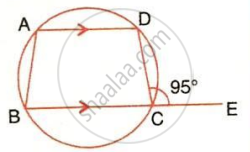
ABCD is a trapezium with AD parallel to BC. Side BC is produced to point E and angle DCE = 95°. Angle B is equal to:
85°
105°
95°
175°
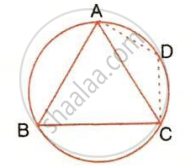
In the given figure, ABC is an equilateral triangle. Angle ADC is:
60°
100°
80°
120°
In the given figure, O is the centre of the circle. ∠OAB and ∠OCB are 30° and 40° respectively. ∠AOC is equal to:
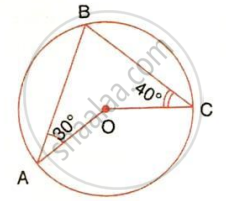
70°
80°
150°
140°
In the given figure APB and CQD are two straight lines, then:
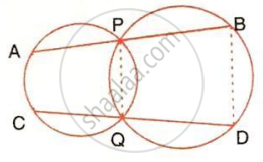
AB // CD
AC // PQ
PQ // BD
AC // BD
In the figure, given below, ∠ABC is equal to:
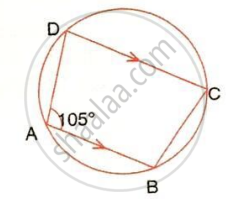
105°
75°
90°
45°
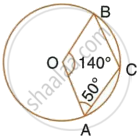
In the given figure, O is the centre of the circle. If ∠AOB = 140° and ∠OAC = 50°; find:
- ∠ACB,
- ∠OBC,
- ∠OAB,
- ∠CBA.
In the figure, given below, ABCD is a cyclic quadrilateral in which ∠BAD = 75°; ∠ABD = 58° and ∠ADC = 77°. Find:
- ∠BDC,
- ∠BCD,
- ∠BCA.

In the following figure, O is centre of the circle and ΔABC is equilateral.
Find:
- ∠ADB,
- ∠AEB.
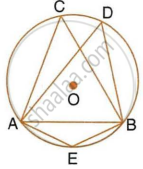
ABCD is a cyclic quadrilateral in a circle with centre O. If ∠ADC = 130°; find ∠BAC.
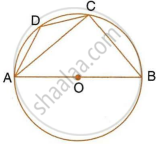
In the following figure,
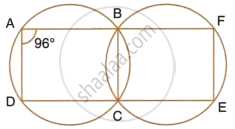
- if ∠BAD = 96°, find ∠BCD and ∠BFE.
- Prove that AD is parallel to FE.
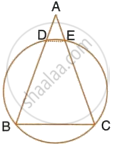
ABCD is a parallelogram. A circle through vertices A and B meets side BC at point P and side AD at point Q. Show that quadrilateral PCDQ is cyclic.
Prove that the parallelogram, inscribed in a circle, is a rectangle.
Prove that the rhombus, inscribed in a circle, is a square.
In the given figure, AB = AC. Prove that DECB is an isosceles trapezium.
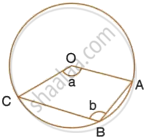
The figure given below, shows a circle with centre O. Given : ∠AOC = a and ∠ABC = b.
-
Find the relationship between a and b.
-
Find the measure of angle OAB, if OABC is a parallelogram.
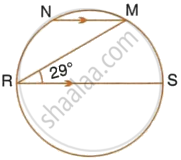
In the given figure, RS is a diameter of the circle. NM is parallel to RS and ∠MRS = 29°. Calculate : ∠RNM

In the given figure, RS is a diameter of the circle. NM is parallel to RS and ∠MRS = 29°. Calculate : ∠NRM
In the given figure, SP is bisector of ∠RPT and PQRS is a cyclic quadrilateral. Prove that : SQ = SR.

In the figure, O is the centre of the circle, ∠AOE = 150°, ∠DAO = 51°. Calculate the sizes of the angles CEB and OCE.

In the figure, given below, P and Q are the centres of two circles intersecting at B and C. ACD is a straight line. Calculate the numerical value of x .

The figure shows two circles which intersect at A and B. The centre of the smaller circle is O and lies on the circumference of the larger circle. Given that ∠APB = a°.
Calculate, in terms of a°, the value of : obtuse ∠AOB,
Give reasons for your answers clearly.

The figure shows two circles which intersect at A and B. The centre of the smaller circle is O and lies on the circumference of the larger circle. Given that ∠APB = a°.
Calculate, in terms of a°, the value of : ∠ACB,
Give reasons for your answers clearly.
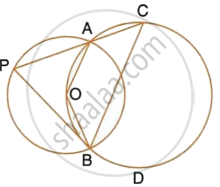
The figure shows two circles which intersect at A and B. The centre of the smaller circle is O and lies on the circumference of the larger circle. Given that ∠APB = a°.
Calculate, in terms of a°, the value of : ∠ADB.
Give reasons for your answers clearly.

In the given figure, O is the centre of the circle and ∠ABC = 55°. Calculate the values of x and y.

ABCD is a cyclic quadrilateral in which AB is parallel to DC and AB is a diameter of the circle. Given ∠BED = 65°, calculate:
- ∠DAB,
- ∠BDC.
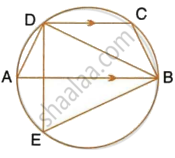
In the given figure, AB is a diameter of the circle. Chord ED is parallel to AB and ∠EAB = 63°.
Calculate:
- ∠EBA,
- ∠BCD.

In the given figure, AB is a diameter of the circle with centre O. DO is parallel to CB and ∠DCB = 120°.
Calculate:
- ∠DAB,
- ∠DBA,
- ∠DBC,
- ∠ADC.
Also, show that the ΔAOD is an equilateral triangle.

Calculate the angles x, y and z if :
`x/3 = y/4 = z/5`

In the given figure, AC is the diameter of the circle with centre O. CD and BE are parallel. Angle ∠AOB = 80° and ∠ACE = 10°.
Calculate:
- Angle BEC,
- Angle BCD,
- Angle CED.

In the given figure, AE is the diameter of the circle. Write down the numerical value of ∠ABC + ∠CDE. Give reasons for your answer.

In the given figure, AOC is a diameter and AC is parallel to ED. If ∠CBE = 64°, calculate ∠DEC.
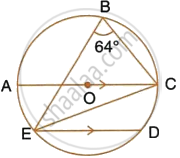
Use the given figure to find:
- ∠BAD,
- ∠DQB.
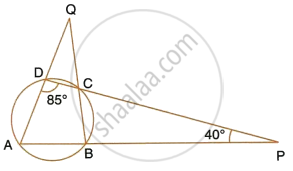
In the given figure, PQ is a diameter. Chord SR is parallel to PQ. Given that ∠PQR = 58°,
Calculate:
- ∠RPQ,
- ∠STP.

AB is the diameter of the circle with centre O. OD is parallel to BC and ∠AOD = 60°. Calculate the numerical values of:
- ∠ABD
- ∠DBC
- ∠ADC
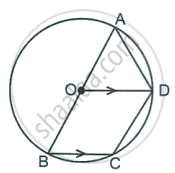
In the given figure, the centre O of the small circle lies on the circumference of the bigger circle. If ∠APB = 75° and ∠BCD = 40°, find :
- ∠AOB,
- ∠ACB,
- ∠ABD,
- ∠ADB.
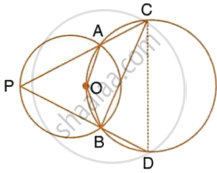
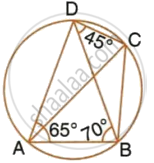
In the given figure, ∠BAD = 65°, ∠ABD = 70° and ∠BDC = 45°. Find:
- ∠BCD
- ∠ACB
Hence, show that AC is a diameter.
Selina solutions for Concise Mathematics [English] Class 10 ICSE 17 Circles EXERCISE 17 (C) [Pages 270 - 271]
Multiple Choice Type: Choose the correct answer from the options given below.
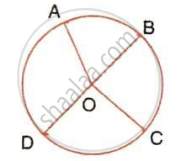
In the given figure, O is the centre of the circle and chord AB : chord CD = 3 : 5. If angle AOB = 60°, angle COD is equal to:
60°
120°
90°
100°
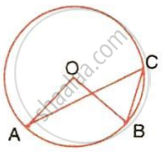
In the given figure, O is the centre of the circle and angle OAB = 55°, then angle ACB is equal to:
55°
35°
70°
30°
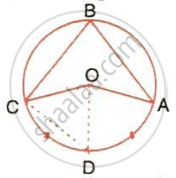
In the given figure, O is the centre of a circle. AB is the side of a square and BC is side of a regular hexagon. Also, arc AD = arc CD. Angle DOC is equal to:
150°
105°
130°
210°
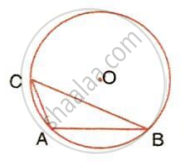
In the given figure, O is the centre of the circle, AB is side of a regular pentagon, then angle ACB is equal to:
36°
72°
50°
40°
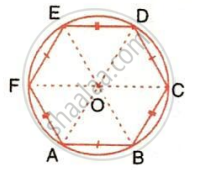
In the given figure, O is the centre of the circle, chords AB, CD and EF are equal whereas chords BC, DE and FA are separately equal. The angle AOC is equal to:
80°
100°
90°
120°
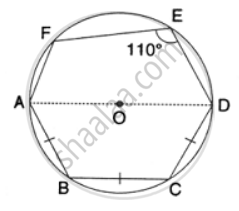
In the following figure, AD is the diameter of the circle with centre O. Chords AB, BC and CD are equal. If ∠DEF = 110°, calculate: ∠AEF

In the following figure, AD is the diameter of the circle with centre O. chords AB, BC and CD are equal. If ∠DEF = 110°, Calculate: ∠FAB.
The given figure shows a circle with centre O. Also, PQ = QR = RS and ∠PTS = 75°.
Calculate:
- ∠POS,
- ∠QOR,
- ∠PQR.

In the given figure, AB is a side of a regular six-sided polygon and AC is a side of a regular eight-sided polygon inscribed in the circle with centre O. Calculate the sizes of:
- ∠AOB,
- ∠ACB,
- ∠ABC.
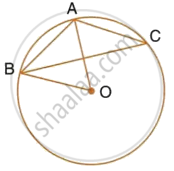
In the given figure, AB = BC = CD and ∠ABC = 132°.
Calcualte:
- ∠AEB,
- ∠AED,
- ∠COD.

In the figure, O is the centre of the circle and the length of arc AB is twice the length of arc BC. If angle AOB = 108°, find: ∠CAB

In the figure, O is the centre of the circle and the length of arc AB is twice the length of arc BC. If angle AOB = 108°, find: ∠ADB.
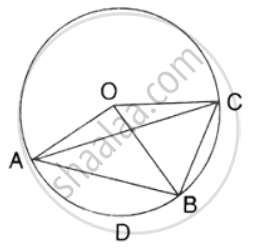
The figure shows a circle with centre O. AB is the side of regular pentagon and AC is the side of regular hexagon. Find the angles of triangle ABC.
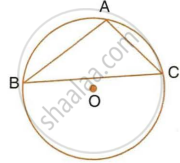
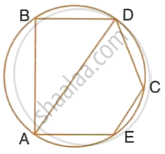
In the given figure, BD is a side of a regular hexagon, DC is a side of a regular pentagon and AD is a diameter.
Calculate :
- ∠ADC,
- ∠BDA,
- ∠ABC,
- ∠AEC.
Selina solutions for Concise Mathematics [English] Class 10 ICSE 17 Circles TEST YOURSELF [Pages 271 - 275]
Multiple Choice Type: Choose the correct answer from the options given below.
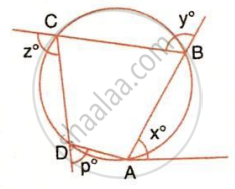
In the given figure x°, y°, z and p° are exterior angles of cyclic quadrilateral ABCD, then x° + y° + z° + p° is ______.
180°
270°
360°
720°
In the given figure, O is centre of the circle and OABC is a rhombus, then:
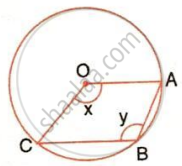
x° + y° = 180°
x° = y° = 90°
x° + 2y° = 360°
x° = y° = 45°
Arcs AB and BC are of lengths in the ratio 11: 4 and O is centre of the circle. If angle BOC = 32°, angle AOB is:.
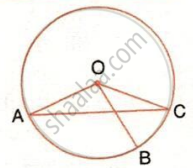
64°
88°
128°
132°
In the given figure, AB is the side of regular pentagon and BC is the side of regular hexagon. Angle APC is:
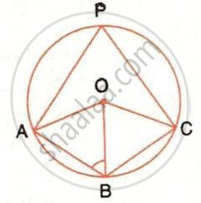
132°
66°
90°
120°
In the given figure, O is centre of the circle. Chord BC = chord CD and angle A = 80°. Angle BOC is:
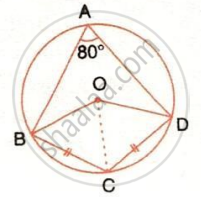
120°
80°
100°
160°
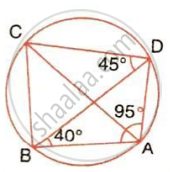
In the given circle, ∠BAD = 95°, ∠ABD = 40° and ∠BDC = 45°.
Assertion (A): To show that AC is a diameter, the angle ADC or angle ABC need to be proved equal to 90°.
Reason (R): In △ADB,
∠ADB = 180° − 95° − 40° = 45°
∴ ∠ADC = 45° + 45° = 90°
A is true, R is false.
A is false, R is true.
Both A and R are true and R is the correct reason for A.
Both A and R are true and R is the incorrect reason for A.
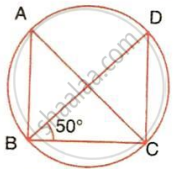
ABCD is a cyclic quadrilateral, BD and AC are its diameters. Also, ∠DBC = 50°.
Assertion (A): ∠BAC = 40°.
Reason (R): ∠BAC = ∠BDC = 180° − (50° + 90°) = 40°
A is true, R is false.
A is false, R is true.
Both A and R are true and R is the correct reason for A.
Both A and R are true and R is the incorrect reason for A .
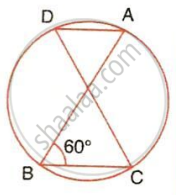
Points A, C, B and D are concyclic, AB is diameter and ∠AВС = 60°.
Assertion (A): ∠BAC = 60°.
Reason (R): AB is diameter so ∠ACB = 90° and ∠ABC + ∠BAC = 90°
A is true, R is false.
A is false, R is true.
Both A and R are true and R is the correct reason for A.
Both A and R are true and R is the incorrect reason for A.
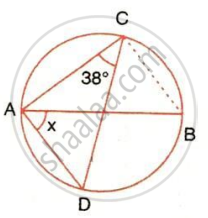
AB is diameter of the circle and ∠ACD = 38°.
Assertion (A): x = 38°.
Reason (R): ∠ACB = 90°
x = ∠DCB
= 90° − 38 = 52°
A is true, R is false.
A is false, R is true.
Both A and R are true and R is the correct reason for A.
Both A and R are true and R is the incorrect reason for A.
Chords AC and BD intersect each other at point P.
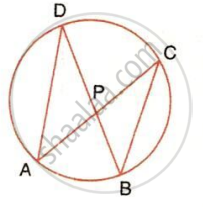
Assertion (A): PA × PC = PВ × PD
Reason (R): Δ APD ∼ Δ BPC
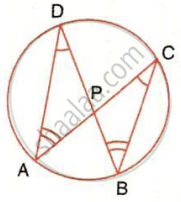
`(PA)/(PB) = (PD)/(PC)`
A is true, R is false.
A is false, R is true.
Both A and R are true and R is the correct reason for A.
Both A and R are true and R is the incorrect reason for A .
A circle with centre at point O and ∠AOC = 160°.
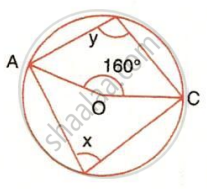
Statement (1): Angle x = 100° and angle y = 80°.
Statement (2): The angle which, an arc of a circle subtends at the centre of the circle is double the angle which it subtends at any point on the remaining part of the circumference.
Both the statements are true
Both the statements are false.
Statement 1 is true, and statement 2 is false.
Statement 1 is false, and statement 2 is true.
AC is diameter, AE is parallel to BC and ∠BAC = 50°.
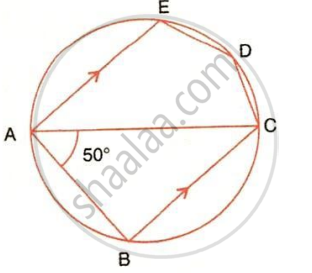
Statement (1): ∠EDC + 50^{\circ} = 180°
Statement (2): ∠EDC + ∠EAC}= 180°
Both the statements are true.
Both the statements are false.
Statement 1 is true, and statement 2 is false.
Statement 1 is false, and statement 2 is true.
O is centre of the circle, OB = BC and ∠BOC = 20°
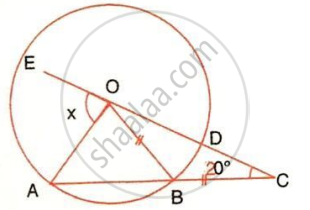
Statement (1): x = 2 × 20° = 40°
Statement (2): ∠BOC = 20°
x = ∠OAB + 20°
= ∠OBA + 20° = 40° + 20° = 60°
Both the statements are true.
Both the statements are false.
Statement 1 is true, and statement 2 is false.
Statement 1 is false, and statement 2 is true.
O is centre of the circle and ∠AOC = 120°.
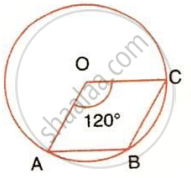
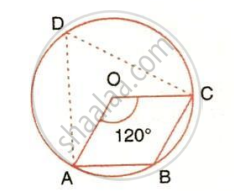
Statement (1): ∠ABC = 120°
Statement (2): ∠ABC + ∠ADC = 180°
⇒ ∠ABC + 60° = 180°
Both the statements are true.
Both the statements are false.
Statement 1 is true, and statement 2 is false.
Statement 1 is false, and statement 2 is true.
In the given circle with diameter AB, find the value of x.

In the given figure, ABC is a triangle in which ∠BAC = 30°. Show that BC is equal to the radius of the circumcircle of the triangle ABC, whose centre is O.

In the given figure, chord ED is parallel to diameter AC of the circle. Given ∠CBE = 65°, calculate ∠DEC.

In the figure, ∠DBC = 58°. BD is diameter of the circle.
Calculate:
- ∠BDC
- ∠BEC
- ∠BAC
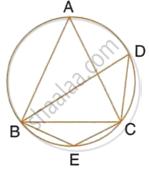
In the given figure, ABCD is a cyclic quadrilateral. AF is drawn parallel to CB and DA is produced to point E. If ∠ADC = 92°, ∠FAE = 20°; determine ∠BCD. Give reason in support of your answer.

If I is the incentre of triangle ABC and AI when produced meets the circumcircle of triangle ABC in point D. If ∠BAC = 66° and ∠ABC = 80°.
Calculate:
- ∠DBC,
- ∠IBC,
- ∠BIC.

In the given figure, AB = AD = DC = PB and ∠DBC = x°. Determine, in terms of x :
- ∠ABD,
- ∠APB.
Hence or otherwise, prove that AP is parallel to DB.

In the given figure; ABC, AEQ and CEP are straight lines. Show that ∠APE and ∠CQE are supplementary.

In the given figure, AB is the diameter of the circle with centre O.

If ∠ADC = 32°, find angle BOC.
In the following figure, ABCD is a cyclic quadrilateral in which AD is parallel to BC.

If the bisector of angle A meets BC at point E and the given circle at point F, prove that:
- EF = FC
- BF = DF
In the given figure, AB is the diameter of a circle with centre O.
If chord AC = chord AD, prove that:
- arc BC = arc DB
- AB is bisector of ∠CAD.
Further, if the length of arc AC is twice the length of arc BC, find:
- ∠BAC
- ∠ABC

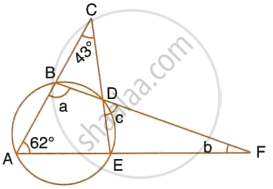
In the given figure, ∠ACE = 43° and ∠CAF = 62°; find the values of a, b and c.
In the given figure, AB is parallel to DC, ∠BCE = 80° and ∠BAC = 25°.
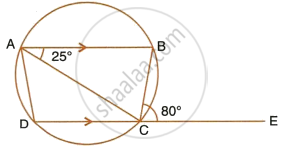
Find:
- ∠CAD
- ∠CBD
- ∠ADC
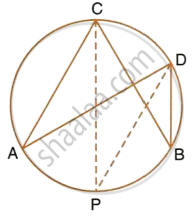
In the figure, given below, CP bisects angle ACB. Show that DP bisects angle ADB.
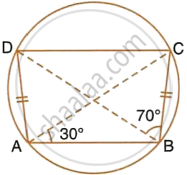
In the figure, given below, AD = BC, ∠BAC = 30° and ∠CBD = 70°.
Find:
- ∠BCD
- ∠BCA
- ∠ABC
- ∠ADB
In the given figure, AD is a diameter. O is the centre of the circle. AD is parallel to BC and ∠CBD = 32°.
Find:
- ∠OBD
- ∠AOB
- ∠BED

In the figure given, O is the centre of the circle. ∠DAE = 70°. Find giving suitable reasons, the measure of:
- ∠BCD
- ∠BOD
- ∠OBD

Solutions for 17: Circles
Selina solutions for Concise Mathematics [English] Class 10 ICSE chapter 17 - Circles
Shaalaa.com has the CISCE Mathematics Concise Mathematics [English] Class 10 ICSE CISCE solutions in a manner that help students grasp basic concepts better and faster. The detailed, step-by-step solutions will help you understand the concepts better and clarify any confusion. Selina solutions for Mathematics Concise Mathematics [English] Class 10 ICSE CISCE 17 (Circles) include all questions with answers and detailed explanations. This will clear students' doubts about questions and improve their application skills while preparing for board exams.
Further, we at Shaalaa.com provide such solutions so students can prepare for written exams. Selina textbook solutions can be a core help for self-study and provide excellent self-help guidance for students.
Concepts covered in Concise Mathematics [English] Class 10 ICSE chapter 17 Circles are Theorems on Angles in a Circle, Chord, Geometrical Concepts Related to a Circle, Cyclic Quadrilateral and Concyclic Points, Some Important Results on Circles, Advanced Theorems Related to Circles, Arc of the Circle, Segment of a Circle, Theorems on Angles in a Circle, Chord, Geometrical Concepts Related to a Circle, Cyclic Quadrilateral and Concyclic Points, Some Important Results on Circles, Advanced Theorems Related to Circles, Arc of the Circle, Segment of a Circle, Theorems on Angles in a Circle, Chord, Geometrical Concepts Related to a Circle, Cyclic Quadrilateral and Concyclic Points, Some Important Results on Circles, Advanced Theorems Related to Circles, Arc of the Circle, Segment of a Circle.
Using Selina Concise Mathematics [English] Class 10 ICSE solutions Circles exercise by students is an easy way to prepare for the exams, as they involve solutions arranged chapter-wise and also page-wise. The questions involved in Selina Solutions are essential questions that can be asked in the final exam. Maximum CISCE Concise Mathematics [English] Class 10 ICSE students prefer Selina Textbook Solutions to score more in exams.
Get the free view of Chapter 17, Circles Concise Mathematics [English] Class 10 ICSE additional questions for Mathematics Concise Mathematics [English] Class 10 ICSE CISCE, and you can use Shaalaa.com to keep it handy for your exam preparation.
