Advertisements
Advertisements
Question
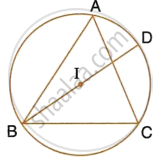
In the given figure, I is the incentre of ΔABC. BI when produced meets the circumcircle of ΔABC at D. ∠BAC = 55° and ∠ACB = 65°; calculate:
- ∠DCA,
- ∠DAC,
- ∠DCI,
- ∠AIC.
Sum
Advertisements
Solution
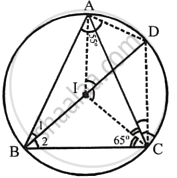
Join AD, DC, AI and CI,
In ΔABC,
∠BAC = 55°, ∠ACB = 65°
∴ ∠ABC = 180° – (∠BAC + ∠ACB)
= 180° – (55° + 65°)
= 180° – 120°
= 60°
In cyclic quad. ABCD,
∠ABC + ∠ADC = 180°
`\implies` 60° + ∠ADC = 180°
∴ ∠ADC = 180° – 60° = 120°
In ΔADC,
∠DAC + ∠DCA + ∠ADC = 180°
`\implies` ∠DAC + ∠DCA + 120° = 180°
`\implies` ∠DAC + ∠DCA = 180° – 120° = 60°
But ∠DAC = ∠DCA
(I lies on the bisector of ∠ABC)
∴ ∠DAC = ∠DCA = 30°
∴ DI is perpendicular bisector of AC
∠AIC = ∠ADC = 120°
∴ IC is the bisector of ∠ACB
∴ ∠ICA = `65^circ/2` = 32.5°
∴ ∠DCI = ∠DCA + ∠ACI
= 30° + 32.5°
= 62.5°.
= (62.5)°
= 60° 30'.
shaalaa.com
Is there an error in this question or solution?
