Advertisements
Chapters
1: Reproduction in Organisms
2: Sexual Reproduction in Flowering Plants
3: Human Reproduction
4: Reproductive Health-Problems and Strategies
Unit 2 – Genetics and Evolution
5: Principles of Inheritance and Variation
6: Chromosomes, Sex-Linked Inheritance and Human Genetic Disorders
7: Molecular Basis of Inheritance
8: Evolution-Origin of Life
9: Theory of Evolution and Evolution of Man
Unit 3 – Biology and Human Welfare
10: Human Health and Diseases
11: Adolescent Issues: Alcoholism and Drugs
12: Animal Breeding for Improvement in Food Production
13: Plant Breeding to Enhance Food Production
14: Microbes in Human Welfare
Unit 4 – Biotechnology
15: Biotechnology: Principles and Processes
16: Biotechnology and Its Applications
Unit 5 – Ecology and Environment
▶ 17: Organisms and Populations
18: Ecosystem
19: Biodiversity and Conservation
20: Environmental Issues
Advertisements
Solutions for Chapter 17: Organisms and Populations
Below listed, you can find solutions for Chapter 17 of CISCE Sarita Aggarwal for Biology [English] Class 12 ISC.
Sarita Aggarwal solutions for Biology [English] Class 12 ISC 17 Organisms and Populations EXERCISES [Pages 951 - 967]
A. OBJECTIVE QUESTIONS I. Multiple choice question Choose the correct answer:
The outward movement of members of a species is known as ______.
immigration
emigration
migration
mortality
The natality is also known as ______.
birth rate
death rate
net increase
net decrease
The maximum capacity of an organism to reproduce or increase in number is termed as ______.
natality
mortality
biotic potential
carrying capacity
A stronger species like lion and deer being benefitted at the cost of another weak species is an example of ______.
predation
parasitism
competition
commensalism
The relationship of sea anemone and hermit crab is called ______.
predation
commensalism
protocooperation
competition
The interaction of Rhizobium with root nodules of legume plants is called ______.
predation
commensalism
symbiosis
parasitism
In commensalism, the relationship of species A and species B is such that ______.
A and B both are benefitted
A is benefitted and B is harmed
A is benefitted and B is not affected
A and B both are harmed
Community is defined as aggregation of ______.
individuals of the same kind
individuals of different kinds
individuals of a population
population of different species
Parasite can be explained as an organism which depends on others ______.
for food
for shelter
for both food and shelter
for reproduction
Select the statement which explains best parasitism.
One organism is benefited.
Both the organisms are benefited.
One organism is benefited, other is not affected.
One organism is benefited, other is affected.
A group of individuals inhabiting a particular area form a ______.
population
community
ecosystem
species
A large regional, terrestrial unit characterised by a major vegetation type and associated fauna forms ______.
landscape
biome
ecosystem
community
The short-term changes of the atmosphere at a given place and time form the ______.
environment
weather
climate
topography
The functional role of an organism in the ecological system is referred as ______.
habitat
interaction
niche
symbiosis
A thin layer of ozone is present in ______.
troposphere
stratosphere
stratopause
mesosphere
In troposphere, the temperature ______.
remains constant
remains below 0°C
increases with increasing height
decreases with increasing height
Which of the following is photosynthetically active radiation?
X-rays
ultraviolet
infrared
visible light
The shallow water zone around the edge of the lake is called ______.
littoral zone
limnetic zone
profundal zone
benthic zone
Another term for cold-blooded animals is ______.
endotherms
ectotherms
homoiotherms
thermoregulators
During summer stratification, the upper layer of water is called ______.
thermocline
hypolimnion
epilimnion
ectolimnion
Upper limit of water availability in the soil is also called ______.
capillary water
field capacity
hygroscopic water
gravitational water
The fresh leaves and recognisable litter are found in the following horizon of soil ______.
A-horizon
B-horizon
C-horizon
O-horizon
Genetically adapted local populations of a species (that have a wide range of distribution) are called ______.
phenotypes
ecotypes
sciophytes
mesophytes
Plants adapted to shade or low intensity are called ______.
sciophytes
heliophytes
ephemerals
hydrophytes
Sunken stomata can be seen in ______.
Hydrilla
Nymphaea
Acacia
Rhizophora
Pneumatophores are special features of plants growing in ______.
dry and hot conditions
water
mangrove forests
oligotrophic soils
Adaptation to low temperature and freezing in animals occurs due to the production of ______.
anti-freeze proteins
chaperonins
proline
analine
Fill in the blanks
______ refers to the increase in number of individuals by birth, hatching or germination.
The environmental check on population size is called ______.
The maximum number of individuals of a population that can be sustained in a given habitat represent its ______.
The aggregation of individuals of species is called ______.
The relationship where one organism is benefitted, while the other is neither benefitted nor harmed, is referred as ______.
Organisms preying on animals are called ______.
An association of two species in which both species are benefitted is called ______.
In competition one of the species is benefitted and the other one is ______.
In symbiosis if one species is benefitted the other one is ______.
A parasite lives on another organism. The other organism is called ______.
Lichen is an example of ______.
The transition zone between two communities is known as ______.
______ is the transition layer between troposphere and stratosphere.
Visible light occurs in the wavelength of ______ nm.
Ozone layer absorbs ______ rays which on reaching earth are harmful to the organisms.
During summer, the upper warm layer of water is separated from the deeper cold water by a ______.
In ______ soils, the top soil has little or no humus.
Shade-tolerant plants are called ______ while the sun-adapted plants are called ______.
______ plants possess CAM pathway of photosynthesis.
Plants growing in nutrient-poor soils possess ______ which help in efficient absorption of nutrients.
State whether the following is true or false.
An ecosystem consists of various biotic communities interacting with each other and influencing the environment.
State whether the following is true or false.
Tropical rainforest biome in India are present in Assam in North-Eastern Himalaya and Western ghats.
State whether the following is true or false.
Eurythermal organisms are the ones that can tolerate only a narrow range of temperature.
State whether the following is true or false.
Hygroscopic water of soil is the most readily available water for the plants.
State whether the following is true or false.
Cold-blooded animals like frogs undergo winter sleep called hibernation.
State whether the following is true or false.
Benthic zone is a shallow zone near the edge of a lake.
State whether the following is true or false.
Halophytic plants occur in tidal marshes and mangroves.
State whether the following is true or false.
Lichens is an example of commensalism.
State whether the following is true or false.
A non-poisonous snake mimics the poisonous snake. It is an example of Mullerian mimicry.
State whether the following is true or false.
A zone where two communities meet and blend together is called ecotone.
Match the following.
Part A
| Column A | Column B |
|---|---|
| 1. Rhizobium in root nodules | (a) Protocooperation |
| 2. Sea anemone and hemit crab | (b) Predator-prey |
| 3. Epiphytes growing on trees | (c) Keystone species |
| 4. Tiger eating a deer | (d) Mutualism |
| 5. Cuscuta living on a flowering plant | (e) Commensalism |
| 6. Fig trees in a tropical rainforest | (f) Ectoparasite |
| 7. Leaf insect on a leaf | (g) Camouflage |
Match the following.
Part B
| Column A | Column B |
|---|---|
| 1. Hydrophytes | (a) Oligotrophic soil |
| 2. Bat | (b) Glycerol |
| 3. Antifreeze | (c) Aerenchyma |
| 4. Mycorrhizae | (d) Echolocation |
| 5. Xerophytes | (e) Succulents |
| 6. Warm layer | (f) Stratosphere |
| 7. Dark region | (g) Epilimnion |
| 8. Ozone | (h) Profundal zone |
| 9. Halophytes | (i) Shade tolerant |
| 10. Sciophytes | (j) Viviparity |
Answer the following in one or two words.
A set of populations connected by dispersing individuals.
Answer the following in one or two words.
Death rate of a population.
Answer the following in one or two words.
Kind of association shown by sea anemone and hermit crab.
Answer the following in one or two words.
Species having much greater influence on community, relative to their low abundance.
Answer the following in one or two words.
Transition zone between two communities.
Answer the following in one or two words.
Community characters that are derived from the measurement of analytic characters.
Answer the following in one or two words.
Quantity of living material per unit area, indicating growth of a species.
Answer the following in one or two words.
An interaction in which one species gets the benefit while the other neither gets benefit nor is harmed.
Answer the following in one or two words.
Aerial respiratory roots present in plants growing in mangroves.
Answer the following in one or two words.
Maximum size of the population that can be supported in a given habitat.
Answer the following in one or two words.
Another term for cold-blooded animals.
Answer the following in one or two words.
Maintenance of relatively constant internal environment.
Answer the following in one or two words.
Dead and fallen leaves and partially decomposed plant and animal material.
Answer the following in one or two words.
Gradual physiological adjustment to slowly changing new environment.
Answer the following in one or two words.
Plants adapted to grow in saline environments.
Answer the following in one or two words.
Mutualistic association of fungi and roots of higher plants.
Answer the following in one or two words.
Movement of arctic tern in summer and autumn.
Answer the following in one or two words.
Capacity to blend with surroundings.
Answer the following in one or two words.
Palatable species mimics the distasteful model.
Answer the following in one or two words.
Winter sleep during cold environment by certain animals.
In the questions given below, there are two statements marked as Assertion (A) and Reason (R). Read the statements and choose the correct option
Assertion (A): Habitat is a specific place, locality or a portion of ecosystem where an organism can be found.
Reason (R): A habitat contains many niches and supports a variety of species.
Both assertion (A) and reason (R) are true, and reason is the correct explanation of assertion.
Both assertion (A) and reason (R) are true, but reason is not the correct explanation of assertion.
Assertion (A) is true but reason (R) is false.
Both assertion (A) and reason (R) are false.
Assertion (A): Capillary water is readily available and easily utilised by the plants.
Reason (R): Capillary water fills the finer pores and is held around the soil particles by capillary forces against the force of gravity.
Both assertion (A) and reason (R) are true, and reason is the correct explanation of assertion.
Both assertion (A) and reason (R) are true, but reason is not the correct explanation of assertion.
Assertion (A) is true but reason (R) is false.
Both assertion (A) and reason (R) are false.
Assertion (A): Species are groups of potentially interbreeding natural populations which are isolated from other such groups.
Reason (R): Distinctive morphological characters are displayed due to reproductive isolation.
Both assertion (A) and reason (R) are true, and reason is the correct explanation of assertion.
Both assertion (A) and reason (R) are true, but reason is not the correct explanation of assertion.
Assertion (A) is true but reason (R) is false.
Both assertion (A) and reason (R) are false.
Assertion (A): Leaf butterfly and stick insect show mimicry to dodge their enemies.
Reason (R): Mimicry is a method to acquire body colour blending with the surroundings.
Both assertion (A) and reason (R) are true, and reason is the correct explanation of assertion.
Both assertion (A) and reason (R) are true, but reason is not the correct explanation of assertion.
Assertion (A) is true but reason (R) is false.
Both assertion (A) and reason (R) are false.
Assertion (A): Acclimatisation is the gradual physiological adjustment of an organism in the slowly changing new environmental conditions.
Reason (R): An organism undergoes morphological, physiological and behavioural adaptations to survive well in an environment.
Both assertion (A) and reason (R) are true, and reason is the correct explanation of assertion.
Both assertion (A) and reason (R) are true, but reason is not the correct explanation of assertion.
Assertion (A) is true but reason (R) is false.
Both assertion (A) and reason (R) are false.
Assertion (A): The prickly pear cactus introduced into Australia in early 1920s caused havoc by spreading rapidly.
Reason (R): When certain exotic species are introduced into a geographical area, they become invasive and start spreading fast because the invaded land does not have the natural predators.
Both assertion (A) and reason (R) are true, and reason is the correct explanation of assertion.
Both assertion (A) and reason (R) are true, but reason is not the correct explanation of assertion.
Assertion (A) is true but reason (R) is false.
Both assertion (A) and reason (R) are false.
Assertion (A): The community of an ecotone commonly contains the organisms of each of the overlapping communities and in addition the organisms which are restricted to the ecotone.
Reason (R): The tendency for increased variety and density at community junctions is known as the edge effect.
Both assertion (A) and reason (R) are true, and reason is the correct explanation of assertion.
Both assertion (A) and reason (R) are true, but reason is not the correct explanation of assertion.
Assertion (A) is true but reason (R) is false.
Both assertion (A) and reason (R) are false.
Assertion (A): The rate at which a population can be expected to grow in the future can be assessed graphically by means of a population pyramid.
Reason (R): A triangular population pyramid is characteristic of a country whose population is stable, neither growing nor shrinking.
Both assertion (A) and reason (R) are true, and reason is the correct explanation of assertion.
Both assertion (A) and reason (R) are true, but reason is not the correct explanation of assertion.
Assertion (A) is true but reason (R) is false.
Both assertion (A) and reason (R) are false.
Assertion (A): Relationship between sea anemone and hermit crab is said to be an example of obligate mutualism.
Reason (R): Obligate mutualism is a negative harmful interaction between two species.
Both assertion (A) and reason (R) are true, and reason is the correct explanation of assertion.
Both assertion (A) and reason (R) are true, but reason is not the correct explanation of assertion.
Assertion (A) is true but reason (R) is false.
Both assertion (A) and reason (R) are false.
Assertion (A): Competitive exclusion principle is the tendency for competition to bring about an ecological separation of closely related, or otherwise similar species.
Reason (R): If two species compete for the same resources, they could avoid competition by choosing different times for feeding or different foraging patterns.
Both assertion (A) and reason (R) are true, and reason is the correct explanation of assertion.
Both assertion (A) and reason (R) are true, but reason is not the correct explanation of assertion.
Assertion (A) is true but reason (R) is false.
Both assertion (A) and reason (R) are false.
Read the sources given and answer any four from the questions given below:
|
Animals like kangaroo rat and camel live in dry and hot regions like desert and face acute shortage of water. They show various adaptations to survive in such conditions by reducing water loss and tolerating desert conditions. Kangaroo rat conserves water by excreting highly concentrated urine and forms almost completely dry faeces. It obtains all its water needs from its food and metabolic water, i.e., water produced during cell respiration. To reduce water loss, it is active only during the night (nocturnal) when the temperature is low and lives in its underground burrow where the moisture is high. Camel can survive without drinking water for 10-16 days. It saves several litres of water by not sweating or perspiring. Its faeces contain very little water and excretes very little, hypertonic urine. |
- The adaptations in an animal help it to
- have long life span
- have good mobility in environment
- survive well in environment
- be part of a food chain
- What is metabolic water?
- water present in interstitial spaces in body
- water needed for metabolic activities
- water produced during cell respiration
- water excreted by kidneys
- Animals living in dry and hot regions minimise water loss by
- producing dry faeces
- producing highly concentrated urine
- not sweating or perspiring
- all of these
- Camel minimises water loss by
- being without drinking water for days
- being active at early morning
- using water from food
- by not sweating and perspiring
- Kangaroo rat is nocturnal. How does this adaption help the animal?
- low temperature at night helps in reducing water loss
- food is plenty at night in desert
- can see well at night
- has few predators at night
Read the sources given and answer any four from the questions given below:
|
There are a number of examples of mutualism and co-evolution in plantanimal relationship. Figs and tiny figpollinating wasps both benefit each other. The female wasps enter the figs inflorescence, pollinate female flowers and lay eggs into some of the flowers. When larvae come out, they feed on the developing seeds within the fig fruit. Hence in return for pollination, fig offers the site as well as food for developing larvae. The orchids have beautiful floral patterns, many of which have evolved to attract the bees and bumble bees to ensure pollination. The structure, shape, colour and markings on Ophrys flower resemble a specific species of female bumble bee. The male bumble bee gets attracted towards this flower, assuming it to be a female bee for mating. As the male bee visits the flower, it gets dusted with the pollen from the flower and on visiting another flower transfers pollens to it, thus bringing pollination. Even a slight change in the markings of the Ophrys flower, pollination does not occur, hence it shows both mutualism and co-evolution. |
- Where do the wasps that pollinate figs lay eggs?
- Fig leaves
- Fig flowers
- Fig seeds
- Fig branches
- The markings on the orchid flower Ophrys resemble the
- male species of a bee
- female species of a bee
- a specific beetle
- another species of orchid flower
- The relationship between Ophrys and bumble bee is of
- co-evolution
- mutualism
- both (a) and (b)
- none of these
- Why is the relationship between fig and wasp called mutualism?
- Fig flowers get pollinated and offer food for wasp larvae
- Fig flowers get pollinated and wasp gets a place to live
- Colour of fig flower matches that of wasp markings
- Fig flower and wasp originated on land at the same time
- What happens if the markings on the Ophrys flower are changed?
- fertilisation does not occur
- female bumble bee does not recognise it
- male bumble bee does not recognise it
- both (a) and (c)
Read the sources given and answer any four from the questions given below:
|
In temperate cold regions thermal stratification occurs in lakes and deepwater bodies during summer and winter. During summer, the top layer of water becomes warmer than the bottom layer. The warm top layer does not mix with the bottom cold layer of water. As a result, a distinct zone forms between the top and the bottom layer of water called thermocline and the stratification is called summer stratification. Upper, warm circulating water is called epilimnion and the bottom, non-circulating colder water is called hypolimnion. In autumn, the temperature of upper layer lowers and becomes same as of hypolimnion. It is called autumn turnover. During winter, the surface water cools below 4°C, it expands, becomes lighter and freezes. The temperature in the lower layers remains at about 4°C and so water remains in liquid state. This is called winter stratification. In spring, when ice melts, water becomes warmer and heavier and sinks to the bottom. It leads to mixing of water in the whole lake and results in uniform mixing of oxygen and nutrients in the lake. This is called spring turnover. During autumn and spring turnover, there is redistribution and mixing of oxygen and nutrients and this results in the bloom of phytoplankton growth. During summer and winter stratification, the oxygen availability and nutrient supply is greatly reduced and so is phytoplankton growth. |
- Where is thermocline present?
- upper layer of water in summers
- bottom layer of water in summers
- a layer of water between upper and bottom layer of water in autumn
- a layer of water between upper and bottom layer of water in summers
- Which statement is true for summer stratification?
- no mixing of warm and cold water
- epilimnion is at 4°C
- hypolimnion is very warm
- thermocline zone forms above epilimnion
- The phytoplankton bloom occurs due to the
- mixing of oxygen and nutrients during summer
- mixing of oxygen and nutrients during autumn
- presence of thermocline layer
- highoxygen content in hypolimnion
- The lower layers of water in winter are
- at less than 4°C
- frozen as ice
- lighter and remain as liquid water
- at 4°C and in liquid state of water
- Thermocline zone is present in the following season
- winter
- summer
- autumn
- both (a) and (b)
B. SUBJECTIVE QUESTIONS Very short answer type questions (1 mark)
What do you understand by the term ‘ecology’?
Give higher levels of organisation beyond an organism.
What is a ‘biotic community’?
Give important features of an ecosystem.
What is a biosphere?
Which are three important regions of a biosphere?
What is a microhabitat?
What is an ecological niche?
What is a biome?
Where do the tropical rainforest biomes exist in India?
What are the climatic conditions in tropical deciduous rainforest biomes?
Give two recognisable features of temperate broad-leaf forest biome.
Name various layers that form stratification in a forest.
Give the type of vegetation found in savannas.
What are the climatic conditions in cold desert biomes?
What are ectotherms?
Give examples of ectotherms.
Give examples of endotherms.
Name three important thermal zones in a lake during summers.
What is the meaning of photosynthetically active radiation (PAR)?
What is an abyssal zone?
What is a limnetic zone in a lake?
Name types of organisms present in limnetic zone.
What type of soil do tropical rainforests have?
Which type of soil is well suited for plants and why?
Where is tropopause present?
Where does Ozone layer lie?
What is the significance of ozone layer?
Give two features of drought-enduring plants.
What are chaperonins?
What are halophytes?
Why do mangrove plants have pneumatophores?
What is mycorrhiza?
What is Batesian mimicry?
What is Gause's 'Competitive Exclusion Principle'?
Give two adaptations in parasites to live in or on host.
What is protocooperation?
Give one example of protocooperation.
Give one example of protocooperation.
Give an example of co-evolution in mutualism.
What are keystone species?
What is ecotone?
What type of association exists between sharks and sucker fish, Echenesis?
How does less pre-reproductive population and large older population change the structure of a population?
What are homoiothermic animals?
Short answer type questions (2 marks)
Define the term ‘population’.
Name a few characteristics that affect density of a population.
Name various components of an ecosystem.
What is an ecological niche?
What is biotic potential?
Why is the biotic potential not achieved in a population?
Name the vertical layers of atmosphere.
What is the limit of stratosphere?
What does solar spectrum comprise of?
What is PAR?
Name various types of UV radiations depending upon their wavelength. What is their effect on humans?
Name various zones in a lake.
In which zone are phytoplanktons found in a lake?
What is symbiosis?
Give an example of symbiosis.
What are ectoparasites?
Give two adaptations in them for survival in host.
What is commensalism?
Give one example of commensalism.
How do active ectotherms control their body temperature?
Why do endotherms have metabolic advantage over other animals?
What is spring turnover?
Why is the growth of phytoplanktons low during summer stratification?
How do ecotypes differ from each other?
How are ephemerals adapted to dry conditions?
What are succulents?
Which type of plants accumulate proline?
Name two emergent and rooted hydrophytes.
Why do tropical rainforests have oligotrophic soil?
Give an example of Batesian mimicry.
Give an example of Mullerian mimicry.
Name the interaction in the following:
Orchid grows on a mango tree.
Name the interaction in the following:
Clown fish living among the tentacles of sea anemone.
Short answer type questions (3 marks)
List two important features of an ecosystem.
List two important features of biome.
List two important features of biosphere.
What is the difference between habitat and microhabitat?
Define ecological niche.
List main climatic regions on the basis of mean temperature.
What is the effect of altitude on biomes?
What is stratification?
Name various strata in a forest.
What type of vegetation is found in temperate needle-leaf forests?
Explain the term:
camouflage
Explain the term:
migration
Explain the term:
aestivation
What is mimicry?
Name two different types of mimicry. Give one example of each.
What is the difference between ectotherms and endotherms? Give examples of both.
What is the effect of light on aquatic systems?
What is the meaning of soil profile?
Name different horizons in soil profile.
Define ecotone and its important features.
What are edge species?
What are regulators?
What are conformers?
Why have conformers not evolved to become regulators?
What are analytic characters?
What are synthetic characters?
Name a few analytical characters of a community.
How is symbiosis different from commensalism? Explain by giving one example of each.
Give reasons for the following:
Sea anemone is often found on the shell of hermit crab.
Give reasons for the following:
Smaller barnacles disappeared when Balanus barnacles dominated the coast of Scotland.
Give reasons for the following:
Mycorrhizae are found on the roots of higher plants.
Explain the following interaction:
Sucker fish is attached to shark.
Explain the following interaction:
Cuscuta grows on bushes or trees.
Explain the following interaction:
Wasps pollinate inflorescence of fig.
Differentiate between natality and mortality.
Differentiate between commensalism and mutualism.
Differentiate between the following:
Predator and Parasite
Differentiate between the following:
Ectoparasite and Endoparasit
Differentiate between the following:
Keystone species and Critical link species
Differentiate between population and community.
Differentiate between the following:
Ecosystem and Biosphere
Differentiate between biotic and abiotic components.
Distinguish between Weather and climate.
Differentiate between the following:
Habitat and Microhabitat
Differentiate between the following:
Short wave and Long wave radiations
Differentiate between the following:
Littoral and Profundal zone
Distinguish between the following:
Ectotherms and Endotherms
Differentiate between the following:
Epilimnion and Hypolimnion
List the differences between clayey soil and sandy soil.
Differentiate between the following:
Sciophytes and Heliophytes
Differentiate between
xerophytes and hydrophytes
Differentiate between the following:
Xerophytes and Mesophytes
Differentiate between the following:
Heliophytes and Halophytes
Differentiate between the following:
Batesian and Mullerian mimicry
Long answer type questions (5 marks)
How do different age groups influence the population growth? Explain with the help of graphic representation.
What is the relationship between the biotic community and environment?
Mention briefly the role of any two environmental factors on plants.
Explain the importance of various zones in a lake.
Describe the process of thermal stratification in a deep lake.
Draw a diagram showing various vertical layers of the atmosphere and the temperatures in each layer. Give importance of each of these layers.
What does the J-shaped population growth curve depict?
Compare J-shaped pattern with S-shaped pattern of population growth.
Explain mutualism with the help of any two examples.
Explain the predator-prey relationship.
How is predator-prey relationship different from parasite-host relationship?
Why are keystone species important?
Explain the ecotone.
Explain the edge effect.
What is soil profile?
Explain the four main horizons in a soil profile.
How does the soil profile differ in a desert and a grassland soil?
Explain the bell-shaped curve of range of tolerance.
What is adaptation?
How is cactus adapted to dry and hot conditions?
How does CAM pathway help xerophytes?
List the adaptations shown by animals living in arid regions.
List a few adaptations found in submerged hydrophytes.
What are the special adaptations found in the mangrove plants?
Explain the significance of mycorrhizae for plants growing in oligotrophic soil.
Enumerate the adaptations shown by animals to resist and survive in extreme colds.
Explain Batesian mimicry with an example.
What is migration? Explain with the help of an example.
How do living organisms maintain homeostasis? Explain briefly with respect to: (i) regulators, (ii) conformers, (iii) migration, (iv) suspension.
List three important adaptation of the following:
halophytes
List three important adaptation of the following:
submerged plants
List three important adaptation of the following:
drought-enduring plants
List three important adaptation of the following:
heliophytes
List three important adaptation of the following:
plants in oligotrophic soils
E. BOARD QUESTIONS 1 mark
Define Brood parasitism.
Define the Stenothermal organisms.
Which organisms constitute the last trophic level?
Give a reason for the following:
Equilibrium of a forest ecosystem can be disturbed by uncontrolled hunting of big predators.
2 marks
Study the graph given below and answer the questions that follow:
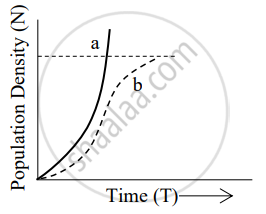
- In the absence of predators which one of the two curves would appropriately depict the prey population? Give a reason.
- Time has been shown on the X-axis, and there is a parallel dotted line shown above. Explain the significance of this dotted line.
3 marks
With the help of neatly labelled diagrams, explain the different types of age pyramids of human population.
Solutions for 17: Organisms and Populations
Sarita Aggarwal solutions for Biology [English] Class 12 ISC chapter 17 - Organisms and Populations
Shaalaa.com has the CISCE Mathematics Biology [English] Class 12 ISC CISCE solutions in a manner that help students grasp basic concepts better and faster. The detailed, step-by-step solutions will help you understand the concepts better and clarify any confusion. Sarita Aggarwal solutions for Mathematics Biology [English] Class 12 ISC CISCE 17 (Organisms and Populations) include all questions with answers and detailed explanations. This will clear students' doubts about questions and improve their application skills while preparing for board exams.
Further, we at Shaalaa.com provide such solutions so students can prepare for written exams. Sarita Aggarwal textbook solutions can be a core help for self-study and provide excellent self-help guidance for students.
Concepts covered in Biology [English] Class 12 ISC chapter 17 Organisms and Populations are .
Using Sarita Aggarwal Biology [English] Class 12 ISC solutions Organisms and Populations exercise by students is an easy way to prepare for the exams, as they involve solutions arranged chapter-wise and also page-wise. The questions involved in Sarita Aggarwal Solutions are essential questions that can be asked in the final exam. Maximum CISCE Biology [English] Class 12 ISC students prefer Sarita Aggarwal Textbook Solutions to score more in exams.
Get the free view of Chapter 17, Organisms and Populations Biology [English] Class 12 ISC additional questions for Mathematics Biology [English] Class 12 ISC CISCE, and you can use Shaalaa.com to keep it handy for your exam preparation.
