Advertisements
Online Mock Tests
Chapters
2: Physics and Mathematics
3: Rest and Motion: Kinematics
4: The Forces
5: Newton's Laws of Motion
6: Friction
7: Circular Motion
8: Work and Energy
9: Centre of Mass, Linear Momentum, Collision
10: Rotational Mechanics
11: Gravitation
12: Simple Harmonics Motion
13: Fluid Mechanics
14: Some Mechanical Properties of Matter
15: Wave Motion and Waves on a String
16: Sound Waves
17: Light Waves
18: Geometrical Optics
19: Optical Instruments
20: Dispersion and Spectra
21: Speed of Light
22: Photometry
23: Heat and Temperature
24: Kinetic Theory of Gases
25: Calorimetry
26: Laws of Thermodynamics
27: Specific Heat Capacities of Gases
28: Heat Transfer
29: Electric Field and Potential
30: Gauss’s Law
31: Capacitors
32: Electric Current in Conductors
33: Thermal and Chemical Effects of Current
34: Magnetic Field
35: Magnetic Field due to a Current
▶ 36: Permanent Magnets
37: Magnetic Properties of Matter
38: Electromagnetic Induction
39: Alternating Current
40: Electromagnetic Waves
41: Electric Current through Gases
42: Photoelectric Effect and Wave-Particle Duality
43: Bohr’s Model and Physics of Atom
44: X-rays
45: Semiconductors and Semiconductor Devices
46: The Nucleus
47: The Special Theory of Relativity
![HC Verma solutions for Concepts of Physics Volume 1 and 2 [English] chapter 36 - Permanent Magnets - Shaalaa.com](/images/concepts-of-physics-volume-1-and-2-english_6:9bad16cab2dd4ae1a1a6bac3add1eb27.jpg "HC Verma solutions for Concepts of Physics Volume 1 and 2 [English] chapter 36 - Permanent Magnets")
Advertisements
Solutions for Chapter 36: Permanent Magnets
Below listed, you can find solutions for Chapter 36 of CBSE, Karnataka Board PUC HC Verma for Concepts of Physics Volume 1 and 2 [English].
HC Verma solutions for Concepts of Physics Volume 1 and 2 [English] 36 Permanent Magnets Short Answers [Pages 275 - 276]
Can we have a single north pole, or a single south pole?
Do two distinct poles actually exist at two nearby points in a magnetic dipole?
An iron needle is attracted to the ends of a bar magnet but not to the middle region of the magnet. Is the material making up the ends of a bare magnet different from that of the middle region?
Compare the direction of the magnetic field inside a solenoid with that of the field there if the solenoid is replaced by its equivalent combination of north pole and south pole.
Sketch the magnetic field lines for a current-carrying circular loop near its centre. Replace the loop by an equivalent magnetic dipole and sketch the magnetic field lines near the centre of the dipole. Identify the difference.
The force on a north pole, `vecF = mvecB` , parallel to the field `vecB` . Does it contradict our earlier knowledge that a magnetic field can exert forces only perpendicular to itself?
Two bar magnets are placed close to each other with their opposite poles facing each other. In absence of other forces, the magnets are pulled towards each other and their kinetic energy increases. Does it contradict our earlier knowledge that magnetic forces cannot do any work and hence cannot increase kinetic energy of a system?
Magnetic scalar potential is defined as `U(vec r_2) - U(vec r_1) = - ∫_vec(r_1)^vec(r_2)` `vec (B) . dvec(l)`
Apply this equation to a closed curve enclosing a long straight wire. The RHS of the above equation is then `-u_0 i` by Ampere's law. We see that `U(vec(r_2)) ≠ U(vec(r_1))` even when `vec r_2 =vec r_1` .Can we have a magnetic scalar potential in this case?
Can the earth's magnetic field be vertical at a place? What will happen to a freely suspended magnet at such a place? What is the value of dip here?
Can the dip at a place be (a) zero (b) 90°?
The reduction factor K of a tangent galvanometer is written on the instrument. The manual says that the current is obtained by multiplying this factor to tan θ. The procedure works well at Bhuwaneshwar. Will the procedure work if the instrument is taken to Nepal? If there is same error, can it be corrected by correcting the manual or the instrument will have to be taken back to the factory?
HC Verma solutions for Concepts of Physics Volume 1 and 2 [English] 36 Permanent Magnets MCQ [Page 276]
A circular loop carrying a current is replaced by an equivalent magnetic dipole. A point on the axis of the loop is in
end-on position
broadside-on position
both
none
A circular loop carrying a current is replaced by an equivalent magnetic dipole. A point on the loop is in ______.
end-on position
broadside-on position
both
none
When a current in a circular loop is equivalently replaced by a magnetic dipole,
the pole strength m of each pole is fixed
the distance d between the poles is fixed
the product md is fixed
none of the above
Let r be the distance of a point on the axis of a bar magnet from its centre. The magnetic field at such a point is proportional to
`1/r`
`1/r^2`
`1/r^3`
none of these
Let r be the distance of a point on the axis of a magnetic dipole from its centre. The magnetic field at such a point is proportional to
`1/r`
`1/r^2`
`1/r^3`
none of these
Two short magnets of equal dipole moments M are fastened perpendicularly at their centre in the Figure . The magnitude of the magnetic field at a distance d from the centre on the bisector of the right angle is
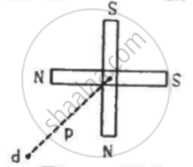
`(u_0)/(4pi) M/d^3`
`(u_0)/(4pi) (sqrt2M)/d^3`
`(u_0)/(4pi) (2sqrt2M)/d^3`
`(u_0)/(4pi) (2M)/d^3`
Magnetic meridian is
a point
a line along north-south
a horizontal plane
a vertical plane
A compass needle which is allowed to move in a horizontal plane is taken to a geomagnetic pole. It ______.
will stay in north-south direction only
will stay in east-west direction only
will become rigid showing no movement
will stay in any position
A dip circle is taken to geomagnetic equator. The needle is allowed to move in a vertical plane perpendicular to the magnetic meridian. The needle will stay ______.
in horizontal direction only
in vertical direction only
in any direction except vertical and horizontal
in the direction it is released
Which of the following four graphs may best represent the current-deflection relation in a tangent galvanometer?
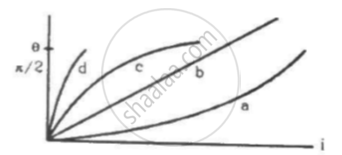
A tangent galvanometer is connected directly to an ideal battery. If the number of turns in the coil is doubled the deflection will
increase
decrease
remain unchanged
either increase or decrease
If the current is doubled, the deflection is also doubled in
a tangent galvanometer
a moving-coil galvanometer
both
none
A very long bar magnet is placed with its north pole coinciding with the centre of a circular loop carrying as electric current i. The magnetic field due to the magnet at a point on the periphery of the wire is B. The radius of the loop is a. The force on the wire is
very nearly 2πaiB perpendicular to the plane of the wire
2πaiB in the plane of the wire
πaiB along the magnet
zero
HC Verma solutions for Concepts of Physics Volume 1 and 2 [English] 36 Permanent Magnets MCQ [Page 277]
Pick the correct options.
(a) Magnetic field is produced by electric charges only
(b) Magnetic poles are only mathematical assumptions having no real existence
(b) A north pole is equivalent to a clockwise current and a south pole is equivalent to an anticlockwise current.
(d) A bar magnet is equivalent to a long, straight current.
A horizontal circular loop carries a current that looks clockwise when viewed from above. It is replaced by an equivalent magnetic dipole consisting of a south pole S and a north pole N.
(a) The line SN should be along a diameter of the loop.
(b) The line SN should be perpendicular to the plane of the loop
(c) The south pole should be slow the loop
(d) The north pole should be below the loop
Consider a magnetic dipole kept in the north to south direction. Let P1, P2, Q1, Q2 be four points at the same distance from the dipole towards north, south, east and west of the dipole respectively. The directions of the magnetic field due to the dipole are the same at
(a) P1 and P2
(b) Q1 and Q2
(c) P1 and Q1
(d) P2 and Q2
Consider the situation of the previous problem. The directions of the magnetic field due to the dipole are opposite at
(a) P1 and P2
(b) Q1 and Q2
(c) P1 and Q1
(d) P2 and Q2
To measure the magnetic moment of a bar magnet, one may use
(a) a tangent galvanometer
(b) a deflection galvanometer if the earth's horizontal field is known
(c) an oscillation magnetometer if the earth's horizontal field is known
(d) both deflection and oscillation magnetometer if the earth's horizontal field is not known
HC Verma solutions for Concepts of Physics Volume 1 and 2 [English] 36 Permanent Magnets Exercises [Pages 277 - 278]
A long bar magnet has a pole strength of 10 Am. Find the magnetic field at a point on the axis of the magnet at a distance of 5 cm from the north pole of the magnet.
Two long bare magnets are placed with their axes coinciding in such a way that the north pole of the first magnet is 2.0 cm from the south pole of the second. If both the magnets have a pole strength of 10 Am, find the force exerted by one magnet of the other.
A uniform magnetic field of `0.20 xx 10^-3 "T"` exists in the space. Find the change in the magnetic scalar potential as one moves through 50 cm along the field.
Figure shows some of the equipotential surfaces of the magnetic scalar potential. Find the magnetic field B at a point in the region.
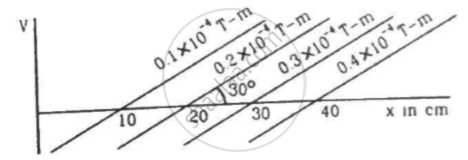
The magnetic field at a point, 10 cm away from a magnetic dipole, is found to be `2.0 xx 10^-4 "T"` . Find the magnetic moment of the dipole if the point is (a) in end-on position of the dipole and (b) in broadside-on position of the dipole.
Show that the magnetic field at a point due to a magnetic dipole is perpendicular to the magnetic axis if the line joining the point with the centre of the dipole makes an angle of `tan^-1(sqrt 2)` with the magnetic axis
A bar magnet has a length of 8 cm. The magnetic field at a point at a distance 3 cm from the centre in the broadside-on position is found to be `4 xx 10^-6 "T"`.Find the pole strength of the magnet.
A magnetic dipole of magnetic moment `1.44 "A m"^2`is placed horizontally with the north pole pointing towards north. Find the position of the neutral point if the horizontal component of the earth's magnetic field is 18 μT.
A magnetic dipole of magnetic moment 0.72 A m2 is placed horizontally with the north pole pointing towards south. Find the position of the neutral point if the horizontal component of the earth's magnetic field is 18 μT.
A magnetic dipole of magnetic moment `0.72sqrt(2) "Am"^2` is placed horizontally with the north pole pointing towards east. Find the position of the neutral point if the horizontal component of the earth's magnetic field is 18 μT.
The magnetic moment of the assumed dipole at the earth's centre is 8.0 × 10²² A m2. Calculate the magnetic field B at the geomagnetic poles of the earth. Radius of the earth is 6400 km.
If the earth's magnetic field has a magnitude 3.4 × 10⁻⁵ T at the magnetic equator of the earth, what would be its value at the earth's geomagnetic poles?
The magnetic field due to the earth has a horizontal component of 26 μT at a place where the dip is 60°. Find the vertical component and the magnitude of the field.
A magnetic needle is free to rotate in a vertical plane which makes an angle of 60° with the magnetic meridian. If the needle stays in a direction making an angle of `tan^-1(2sqrt(3))` with the horizontal, what would be the dip at that place?
The needle of a dip circle shows an apparent dip of 45° in a particular position and 53° when the circle is rotated through 90°. Find the true dip.
A tangent galvanometer shows a deflection of 45° when 10 mA of current is passed through it. If the horizontal component of the earth's magnetic field is `B_H = 3.6 xx 10^-5 "T"` and radius of the coil is 10 cm, find the number of turns in the coil.
A moving-coil galvanometer has a 50-turn coil of size 2 cm × 2 cm. It is suspended between the magnetic poles producing a magnetic field of 0.5 T. Find the torque on the coil due to the magnetic field when a current of 20 mA passes through it.
A short magnet produces a deflection of 37° in a deflection magnetometer in Tan-A position when placed at a separation of 10 cm from the needle. Find the ratio of the magnetic moment of the magnet to the earth's horizontal magnetic field.
The magnetometer of the previous problem is used with the same magnet in Tan-B position. Where should the magnet be placed to produce a 37° deflection of the needle?
A deflection magnetometer is placed with its arms in north-south direction. How and where should a short magnet having M/BH = 40 A m2 T−1 be placed so that the needle can stay in any position?
A bar magnet takes π/10 second the complete one oscillation in an oscillation magnetometer. The moment of inertia of the magnet about the axis of rotation is 1.2 × 10⁻⁴ kg m2 and the earth's horizontal magnetic field is 30 μT. Find the magnetic moment of the magnet.
The combination of two bar magnets makes 10 oscillations per second in an oscillation magnetometer when like poles are tied together and 2 oscillations per second when unlike poles are tied together. Find the ratio of the magnetic moments of the magnets. Neglect any induced magnetism.
A short magnet oscillates in an oscillation magnetometer with a time period of 0.10 s where the earth's horizontal magnetic field is 24 μT. A downward current of 18 A is established in a vertical wire placed 20 cm east of the magnet. Find the new time period.
A bar magnet makes 40 oscillations per minute in an oscillation magnetometer. An identical magnet is demagnetized completely and is placed over the magnet in the magnetometer. Find the time taken for 40 oscillations by this combination. Neglect any induced magnetism.
A short magnet makes 40 oscillations per minute when used in an oscillation magnetometer at a place where the earth's horizontal magnetic field is 25 μT. Another short magnet of magnetic moment 1.6 A m2 is placed 20 cm east of the oscillating magnet. Find the new frequency of oscillation if the magnet has its north pole (a) towards north and (b) towards south.
Solutions for 36: Permanent Magnets
HC Verma solutions for Concepts of Physics Volume 1 and 2 [English] chapter 36 - Permanent Magnets
Shaalaa.com has the CBSE, Karnataka Board PUC Mathematics Concepts of Physics Volume 1 and 2 [English] CBSE, Karnataka Board PUC solutions in a manner that help students grasp basic concepts better and faster. The detailed, step-by-step solutions will help you understand the concepts better and clarify any confusion. HC Verma solutions for Mathematics Concepts of Physics Volume 1 and 2 [English] CBSE, Karnataka Board PUC 36 (Permanent Magnets) include all questions with answers and detailed explanations. This will clear students' doubts about questions and improve their application skills while preparing for board exams.
Further, we at Shaalaa.com provide such solutions so students can prepare for written exams. HC Verma textbook solutions can be a core help for self-study and provide excellent self-help guidance for students.
Concepts covered in Concepts of Physics Volume 1 and 2 [English] chapter 36 Permanent Magnets are .
Using HC Verma Concepts of Physics Volume 1 and 2 [English] solutions Permanent Magnets exercise by students is an easy way to prepare for the exams, as they involve solutions arranged chapter-wise and also page-wise. The questions involved in HC Verma Solutions are essential questions that can be asked in the final exam. Maximum CBSE, Karnataka Board PUC Concepts of Physics Volume 1 and 2 [English] students prefer HC Verma Textbook Solutions to score more in exams.
Get the free view of Chapter 36, Permanent Magnets Concepts of Physics Volume 1 and 2 [English] additional questions for Mathematics Concepts of Physics Volume 1 and 2 [English] CBSE, Karnataka Board PUC, and you can use Shaalaa.com to keep it handy for your exam preparation.
