Advertisements
Advertisements
Question
Consider the situation of the previous problem. The directions of the magnetic field due to the dipole are opposite at
(a) P1 and P2
(b) Q1 and Q2
(c) P1 and Q1
(d) P2 and Q2
Advertisements
Solution
(c) P1 and Q1
(d) P2 and Q2
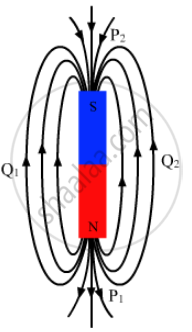
We know that magnetic field lines are directed from the north pole to the south pole. From the given figure, we can say that the direction of the magnetic field `vecB` is opposite at points P1 and Q1 and at points P2 and Q2.
APPEARS IN
RELATED QUESTIONS
State two advantages of an electromagnet over a permanent magnet.
Magnetic scalar potential is defined as `U(vec r_2) - U(vec r_1) = - ∫_vec(r_1)^vec(r_2)` `vec (B) . dvec(l)`
Apply this equation to a closed curve enclosing a long straight wire. The RHS of the above equation is then `-u_0 i` by Ampere's law. We see that `U(vec(r_2)) ≠ U(vec(r_1))` even when `vec r_2 =vec r_1` .Can we have a magnetic scalar potential in this case?
Magnetic meridian is
A dip circle is taken to geomagnetic equator. The needle is allowed to move in a vertical plane perpendicular to the magnetic meridian. The needle will stay ______.
A tangent galvanometer is connected directly to an ideal battery. If the number of turns in the coil is doubled the deflection will
Show that the magnetic field at a point due to a magnetic dipole is perpendicular to the magnetic axis if the line joining the point with the centre of the dipole makes an angle of `tan^-1(sqrt 2)` with the magnetic axis
A magnetic dipole of magnetic moment `1.44 "A m"^2`is placed horizontally with the north pole pointing towards north. Find the position of the neutral point if the horizontal component of the earth's magnetic field is 18 μT.
The coercive force for a certain permanent magnet is 4.0 × 10⁴ A m−1. This magnet is placed inside a long solenoid of 40 turns/cm and a current is passed in the solenoid to demagnetise it completely. Find the current.
If the earth's magnetic field has a magnitude 3.4 × 10⁻⁵ T at the magnetic equator of the earth, what would be its value at the earth's geomagnetic poles?
The needle of a dip circle shows an apparent dip of 45° in a particular position and 53° when the circle is rotated through 90°. Find the true dip.
A short magnet produces a deflection of 37° in a deflection magnetometer in Tan-A position when placed at a separation of 10 cm from the needle. Find the ratio of the magnetic moment of the magnet to the earth's horizontal magnetic field.
A bar magnet takes π/10 second the complete one oscillation in an oscillation magnetometer. The moment of inertia of the magnet about the axis of rotation is 1.2 × 10⁻⁴ kg m2 and the earth's horizontal magnetic field is 30 μT. Find the magnetic moment of the magnet.
Answer in brief.
Explain one application of electromagnet.
A thin diamagnetic rod is placed vertically between the poles of an electromagnet. When the current in the electromagnet is switched on, then the diamagnetic rod is pushed up, out of the horizontal magnetic field. Hence the rod gains gravitational potential energy. The work required to do this comes from ______.
A wire of length 2 m carrier of lamp is bend to form a circle. The magnetic moment of a coil is :-
A steel wire of length 1 has a magnetic moment m it is then bent into a semicircular arc. The new magnetic moment is
Which of the following is most suitable for the core of an electromagnet?
