हिंदी
कर्नाटक बोर्ड पी.यू.सी.पीयूसी विज्ञान कक्षा ११

Consider the Situation of the Previous Problem. the Directions of the Magnetic Field Due to the Dipole Are Opposite at - Physics

Advertisements
Advertisements

प्रश्न

Consider the situation of the previous problem. The directions of the magnetic field due to the dipole are opposite at

(a) P1 and P2
(b) Q1 and Q2
(c) P1 and Q1
(d) P2 and Q2

संक्षेप में उत्तर
Advertisements

उत्तर

(c) P1 and Q1
(d) P2 and Q2
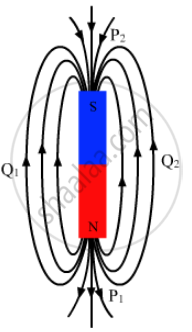
We know that magnetic field lines are directed from the north pole to the south pole. From the given figure, we can say that the direction of the magnetic field `vecB` is opposite at points P1 and Q1 and at points P2 and Q2.

shaalaa.com
  क्या इस प्रश्न या उत्तर में कोई त्रुटि है?
अध्याय 14: Permanent Magnets - MCQ [पृष्ठ २७७]

APPEARS IN

एचसी वर्मा Concepts of Physics Vol. 2 [English] Class 11 and 12
अध्याय 14 Permanent Magnets
MCQ | Q 4 | पृष्ठ २७७

संबंधित प्रश्न

State any two advantages of electromagnets over permanent magnets.


State how magnetic susceptibility is different for the three types of magnetic materials, i.e. diamagnetic, paramagnetic and ferromagnetic materials


Why is the core of an electromagnet made of ferromagnetic materials?


Why should the material used for making permanent magnets have high coercivity?


The force on a north pole, `vecF = mvecB` , parallel to the field `vecB` . Does it contradict our earlier knowledge that a magnetic field can exert forces only perpendicular to itself?


Magnetic meridian is


A uniform magnetic field of `0.20 xx 10^-3  "T"`  exists in the space. Find the change in the magnetic scalar potential as one moves through 50 cm along the field.


The magnetic field at a point, 10 cm away from a magnetic dipole, is found to be `2.0 xx 10^-4  "T"` . Find the magnetic moment of the dipole if the point is (a) in end-on position of the dipole and (b) in broadside-on position of the dipole.


Show that the magnetic field at a point due to a magnetic dipole is perpendicular to the magnetic axis if the line joining the point with the centre of the dipole makes an angle of `tan^-1(sqrt 2)` with the magnetic axis


The desirable properties for making permanent magnets are _________________ .


A moving-coil galvanometer has a 50-turn coil of size 2 cm × 2 cm. It is suspended between the magnetic poles producing a magnetic field of 0.5 T. Find the torque on the coil due to the magnetic field when a current of 20 mA passes through it.


A bar magnet takes π/10 second the complete one oscillation in an oscillation magnetometer. The moment of inertia of the magnet about the axis of rotation is 1.2 × 10⁻⁴ kg m2 and the earth's horizontal magnetic field is 30 μT. Find the magnetic moment of the magnet.


A bar magnet makes 40 oscillations per minute in an oscillation magnetometer. An identical magnet is demagnetized completely and is placed over the magnet in the magnetometer. Find the time taken for 40 oscillations by this combination. Neglect any induced magnetism.


A short magnet makes 40 oscillations per minute when used in an oscillation magnetometer at a place where the earth's horizontal magnetic field is 25 μT. Another short magnet of magnetic moment 1.6 A m2 is placed 20 cm east of the oscillating magnet. Find the new frequency of oscillation if the magnet has its north pole (a) towards north and (b) towards south.


In a permanent magnet at room temperature ______.


Identify the mismatched pair.

Permanent magnets are the substances having the property of ______.

The relation b/w magnetic susceptibility xm and relativ~ permeability µr is


Which of the following is most suitable for the core of an electromagnet?


Which magnetic properties are desirable for making a permanent magnet?


Share
Notifications

Englishहिंदीमराठी


      Forgot password?
Use app×