English
Karnataka Board PUCPUC Science Class 11

Show that the Magnetic Field at a Point Due to a Magnetic Dipole is Perpendicular to the Magnetic Axis If the Line Joining the Point with the Centre of the Dipole Makes an Angle - Physics

Advertisements
Advertisements

Question

Show that the magnetic field at a point due to a magnetic dipole is perpendicular to the magnetic axis if the line joining the point with the centre of the dipole makes an angle of `tan^-1(sqrt 2)` with the magnetic axis

Sum
Advertisements

Solution

Given : 

Angle made by observation point P with the axis of the dipole, `θ = tan^-1 (sqrt 2)`

⇒ `tan θ = sqrt 2`

⇒ `2 = tan^2 θ`

⇒ `tan θ = cot θ`

⇒ `tan θ /2 = cot θ`         .....(1)

we know , 

`tan θ /2 = tan α`      ....(2)
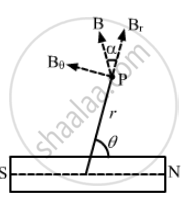
On comparing (1) and (2), we get

`tan α = cot θ`

⇒ `tan α = tan (90 - θ)`

⇒ `α = 90 - θ`

⇒ `θ + α = 90^circ`

Hence, the magnetic field due to the dipole is perpendicular to the magnetic axis.

shaalaa.com
  Is there an error in this question or solution?
Chapter 14: Permanent Magnets - Exercises [Page 277]

APPEARS IN

HC Verma Concepts of Physics Vol. 2 [English] Class 11 and 12
Chapter 14 Permanent Magnets
Exercises | Q 6 | Page 277

RELATED QUESTIONS

State any two advantages of electromagnets over permanent magnets.


Magnetic scalar potential is defined as `U(vec r_2) - U(vec r_1) = - ∫_vec(r_1)^vec(r_2)` `vec (B) . dvec(l)`

Apply this equation to a closed curve enclosing a long straight wire. The RHS of the above equation is then `-u_0 i` by Ampere's law. We see that `U(vec(r_2)) ≠ U(vec(r_1))` even when `vec r_2 =vec r_1` .Can we have a magnetic scalar potential in this case?


A tangent galvanometer is connected directly to an ideal battery. If the number of turns in the coil is doubled the deflection will


If the current is doubled, the deflection is also doubled in


Two long bare magnets are placed with their axes coinciding in such a way that the north pole of the first magnet is 2.0 cm from the south pole of the second. If both the magnets have a pole strength of 10 Am, find the force exerted by one magnet of the other.


The magnetic field at a point, 10 cm away from a magnetic dipole, is found to be `2.0 xx 10^-4  "T"` . Find the magnetic moment of the dipole if the point is (a) in end-on position of the dipole and (b) in broadside-on position of the dipole.


A bar magnet has a length of 8 cm. The magnetic field at a point at a distance 3 cm from the centre in the broadside-on position is found to be `4 xx 10^-6  "T"`.Find the pole strength of the magnet.


The coercive force for a certain permanent magnet is 4.0 × 10⁴ A m−1. This magnet is placed inside a long solenoid of 40 turns/cm and a current is passed in the solenoid to demagnetise it completely. Find the current.


The magnetic moment of the assumed dipole at the earth's centre is 8.0 × 10²² A m2. Calculate the magnetic field B at the geomagnetic poles of the earth. Radius of the earth is 6400 km.


The magnetic field due to the earth has a horizontal component of 26 μT at a place where the dip is 60°. Find the vertical component and the magnitude of the field.


The needle of a dip circle shows an apparent dip of 45° in a particular position and 53° when the circle is rotated through 90°. Find the true dip.


A moving-coil galvanometer has a 50-turn coil of size 2 cm × 2 cm. It is suspended between the magnetic poles producing a magnetic field of 0.5 T. Find the torque on the coil due to the magnetic field when a current of 20 mA passes through it.


The magnetometer of the previous problem is used with the same magnet in Tan-B position. Where should the magnet be placed to produce a 37° deflection of the needle?


A deflection magnetometer is placed with its arms in north-south direction. How and where should a short magnet having M/BH = 40 A m2 T−1 be placed so that the needle can stay in any position?


Which of the following is the most suitable material for making permanent magnet?

The materials suitable for making electromagnets should have ______.

Permanent magnets are the substances having the property of ______.

The relation b/w magnetic susceptibility xm and relativ~ permeability µr is


Share
Notifications

Englishहिंदीमराठी


      Forgot password?
Use app×