Advertisements
Advertisements
प्रश्न
Show that the magnetic field at a point due to a magnetic dipole is perpendicular to the magnetic axis if the line joining the point with the centre of the dipole makes an angle of `tan^-1(sqrt 2)` with the magnetic axis
Advertisements
उत्तर
Given :
Angle made by observation point P with the axis of the dipole, `θ = tan^-1 (sqrt 2)`
⇒ `tan θ = sqrt 2`
⇒ `2 = tan^2 θ`
⇒ `tan θ = cot θ`
⇒ `tan θ /2 = cot θ` .....(1)
we know ,
`tan θ /2 = tan α` ....(2)
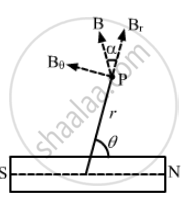
On comparing (1) and (2), we get
`tan α = cot θ`
⇒ `tan α = tan (90 - θ)`
⇒ `α = 90 - θ`
⇒ `θ + α = 90^circ`
Hence, the magnetic field due to the dipole is perpendicular to the magnetic axis.
APPEARS IN
संबंधित प्रश्न
State any two advantages of electromagnets over permanent magnets.
State how magnetic susceptibility is different for the three types of magnetic materials, i.e. diamagnetic, paramagnetic and ferromagnetic materials
Why should the material used for making permanent magnets have high coercivity?
Can we have a single north pole, or a single south pole?
The force on a north pole, `vecF = mvecB` , parallel to the field `vecB` . Does it contradict our earlier knowledge that a magnetic field can exert forces only perpendicular to itself?
Magnetic scalar potential is defined as `U(vec r_2) - U(vec r_1) = - ∫_vec(r_1)^vec(r_2)` `vec (B) . dvec(l)`
Apply this equation to a closed curve enclosing a long straight wire. The RHS of the above equation is then `-u_0 i` by Ampere's law. We see that `U(vec(r_2)) ≠ U(vec(r_1))` even when `vec r_2 =vec r_1` .Can we have a magnetic scalar potential in this case?
The magnetic field at a point, 10 cm away from a magnetic dipole, is found to be `2.0 xx 10^-4 "T"` . Find the magnetic moment of the dipole if the point is (a) in end-on position of the dipole and (b) in broadside-on position of the dipole.
A magnetic dipole of magnetic moment `1.44 "A m"^2`is placed horizontally with the north pole pointing towards north. Find the position of the neutral point if the horizontal component of the earth's magnetic field is 18 μT.
The coercive force for a certain permanent magnet is 4.0 × 10⁴ A m−1. This magnet is placed inside a long solenoid of 40 turns/cm and a current is passed in the solenoid to demagnetise it completely. Find the current.
The magnetic field due to the earth has a horizontal component of 26 μT at a place where the dip is 60°. Find the vertical component and the magnitude of the field.
A magnetic needle is free to rotate in a vertical plane which makes an angle of 60° with the magnetic meridian. If the needle stays in a direction making an angle of `tan^-1(2sqrt(3))` with the horizontal, what would be the dip at that place?
A short magnet produces a deflection of 37° in a deflection magnetometer in Tan-A position when placed at a separation of 10 cm from the needle. Find the ratio of the magnetic moment of the magnet to the earth's horizontal magnetic field.
A bar magnet takes π/10 second the complete one oscillation in an oscillation magnetometer. The moment of inertia of the magnet about the axis of rotation is 1.2 × 10⁻⁴ kg m2 and the earth's horizontal magnetic field is 30 μT. Find the magnetic moment of the magnet.
The relation b/w magnetic susceptibility xm and relativ~ permeability µr is
A wire of length 2 m carrier of lamp is bend to form a circle. The magnetic moment of a coil is :-
