Advertisements
Chapters
1: Haunted Houses
2: The Glove and the Lions
3: When Great Trees fall
4: A Considerable Speck
5: The Power of Music
Section - 2 (Short Stories) Origin and Structure of the Short Story
1: With the Photographer
2: The Elevator
▶ 3: The Girl Who Can
4: The Pedestrian
5: The Last Lesson
Advertisements
Solutions for Chapter 3: The Girl Who Can
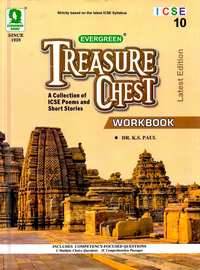
Below listed, you can find solutions for Chapter 3 of CISCE Evergreen Publication for English Treasure Chest Workbook Class 10 ICSE.
Evergreen Publication solutions for English Treasure Chest Workbook Class 10 ICSE 3 The Girl Who Can COMPETENCY - FOCUSED QUESTIONS [Pages 140 - 151]
Multiple Choice Questions: Choose the correct answers of the following questions from the options given: Analysis, Application and Evaluation:
Which of the following statements is Not True of Adjoa in The Girl Who Can?
She has thin and long legs.
She is declared the best all-round junior athlete.
She is seven years old girl from Ghana.
She is proud of her abilities.
Assess the impact of education on Adjoa’s life as depicted in the story The Girl Who Can.
It has no significant influence.
It is detrimental to her growth.
It empowers her and provides her with a sense of identity.
It creates a rift between her and her family.
What does Adjoa mean by “the land of sweet soft silence”?
Her girlish dreams.
Her native village.
Her mother’s womb.
Her entire world.
Adjoa’s grandmother is a representative of ______.
- authority
- determination
- unconventional approach
- patriarchal outlook
(i) & (ii)
(ii) & (iii)
(ii) & (iv)
(i) & (iv)
The story highlights one of the traditions of post colonial African society that ______.
a woman need not get any education
a woman must remain docile
a woman should not participate in sports
a woman can be ‘useful’ only if she has normal, strong legs.
‘She carried the gleaming cup on her back. Like they do with babies...’ Which figure of speech is used here?
metaphor
simile
alliteration
personification
Select the option that shows the correct relationship between statement (I) and statement (II).
Statement I: I have always wanted to tell them not to worry.
Statement II: That it did not have to be an issue for my two favourite people to fight over.
I is in contradiction of II.
II is independent of I.
II is the cause of I
I is an example of II.
Choose the option that lists the sequence of events in the correct order.
- The narrator tells about Nana paying attention to her.
- Nana and Maami must have been discussing the narrator’s legs since her birth is told by the narrator.
- The narrator tells that she is seven years of age.
- We learn that Maami is the narrator’s mother.
4, 3, 1, 2
2, 1, 3, 4
4, 2, 1, 3
1, 4, 3, 2
“But Kaya, I am not sure about her legs. Hm.... hm.... Hm” which of the following words best describes the speaker’s tone?
appreciative
complaining
comic
satirical
Which of these statements is NOT true?
Nana has a special voice to silence or snub everyone up.
Maami is Nana’s daughter.
Nana is not liked by the narrator.
The narrator likes Nana despite her negative attitude towards the narrator’s legs.
Mammi’s words, “Mother, why are you always complaining about Adjoa’s legs?” made Nana feel ______.
happу
confident
annoyed
frustrated
Recall and Understanding:
Adjoa is a ______ year old girl.
eight
nine
seven
ten
The place Adjoa hails from is ______.
barren
fertile
a plateau
frequented by earthquakes
Adjoa’s Maami is ______.
dominating
orthoрox
humble and helpless
conservative
Adjoa was ______.
headstrong
timid
cunning
analytical and sensitive
Who was Kaya?
Nana
Maami
Adjoa’s school teacher
Adjoa’s nickname
When Adjoa thinks of her legs, she is ______.
depressed
excited
analytical
angry with her lot
Adjoa is selected to represent her school in ______.
state games
international games
national-level games
junior district games
How does Nana hold the cup won by Adjoa?
keeps it on her head
holds it in her hands
carries it on the back
throws out away
In the end of the story, Nana appears as ______.
a kill joy
a progressive dynamic woman
a frustrated woman
making compromise with the way of the world
Where was Adjoa born?
Nigeria
Ghana
Ethiopia
Kenya
Comprehension Passages:
Read the extract given below and answer the questions that follow.
| “Like all this business to do with my legs. I have always wanted to tell them not to worry. I mean Nana and my mother. That it did not have to be an issue for my two favourite people to fight over. But I didn’t want either to be told not to repeat that or it to be considered so funny that anyone would laugh at me until they cried.” |
- Where does the story take place? What is the main conflict faced by the protagonist? (Recall)
- Describe the relationship between Adjoa and her grandmother. Why was she made to feel inadequate? (Understanding)
- Identify three ways Adjoa is shown to be an affectionate child in the story. (Understanding)
- How did Nana’s behaviour change from the time Adjoa was selected as a runner to represent her school at the district sports meet? How would you justify Nana’s actions? (Recall and Analysis)
- Adjoa won the cup for the best-all-round, athlete. What change did this bring about in Nana’s perspective?
How did the grandmother feel at the end of the story? Give a reason to justify your answer. (Analysis and Evaluate)
Read the extract given below and answer the questions that follow.
| And that, I think, is a very serious problem. Because it is always difficult to decide whether to keep quite and not say any of the things that come into my head, or say them and get laughed at. |
- Which serious problem is the narrator talking about? (Understanding and Analysis)
- What is the narrator’s dilemma? (Analysis)
- What is the general attitude of the elders to the problems of the youngsters? (Evaluate)
- Has it been easy for Adjoa to deal with Nana? How do you know? (Understanding and Analysis)
- Which weakness of Adjoa is pointed out by Nana? (Understanding)
Read the extract given below and answer the questions that follow.
| I find something quite confusing in all this. That is, no one ever explains to me, why sometimes I shouldn't repeat somethings I say. |
- Who is the ‘I’ here? What is confusing to her? (Understanding and Analysis)
- hat is the narrator forbidden to do? Who forbids her? (Analysis)
- What surprising thing or habit of the elders is referred to here? (Analysis)
- How, according to the narrator, do the elders behave about the follies or foibles of the youngsters? (Understanding)
- What does the narrator think about the grown-ups? (Understanding)
Read the extract given below and answer the questions that follow.
| That it did not have to be an issue for my two favourite people to fight over. But I didn’t want either to be told not to repeat that or it to be considered so funny that anyone would laught at me until they cried. |
- Which issue does the narrator refer to here? (Understanding)
- Who are the two favourite people of the narrator mentioned here? Do they have the same views? (Understanding and Analysis)
- What does the narrator expect of her mother and grandmother regarding her issue? (Analysis)
- What opinion does Nana hold about women’s ability to rear a child? (Understanding)
- How is the outer world of a child as compared to the world before birth? (Analysis)
Read the extract given below and answer the questions that follow.
| And you know, such things are not for talking about everyday. But if any female child decides to come into this world with legs, then they might as well be legs. |
- Whose opinion is talked about here? How sound is this opinion? (Understanding and Analysis)
- What is meant by the ‘such things’ that are not meant to be talked about on a daily basis? (Analysis)
- What kind of legs are not liked? And by whom? (Understanding)
- With what should a female child come into the world? (Understanding)
- Does the narrator get any complex in her mind due to her so-called imperfection? Explain. (Analysis and Evaluation)
Read the extract given below and answer the questions that follow.
| How, ‘After one’s only daughter had insisted on marrying a man like that, you still have to thank your God that the biggest problem you got later was having a grand daughter with spindly legs that are too long for a woman, and too thin to be of any use. |
- What does Nana lament? (Understanding)
- What kind of man did Maami marry? Was it a happy marriage? (Recalling)
- What evil of the society does the passage refer to? (Analysis)
- Why is Nana not happy with Adjoa’s legs? (Understanding)
- What is Nana’s ideal of a perfect woman? (Understanding and Analysis)
Read the extract given below and answer the questions that follow.
| School is another thing. Nana and my mother discussed often and appeared to have different ideas about. Nana thought it would be waste of time. I never understood what she meant. |
- What did Nana think about the education of girls? (Understanding)
- What opinion do you form of Nana? (Analysis)
- Did Adjoa’s mother hold the same views about the education of women as her grandmother Nana? (Analysis)
- Was Adjoa’s mother educated? What was her regret? (Understanding and Analysis)
- Why did Nana not wish the girls to go to school? Does Adjoa agree with her? (Understanding)
Read the extract given below and answer the questions that follow.
| You know what she did? She carried the gleaming cup on her back. Like they do with babies and other very precious things. And this time, not taking the trouble to walk by herself. |
- What moment of pride does the passage refer to? (Recalling)
- How does Nana react at Adjoa’s achievement? (Analysis)
- What change of heart and mind is seen in Nana’s personality? How does it seem different from her earlier attitude? (Analysis)
- What does Nana begin to think about the role of women in society? Who brings this change in her? (Understanding)
- How does Adjoa show the mettle of a woman? (Analysis)
Read the following extract from William Sleater’s short story, ‘The Elevator’ and answer the questions that follow:
| Martin felt nervous when he got back to the building after school. But why should he be afraid of an old lady? He felt ashamed of himself. He pressed the button and stepped into the elevator, hoping that it would not stop, but it stopped on the third floor. Martin watched the door slide open... |
- Who entered the elevator when the door slid open? Describe this person. [3]
- Why was Martin afraid of using this elevator? [3]
- What led to Martin’s fall down the stairs?
What did it result in? [3] - How does the story end?
Bring out the element of horror in the ending. [3] - What was Martin’s father’s opinion of him?
What does this reveal to us about his father’s character? [4]
Project assignments:
What are Nana’s views about women? Do you agree with her? If not why?
Adjoa struggles against hostile circumstances and conquers. Explain the way it happens in her life.
How does Adjoa’s attitude towards life bring a transformation in her grandmother Nana?
Compare and contrast the characters of Nana and her daughter.
Solutions for 3: The Girl Who Can
Evergreen Publication solutions for English Treasure Chest Workbook Class 10 ICSE chapter 3 - The Girl Who Can
Shaalaa.com has the CISCE Mathematics English Treasure Chest Workbook Class 10 ICSE CISCE solutions in a manner that help students grasp basic concepts better and faster. The detailed, step-by-step solutions will help you understand the concepts better and clarify any confusion. Evergreen Publication solutions for Mathematics English Treasure Chest Workbook Class 10 ICSE CISCE 3 (The Girl Who Can) include all questions with answers and detailed explanations. This will clear students' doubts about questions and improve their application skills while preparing for board exams.
Further, we at Shaalaa.com provide such solutions so students can prepare for written exams. Evergreen Publication textbook solutions can be a core help for self-study and provide excellent self-help guidance for students.
Concepts covered in English Treasure Chest Workbook Class 10 ICSE chapter 3 The Girl Who Can are .
Using Evergreen Publication English Treasure Chest Workbook Class 10 ICSE solutions The Girl Who Can exercise by students is an easy way to prepare for the exams, as they involve solutions arranged chapter-wise and also page-wise. The questions involved in Evergreen Publication Solutions are essential questions that can be asked in the final exam. Maximum CISCE English Treasure Chest Workbook Class 10 ICSE students prefer Evergreen Publication Textbook Solutions to score more in exams.
Get the free view of Chapter 3, The Girl Who Can English Treasure Chest Workbook Class 10 ICSE additional questions for Mathematics English Treasure Chest Workbook Class 10 ICSE CISCE, and you can use Shaalaa.com to keep it handy for your exam preparation.
