Advertisements
Chapters
1: Haunted Houses
2: The Glove and the Lions
3: When Great Trees fall
4: A Considerable Speck
5: The Power of Music
Section - 2 (Short Stories) Origin and Structure of the Short Story
▶ 1: With the Photographer
2: The Elevator
3: The Girl Who Can
4: The Pedestrian
5: The Last Lesson
Advertisements
Solutions for Chapter 1: With the Photographer
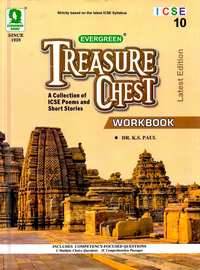
Below listed, you can find solutions for Chapter 1 of CISCE Evergreen Publication for English Treasure Chest Workbook Class 10 ICSE.
Evergreen Publication solutions for English Treasure Chest Workbook Class 10 ICSE 1 With the Photographer Competency - Focused Questions [Pages 102 - 113]
Multiple Choice Questions Answer the following questions by choosing the most appropriate options. Analysis, Application and Evaluation:
The story highlights the theme of ______.
value of attractive appearance
distortion of the self
rejection of one’s real self
acceptance of one’s real self
In the story the author has used the technique of ______.
irony
foreshadowing
contrast
detailing
“I don’t care for it. I like to get the hair clear back to the superficies and make out a new brow line.”
These lines tell us that the photographer is ______.
angry
weak
insensitive
anxious
Which of the following options contains the same literary device that appears in the following line:
“.....the machine still staggering from the shock.....”
The house roofs seemed to heave and sway.
In the vestibule below was a letter box.
So heavy they were, tidal waves come over the islands.
It became transparent like a thin veil.
Select the option that shows the correct relationship between statements and II from the story With the Photographer.
Statement I: The author felt that his eyes in the photograph didn’t look very much like his.
Statement II: The photographer had retouched the eyes.
Statement I is true, and Statement II is false.
Statement II is true, and Statement I is false.
Statement II is the cause for Statement I.
Statement I and Statement II are independent of each other.
Select the option that shows the correct relationship between statement I and statement II.
Statement I: I still don’t quite like the face.
Statement II: I swung myself round on the stool.
I is independent of II.
I is a contradiction of II.
I is an example of II.
I is the cause of II.
The photographer’s behaviour with the narrator made him feel.
- happy
- sad
- angry
- irritated
1 and 2
2 and 3
3 and 4
1 and 4
“Is it me?” I asked.
Which of the following words best describes the speaker’s mood?
disbelief and surprise
sadness and frustration
pleasing and playful
none of these
Which of these statements is NOT true?
The narrator went to a photographer’s house
The photographer took the narrator’s photograph
The photographer used his technical skills to improve upon the photo
The narrator was not satisfied with his photograph.
Recall and Understanding:
The photographer looked at the narrator ______.
cheerfully
with enthusiasm
without enthusiasm
indifferently
The narrator was asked to wait for ______.
15 minutes
30 minutes
one hour
45 minutes
The studio was ______.
well-furnished
quite modern
dimly lighted
very big
The photographer had the looks of ______.
a sick man
an angry man
a natural scientist
a crooked politician
The second visit to the photographer was paid by the narrator ______.
the next day
the same evening
the next Saturday
after a fortnight
The narrator’s face was found to be ______ by the photographer.
quite ugly
quite attractive
quite wrong
very innocent
While waiting for the photographer the narrator ______.
read the latest news
a journal for the infants
listened to the music
kept writing something in his diary
What was the age of the narrator when he went to the photographer to have his photograph taken?
fifty
forty
thirty
forty five
The Delphide is a process employed by the photographer to ______.
add new features
remove unwanted feature
adjust body posture
show attractive teeth
Choose the option that lists the sequence of events in the correct order from the story With the Potographer.
- The photographer hurriedly backs away from the machine and, with a serious expression, comments that there is something wrong with the narrator’s face.
- He crawls under the cloth draped over the machine and waits for some time.
- The narrator thinks that the photographer is praying.
- The photographer calls the narrator into the inner room and rolls a machine into the middle of the room.
(i), (ii), (iii), (iv)
(iv), (ii), (iii), (i)
(ii), (iii), (iv), (i)
(iv), (iii), (i), (ii)
In the short story ‘With the Photographer’, the narrator asks the photographer, ‘Is it me?’ because ______.
He is delighted with the photographer’s skill
He looks very handsome in the photograph
He is unable to recognize his own face
He is ashamed of how he looks in the picture.
Comprehension Passages:
Read the extracts given below and answer the questions that follow.
| The photographer looked at me without enthusiasm. He was a drooping man in a gray suit, with the dim eyes of a natural scientist. But there is no need to describe him. Everybody knows what a photographer is like. |
- Give reason for the photographer’s apathy towards the narrator. (Analysis)
- Explain the narrator’s attitude towards the photographer. (Analysis)
- What was the narrator’s experience with the photographer? (Understanding)
- What tells you about the appearance of the photographer? (Understanding)
- How did the narrator spend his time while waiting for the photographer? (Understanding)
Read the extract given below and answer the questions that follow.
| He was only in it a second, -just time enough for one look at me, - and then he was out again, tearing at the cotton sheet and the window panes with a hooked stick, apparently frantic for light and air. |
- Who is ‘he’ here in this extract? Was ‘he’ at peace with himself? (Evaluation)
- What do you think of the studio where the photographer was to take the narrator’s photograph? (Analysis)
- What was the photographer trying to do in his studio? (Understanding)
- What was the photographer’s reaction when he came out of the black cloth draped on the camera? (Understanding)
- What was thought to be the problem with the face of the narrator? (Understanding and Analysis)
Read the extract given below and answer the questions that follow.
| “I’m sure it would,” I said enthusiastically, for I was glad to find that the man had such a human side to him. “So would yours. In fact,” I continued, “how many faces one sees that are apparently hard, narrow, limited, but the minute you get them three-quarters full they get wide, large, almost boundless in - -” |
- What was the narrator sure of? (Understanding)
- “The man had such a human side to him”. What does the narrator wish to convey about the man? (Analysis)
- How are the faces of the human beings made to look better? (Understanding)
- What is the tone of the narrator when he says that human faces are made to look better? (Analysis)
- Did the photographer himself need some improvement in his face or mind? How do you know this? (Evaluation)
Read the extract given below and answer the questions that follow.
| “The ears are bad,” he said; “droop them a little more. Thank you. Now the eyes. Roll them in under the lids. Put the hands on the knees, please, and turn the face just a little upward. Yes, that’s better. |
- Describe the photographer’s appearance. Why did he look at the author without enthusiasm? What impression did he get of the photographer? (Recall and Analysis)
- Where did the photographer make the author sit? Describe the photographer’s initial attempt to take a picture. (Recall and Understanding)
- What instructions did the photographer give the author before taking his photograph? (Recall)
- Which feature in the author’s photograph had some resemblance to his face? How did the photographer offer to set this right? (Recall)
- Comment on the photographer’s retouching and altering of the author’s photograph. Mention one modern-day equivalent of what the photographer attempted to do. Give one reason why the photographer’s action was insensitive. (Analysis)
Read the extract given below and answer the questions that follow.
| “Stop,” I said with emotion but, I think, with dignity. “This face is my face. It is not yours, it is mine. I’ve lived with it for forty years and I know its faults. I know it’s out of drawing. I know it wasn’t made for me, but it’s my face, the only one I have-” |
- In what mood is the speaker? What does he want? (Analysis)
- What prompted the speaker to say, “It is not yours, it is mine”? (Understanding)
- What is the tone of the speaker? Give one reason for it. (Analysis)
- Comment on the statement, ‘I know it wasn’t made for me, but it’s my face, the only one I have...’ (Analysis)
- Which idea does the narrator try to convey through the extract? (Understanding and Analysis)
Read the extract given below and answer the questions that follow.
|
The photographer beckoned me in. I thought he seemed quieter and graver than before. I think, too, there was a certain pride in his manner. He unfolded the proof of a large photograph, and we both looked at it in silence. “Is it me?” I asked. |
- Where was the narrator asked to come and by whom? (Understanding)
- What was the photographer proud of? (Understanding)
- Both the photographer and the narrator looked at the proof of the photograph in silence. Why do you think both were silent? (Analysis)
- What was the narrator’s reaction on seeing his photograph? (Understanding and Analysis)
- What other changes did the photographer want to make in the final finish of the photograph? Why? (Understanding)
Read the extract given below and answer the questions that follow.
| “Yes,” said the photographer thoughtfully, “that’s so; but I can fix that all right in the print. We have a process now - the Sulphide - for removing the ears entirely. I’ll see if - -” |
- What had not been tampered with as far as the body features were concerned? (Understanding)
- To which question of the narrator does the photographer say ‘yes’? Does he agree to improve upon the picture? (Understanding)
- Which features had the photographer retouched to make them look better? (Understanding)
- How do the photographers bring about changes in a photograph so that it looks completely different from the original? (Understanding and Analysis)
- What made the narrator express his anger at his photographer later? What did he want to convey? (Understanding and Analysis)
Read the extract given below and answer the questions that follow.
| “Coat it with an inch of gloss, shade it, emboss it, gild it, till even you acknowledge that it is finished. Then when you have done all that - keep it for yourself and your friends. They may value it. To me it is but a worthless bauble.” |
- What is the narrator’s reaction on his photograph in his next visit? (Understanding)
- Mention at least three different processes with the help of which the photographers change the features in a photograph? (Understanding)
- Does the narrator approve of the techniques of the photographers in bringing about changes in the original photograph? How do you know? (Analysis)
- Would you support the narrator’s viewpoint or the photographer’s? Why? (Evaluation)
- Why does the narrator call the photograph a worthless ‘bauble’? (Evaluation) (Analysis)
Project Assignments:
Describe the author’s first visit to the photographer’s studio.
How does the photographer find faults with the narrator’s face? Explain the way he suggests to make improvements in the photograph.
Sum up the conversation that takes place between the photographer and the author.
A photographer’s job is not to find faults in the outlook and personality of the people coming to get their photographs clicked. How does the author illustrate this idea through this story?
Bring out the contrast between the characters of the photographer and the narrator.
Solutions for 1: With the Photographer
Evergreen Publication solutions for English Treasure Chest Workbook Class 10 ICSE chapter 1 - With the Photographer
Shaalaa.com has the CISCE Mathematics English Treasure Chest Workbook Class 10 ICSE CISCE solutions in a manner that help students grasp basic concepts better and faster. The detailed, step-by-step solutions will help you understand the concepts better and clarify any confusion. Evergreen Publication solutions for Mathematics English Treasure Chest Workbook Class 10 ICSE CISCE 1 (With the Photographer) include all questions with answers and detailed explanations. This will clear students' doubts about questions and improve their application skills while preparing for board exams.
Further, we at Shaalaa.com provide such solutions so students can prepare for written exams. Evergreen Publication textbook solutions can be a core help for self-study and provide excellent self-help guidance for students.
Concepts covered in English Treasure Chest Workbook Class 10 ICSE chapter 1 With the Photographer are .
Using Evergreen Publication English Treasure Chest Workbook Class 10 ICSE solutions With the Photographer exercise by students is an easy way to prepare for the exams, as they involve solutions arranged chapter-wise and also page-wise. The questions involved in Evergreen Publication Solutions are essential questions that can be asked in the final exam. Maximum CISCE English Treasure Chest Workbook Class 10 ICSE students prefer Evergreen Publication Textbook Solutions to score more in exams.
Get the free view of Chapter 1, With the Photographer English Treasure Chest Workbook Class 10 ICSE additional questions for Mathematics English Treasure Chest Workbook Class 10 ICSE CISCE, and you can use Shaalaa.com to keep it handy for your exam preparation.
