Advertisements
Chapters
F.1: How I Taught My Grandmother to Read
F.2: A Dog Named Duke
F.3: The Man Who Knew Too Much
F.4: Keeping lt from Harold
F.5: Best Seller
POETRY
P.1: The Brook
P.2: The Road Not Taken
▶ P.3: The Solitary Reaper
P.4: The Seven Ages
P.5: Oh, I Wish I'd Looked After Me Teeth
P.6: Song of The Rain
DRAMA
D.1: Villa for Sale
D.2: The Bishop's Candlesticks
Advertisements
Solutions for Chapter P.3: The Solitary Reaper
Below listed, you can find solutions for Chapter P.3 of CBSE CBSE for English Literature Reader Class 9.
CBSE solutions for English Literature Reader Class 9 P.3 The Solitary Reaper Exercise [Pages 77 - 83]
Sometimes we see something beautiful and striking, and we remember it for a
long time afterwards. Can you recollect this ever happening to you? If so, what
was it? What do you remember about it now? Are the details of what you saw or
the feelings you experienced at that time fresh in your mind? Think for a few
minutes, then share your thoughts with the class.
Listen to one of William Wordsworth's poems, that describes a memorable
experience he had, while out on a walk. (Your teacher will play a recording.)
Listen to the poem at least twice.
Now read the poem.
Behold her, single in the field,
Yon solitary Highland Lass!
Reaping and singing by herself;
Stop here, or gently pass!
Alone she cuts, and binds the grain,
And sings a melancholy strain;
O listen! for the vale profound
Is overflowing with the sound.
No nightingale did ever chant
More welcome notes to weary bands
Of travellers in some shady haunt.
Among Arabian Sands
A voice so thrilling ne' er was heard
In spring-time from the cuckoo-bird,
Breaking the silence of the seas
Among the farthest Hebrides.
Will no one tell me what she sings?
Perhaps the plaintive numbers flow
For old, unhappy, far-off things,
And battles long ago:
Or is it some more humble lay,
Familiar matter of to-day ?
Same natural sorrow, loss, or pain,
that has been, and may be again ?
Whate'er the theme, the maiden sang
As if her song could have no ending;
I saw her singing at her work,
And o'er the sickle bending;
I listen'd, motionless and still;
And, as I mounted up the hill,
The music in my heart I bore,
Long after it was heard no more.
About the Poet
William Wordsworth was born on 7th April 1770, in Cockermouth in the Lake District,
England. When many poets still wrote about ancient heroes in their grandiloquent
style, Wordsworth focused on nature, children, the poor, common people and used
ordinary words to express his feelings. He defined poetry as "the spontaneous
overflow of powerful feelings" arising from "emotions recollected in tranquility". He
died at Rydal Mount on April 23, 1850.
Imagine that you are the poet, William Wordsworth. You continue on your walk, and when you reach home you tell a friend what you saw and felt. Which of the following best describes your experience? (Work in pairs, then have a class discussion.)
|
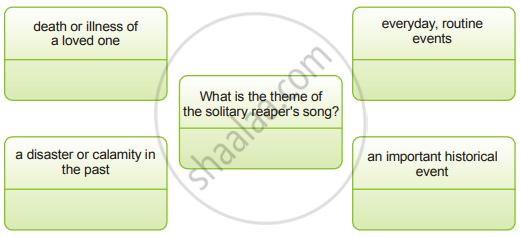
The poet could not understand the words of the song, yet he raised several possibilities about its theme. In the chart below are some of these possibilities. Read the third stanza again, and find the phrase that matches each. Complete the chart by writing a phrase in each of the empty boxes. Work in pairs.
On the basis of your understanding of the poem, answer the following questions by ticking the correct choice.
On the basis of your understanding of the poem, answer the following question
by ticking the correct choice.
The central idea of the poem 'The Solitary Reaper' is _____.
well sung songs give us happiness
melodious sounds appeal to all
beautiful experiences give us life-long pleasure
reapers can sing like birds
On the basis of your understanding of the poem, answer the following question
by ticking the correct choice.
In the poem 'The Solitary Reaper' to whom does the poet say, ' Stop here or gently
pass'?
to the people cutting corn
to himself
to the people who make noise
to all the passers by
On the basis of your understanding of the poem, answer the following question
by ticking the correct choice.
'The Solitary Reaper' is a narrative poem set to music. This form of verse is called
a______.
ballad
soliloquy
monologue
sonnet
On the basis of your understanding of the poem, answer the following question
by ticking the correct choice.
The poet's lament in the poem 'The Solitary Reaper' is that __________.
he cannot understand the song
he did not know the lass
she stopped singing at once
he had to move away
Why does the poet feel that the reaper was most likely singing sorrowful songs?
The poet himself was sad
The tune was melancholic
The surrounding was dismal
The reaper was weeping
Read the given stanza and answer the questions given below by selecting the correct option.
| Alone she cuts and binds the grain, And sings a melancholy strain; O listen! for the Vale profound Is overflowing with the sound. |
1. The exclamation mark used in O listen! suggests ______.
- a call for attention.
- a request to listen.
- a sense of wonder.
- a warning to alert.
2. Select the option that illustrates the task done by “she”.
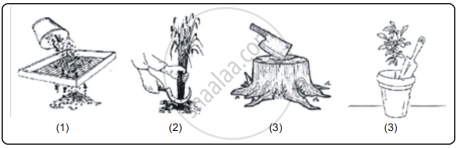
- Option (1)
- Option (2)
- Option (3)
- Option (4)
3. Select the option that displays lines with the same rhyme scheme as that of the given stanza.
- Clear sky, no clouds high up
The farmer looks and sighs
No monsoons yet, God why?
It will rain, it must. - The farmer looks at the sky
Thankful for the monsoon days
I am sure it’s going to rain, he says
Thankful for the clouds up so high - Are any clouds visible?
No, none that I see.
How unfortunate, poor me.
Faith is my only reprieve. - The farmer looks at the sky
Thankful for the clouds up so high.
I am sure it’s going to rain, he says
Thankful for the monsoon days.
Answer in detail:
Do you think that the poet feels overwhelmed by the song of the Solitary Reaper? Why/Why not?
The use of imagery in the poem has a major impact on the reading experience. Discuss.
The language of music is universal. Justify with reference to The Solitary Reaper.
a) Read the second stanza again, in which Wordsworth compares the solitary
reaper's song with the song of the nightingale and the cuckoo. On the basis of
your reading (and your imagination), copy and complete the table below. (Work
in groups of four, then have a brief class discussion.
| Place | Heard by | Impact on listener | |
| Solitary Reaper | Scottish Highlands | the poet | holds him spellbound |
| Nightingale | |||
| Cuckoo |
b) Why do you think Wordsworth has chosen the song of the nightingale and the
cuckoo, for comparison with the solitary reaper's song?
c) As you read the second stanza, what images come to your mind? Be ready to
describe them in your own words, to the rest of the class. (Be imaginative
enough and go beyond what the poet has written.)
In the sixth line of the first stanza, we read:
"... and sings a melancholy strain,..."
This "s" sound at the beginning of sings and strain has been repeated. Poets often do
this. Do you know why? Do you know what this "poetic repetition" is called? Can you
find other instances of this, in The Solitary Reaper?
In the first stanza, some words or phrases have been used to show that the girl
working in the fields is alone. Which words and phrases highlight her being
alone? What effect do they create in the mind of the reader?
Wordsworth was so moved by this experience that later he wrote this poem as a recollection of a memory. Think back in your own life and try to recall an experience that affected you greatly and left a deep impression on you. Then write a poem for your school magazine in which you describe that experience and its impact.
Solutions for P.3: The Solitary Reaper
CBSE solutions for English Literature Reader Class 9 chapter P.3 - The Solitary Reaper
Shaalaa.com has the CBSE Mathematics English Literature Reader Class 9 CBSE solutions in a manner that help students grasp basic concepts better and faster. The detailed, step-by-step solutions will help you understand the concepts better and clarify any confusion. CBSE solutions for Mathematics English Literature Reader Class 9 CBSE P.3 (The Solitary Reaper) include all questions with answers and detailed explanations. This will clear students' doubts about questions and improve their application skills while preparing for board exams.
Further, we at Shaalaa.com provide such solutions so students can prepare for written exams. CBSE textbook solutions can be a core help for self-study and provide excellent self-help guidance for students.
Concepts covered in English Literature Reader Class 9 chapter P.3 The Solitary Reaper are .
Using CBSE English Literature Reader Class 9 solutions The Solitary Reaper exercise by students is an easy way to prepare for the exams, as they involve solutions arranged chapter-wise and also page-wise. The questions involved in CBSE Solutions are essential questions that can be asked in the final exam. Maximum CBSE English Literature Reader Class 9 students prefer CBSE Textbook Solutions to score more in exams.
Get the free view of Chapter P.3, The Solitary Reaper English Literature Reader Class 9 additional questions for Mathematics English Literature Reader Class 9 CBSE, and you can use Shaalaa.com to keep it handy for your exam preparation.
