Advertisements
Advertisements
Depict the equipotential surfaces due to an electric dipole.
Concept: undefined >> undefined
(i)Obtain the expression for the torque `vecτ` experienced by an electric dipole of dipole moment `vecP` in a uniform electric field, `vecE` .
(ii) What will happen if the field were not uniform?
Concept: undefined >> undefined
Advertisements
State the underlying principle of working of a moving coil galvanometer. Write two reasons why a galvanometer can not be used as such to measure current in a given circuit. Name any two factors on which the current sensitivity of a galvanometer depends.
Concept: undefined >> undefined
A normal eye is not able to see objects closer than 25 cm because
Concept: undefined >> undefined
A thin converging lens is formed with one surface convex and the other plane. Does the position of image depend on whether the convex surface or the plane surface faces the object?
Concept: undefined >> undefined
A double convex lens has two surfaces of equal radii R and refractive index \[m = 1 \cdot 5\]
Concept: undefined >> undefined
A symmetric double convex lens in cut in two equal parts by a plane perpendicular to the principal axis. If the power of the original lens was 4 D, the power a cut-lens will be
Concept: undefined >> undefined
A symmetric double convex lens is cut in two equal parts by a plane containing the principal axis. If the power of the original lens was 4 D, the power of a divided lens will be
Concept: undefined >> undefined
Consider three converging lenses L1, L2 and L3 having identical geometrical construction. The index of refraction of L1 and L2 are \[\mu_1 \text{ and } \mu_2\] respectively. The upper half of the lens L3 has a refractive index \[\mu_1\] and the lower half has \[\mu_2\] following figure . A point object O is imaged at O1 by the lens L1 and at O2 by the lens L2placed in same position. If L3 is placed at the same place,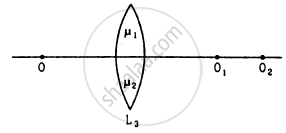
(a) there will be an image at O1
(b) there will be an image at O2.
(c) the only image will form somewhere between O1 and O2
(d) the only image will form away from O2.
Concept: undefined >> undefined
A screen is placed a distance 40 cm away from an illuminated object. A converging lens is placed between the source and the screen and its is attempted to form the image of the source on the screen. If no position could be found, the focal length of the lens
Concept: undefined >> undefined
A double convex lens has focal length 25 cm. The radius of curvature of one of the surfaces is double of the other. Find the radii, if the refractive index of the material of the lens is 1.5.
Concept: undefined >> undefined
A pin of length 2.00 cm is placed perpendicular to the principal axis of a converging lens. An inverted image of size 1.00 cm is formed at a distance of 40.0 cm from the pin. Find the focal length of the lens and its distance from the pin.
Concept: undefined >> undefined
A convex lens produces a double size real image when an object is placed at a distance of 18 cm from it. Where should the object be placed to produce a triple size real image?
Concept: undefined >> undefined
A 5.0 diopter lens forms a virtual image which is 4 times the object placed perpendicularly on the principal axis of the lens. Find the distance of the object from the lens.
Concept: undefined >> undefined
Consider the situation described in the previous problem. Where should a point source be placed on the principal axis so that the two images form at the same place?
Concept: undefined >> undefined
A diverging lens of focal length 20 cm and a converging lens of focal length 30 cm are placed 15 cm apart with their principal axes coinciding. Where should an object be placed on the principal axis so that its image is formed at infinity?
Concept: undefined >> undefined
It is said that the separation between the two charges forming an electric dipole should be small. In comparison to what should this separation be small?
Concept: undefined >> undefined
An electric dipole is placed in an electric field generated by a point charge.
Concept: undefined >> undefined
An electric dipole is placed at the centre of a sphere. Mark the correct options.
(a) The flux of the electric field through the sphere is zero.
(b) The electric field is zero at every point of the sphere.
(c) The electric field is not zero anywhere on the sphere.
(d) The electric field is zero on a circle on the sphere.
Concept: undefined >> undefined
A sample of HCI gas is placed in an electric field of 2.5 × 10⁴ NC−1. The dipole moment of each HCI molecule is 3.4 × 10⁻³⁰ Cm. Find the maximum torque that can act on a molecule.
Concept: undefined >> undefined
