Advertisements
Advertisements
Question
A symmetric double convex lens is cut in two equal parts by a plane containing the principal axis. If the power of the original lens was 4 D, the power of a divided lens will be
Options
2 D
3 D
4 D
5 D.
Advertisements
Solution
4 D
As the lens is cut along the principal axis, the two new lens will act as two double convex lenses. Even after cutting the lens, the radius of the curvature of the two new lens will remain the same as that of the original lens, with the power equal to the original lens.
APPEARS IN
RELATED QUESTIONS
How unit of power related to focal length of a lens?
What is the focal length of a convex lens of focal length 30 cm in contact with a concave lens of focal length 20 cm? Is the system a converging or a diverging lens? Ignore thickness of the lenses.
A student uses a lens of focal length 40 cm and another of –20 cm. Write the nature and power of each lens
A diverging lens has focal length of 3 cm. Calculate the power.
The optician's prescription for a spectacle lens is marked +0.5 D. What is the:
(a) nature of spectacle lens?
(b) focal length of spectacle lens?
The focal length of a lens is +150 mm. What kind of lens is it and what is its power?
The power of a combination of two lenses X and Y is 5 D. If the focal length of lens X be 15 cm :
(a) calculate the focal length of lens Y.
(b) state the nature of lens Y.
A converging lens has a focal length of 50 cm. The power of this lens is:
Name the type of lens whose power is positive.
The image of an object formed by a lens is real, inverted and of the same size as the object. If the image is at a distance of 40 cm from the lens, what is the nature and power of the lens ? Draw ray diagram to justify your answer.
Define power of a lens. Write its units. Deduce the relation `1/f =1/f_1 +1/f_2`for two thin lenses kept in contact coaxially.
Find the radius of curvature of the convex surface of a plano-convex lens, whose focal length is 0.3 m and the refractive index of the material of the lens is 1.5.
A double convex lens has two surfaces of equal radii R and refractive index \[m = 1 \cdot 5\]
Find the power of a convex lens of focal length of + 25 cm.
Match the following:
| Column - I | Column - II | ||
| 1 | Retina | a | Path way of light |
| 2 | Pupil | b | Far point comes closer |
| 3 | Ciliary muscles | c | near point moves away |
| 4 | Myopia | d | Screen of the eye |
| 5 | Hypermetropia | e | Power of accommodation |
Assertion and reasoning type
- Assertion: Myopia is due to the increase in the converging power of eye lens.
- Reason: Myopia can be corrected with the help of concave lens.
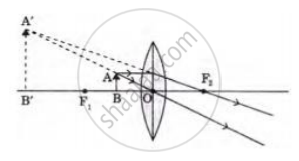
The above lens has a focal length of 10 cm. The object of height 2 mm is placed at a distance of 5 cm from the pole. Find the height of the image.
An object is placed in front of a converging lens. Obtain the conditions under which the magnification produced by the lens is
- negative and
- positive.
In what unit is the power of a lens expressed?
